Buy Natural Opal Cat’s Eye Stones Online – Certified & High Quality
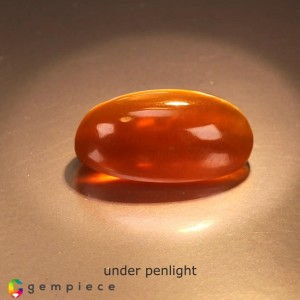
Opal cats eye is one of the rarest optical phenomena in the gemstone world — a variety where
opal, already celebrated for the most complex optical display in the mineral kingdom, adds
a second independent phenomenon on top of its first. Chatoyancy, the optical effect that
produces the cat's eye phenomenon, is created by parallel needle-like inclusions or fibrous
structures within the stone that reflect light in a concentrated line across the surface.
When you tilt the stone or move the light source, that luminous band slides smoothly across
the face of the stone, exactly like the slit pupil of a cat's eye responding to light.
For this to occur in opal — a mineraloid without the regular crystal lattice that normally
produces parallel inclusions — is genuinely unusual. GIA gemological literature explicitly
notes that chatoyancy in opal is rare due to opal's lack of a definite repeating crystal
structure. The cat's eye line requires strictly parallel alignment of inclusion-forming
elements, and in most opals the disordered amorphous structure does not produce this
alignment. When it does occur naturally — either from parallel fibrous needle inclusions
in common cat's eye opal from Tanzania, or from the extraordinary case of linearly aligned
play-of-color patches in precious cat's eye opal — the result is a stone of remarkable
rarity and collectibility.
Two Types of Opal Cats Eye
Gemological research has documented two fundamentally different mechanisms by which opal
cats eye can form, and understanding both helps buyers appreciate the full spectrum of
what this variety encompasses.
Common opal cats eye is the more widely available form. Here, the chatoyancy
is caused by parallel needle-like mineral fiber inclusions within common opal (opal without
play of color). These inclusions are aligned in the same direction across the stone's width,
and when the stone is cut as a high-dome cabochon with the inclusions perpendicular to the
stone's length axis, the band appears centered on the dome. This mechanism — parallel fibrous
inclusions producing a reflected light band — is the same physical principle that produces
the cat's eye effect in chrysoberyl (cymophane), tourmaline, aquamarine, and tiger's eye
quartz. Common cat's eye opal from Tanzania is the most commercially significant source,
typically displaying a creamy honey to golden-brown body color with a strong, sharp white
eye that moves cleanly across the dome.
Precious opal cats eye is extraordinarily rare and scientifically distinct.
In this type, the cat's eye band is produced not by fibrous inclusions but by linearly
arranged patches of play-of-color within the precious opal structure — what GIA researchers
describe as "brushstroke" patterns caused by misalignment of silica spheres along a linear
axis. The GIA's Spring 2021 Gems and Gemology Lab Notes documented a 3.79-carat gray
transparent precious cat's eye opal showing dominant blue play-of-color with a distinct
chatoyancy, where microscopic observation revealed large blue-to-green play-of-color patches
with parallel brushstroke patterns — the brushstrokes in each patch mostly perpendicular to
the length of the cat's eye band. The GIA Winter 2025 Lab Notes documented a 4.80-carat
cushion-shaped double cabochon precious cat's eye boulder opal where the chatoyant play-of-color
band stayed dominantly green as a light source moved across the stone, with flashes of blue
play-of-color mingling with the green. These combinations of chatoyancy with genuine play
of color represent the absolute pinnacle of opal cat's eye collecting.
For comprehensive gemological information, read our
Opal Cats Eye Gemopedia Guide. Browse related
opal varieties including boulder opal,
rainbow opal, and
water opal, with guides at
Boulder Opal Guide,
Rainbow Opal Guide, and
Water Opal Guide.
See the complete Opal Gemstone Guide and browse our full
natural opal collection.
Opal Cats Eye Color Range
Common cat's eye opal from Tanzania and Brazil is best known for its creamy honey color
with a warm golden body and a sharp white eye — a combination that many collectors consider
the most classically beautiful expression of the variety. The body color can also occur in
shades of yellow, pale brown, greenish, white, and occasionally darker tones, with the
cat's eye band appearing as a white to silver line perpendicular to the inclusion direction.
Precious cat's eye opal from Australia and Ethiopia adds play-of-color to the body,
producing an eye that itself shows spectral colors — a green and blue shifting eye
within the play-of-color display, as documented in the 2025 GIA lab notes. This makes
the visual experience significantly more complex and rare: the eye shifts color as it
moves across the stone, rather than simply being a fixed white band.
Opal Cats Eye Properties
Hardness: 5.5 to 6.5 Mohs
Refractive Index: 1.37 to 1.47
Specific Gravity: 1.98 to 2.25
Optical Phenomenon: Chatoyancy (cat's eye effect)
Cut Required: Cabochon — the dome surface is essential for concentrating
the reflected band into a sharp eye
Cleavage: None
Treatment: Natural and untreated
Sources
Tanzania is the most important commercial source of common opal cats eye, producing creamy
honey-colored material with strong, sharp chatoyancy from needle-like inclusions. Brazil's
Minas Gerais state produces rare cat's eye opals in honey-yellow to green hues. Ethiopia's
Welo and Shewa regions produce opals that occasionally exhibit chatoyancy combined with
play-of-color. Australia's Queensland boulder opal fields have produced the rare precious
cat's eye boulder opal documented in GIA lab notes. Australia's Lightning Ridge and Andamooka
fields have produced additional examples of precious cat's eye opal.
Value and Price
Common opal cats eye with a strong, centered, sharp eye in good body color ranges from $20
to $300 per carat depending on eye quality, body color, and size. Precious opal cats eye —
where play-of-color accompanies the chatoyancy — is substantially rarer and commands
significantly higher prices, with exceptional specimens in the collector market reaching
several hundred to over a thousand dollars per carat. The combination of precious cat's
eye boulder opal is the most valuable form, representing the convergence of Queensland's
finest boulder opal material with the rare chatoyancy phenomenon. All opal cats eye is
entirely natural and untreated.
Browse our complete opal cats eye
collection or explore the full natural opal gemstone range.
Cutting Opal Cats Eye
The cat's eye effect in opal is entirely dependent on correct orientation and cutting.
The lapidary must identify the direction of the fibrous inclusions (or play-of-color
brushstrokes in precious cats eye) and orient the stone so that these features run
parallel to the length of the finished cabochon. The dome of the cabochon must then
be sufficiently high to concentrate reflected light from the inclusions into a sharp,
narrow band. A low or flat cabochon produces a diffused, weak eye; a proper high dome
produces a sharp, bright eye that moves cleanly across the stone.
Frequently Asked Questions
What is opal cats eye?
Opal cats eye is a rare variety of opal that displays chatoyancy — a bright band of light
that moves across the stone's surface when the light source or viewing angle changes,
resembling a cat's eye. This phenomenon can be produced by parallel fibrous inclusions
in common opal, or by linearly arranged play-of-color patches in precious opal. It is
one of the rarest optical combinations in the natural gemstone world.
What causes the cat's eye effect in opal?
In common cat's eye opal, parallel needle-like mineral fiber inclusions reflect incident
light in a concentrated line perpendicular to the inclusion direction. In precious cat's eye
opal, linearly arranged misalignments in the silica sphere structure (described as
brushstroke patterns in GIA research) produce the same effect from the play-of-color
mechanism. Both require high-dome cabochon cutting to maximize the effect.
Where is opal cats eye found?
Common opal cats eye is primarily from Tanzania and Brazil. Precious cat's eye opal
specimens have been documented from Australian boulder fields and Ethiopian deposits.
The finest precious cat's eye boulder opal combines Queensland ironstone backing with
chatoyant play-of-color.
Is opal cats eye the same as chrysoberyl cats eye?
No. Chrysoberyl cats eye (cymophane) is the benchmark cat's eye gemstone with the sharpest
and most brilliant eye of any gem species. Opal cats eye is a different mineral species
(hydrated amorphous silica) with a softer, more diffused eye but with the unique additional
possibility of combining chatoyancy with play-of-color — something chrysoberyl cannot do.
How should I care for opal cats eye?
Clean with warm water and a soft cloth only. Avoid ultrasonic cleaners, steam cleaning,
and sudden temperature changes. Store separately from harder stones. Opal cats eye requires
the same care as all natural opal — gentle handling and protection from impact and abrasion.