
Red Beryl – Rarest Beryl, Utah Volcanic Geology and Manganese Color
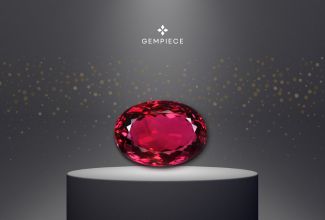
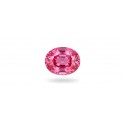
Red beryl — known to mineralogists and collectors by its historical name bixbite, though the name red beryl is now preferred to avoid confusion with the unrelated mineral bixbyite — is the most extraordinary member of the beryl family in terms of rarity, and one of the rarest gemstones known to exist on Earth by any measure. First discovered in 1904 by American mineralogist Maynard Bixby in the Wah Wah Mountains of Utah — the same remote desert terrain where it remains the world's only commercially significant source — red beryl produces a vivid cherry-red to raspberry-red color from trace manganese that rivals the finest ruby in visual impact while representing a fundamentally different mineral, a completely different geological environment, and a scarcity that makes ruby look commonplace by comparison. This guide covers red beryl's beryl mineralogy, the unique rhyolite volcanic geology of Utah, manganese color chemistry, rarity context, clarity, and collector value.
Mineral Composition and Physical Properties
Red beryl is a variety of beryl (Be₃Al₂Si₆O₁₈) sharing the species' hexagonal crystal system. Physical properties: Mohs hardness 7.5 to 8; specific gravity 2.66 to 2.70; refractive index 1.564 to 1.574, uniaxial negative, birefringence 0.006 to 0.008. Weakly to moderately dichroic — different viewing directions reveal slightly different red intensities. The gemstone is typically heavily included — a Type III characteristic similar to emerald — with most crystals containing visible inclusions including fluid inclusions, growth tubes, and fractures. Eye-clean red beryl commands exceptional premiums.
Manganese Color Chemistry
The vivid red color of red beryl is produced by manganese (Mn³⁺) substituting for aluminum in the octahedral sites of the beryl crystal lattice — the same element that colors morganite pink and pezzottaite raspberry-pink, but at higher concentrations and in the specific structural and chemical environment of the Utah rhyolite that produces the vivid cherry-red rather than pink. The absorption characteristics of Mn³⁺ in this environment produce a transmission window in the red region that creates the characteristic color. The pleochroism of red beryl — showing different intensities of red from different crystallographic directions — is also driven by the directional absorption properties of the manganese color centers.
The Utah Rhyolite Geology
The geological story of red beryl is as remarkable as the gemstone itself. Standard beryl forms in granitic pegmatites — rocks that crystallize slowly from the final fractions of cooling granite magmas, concentrating rare elements including beryllium. Red beryl forms in a completely different geological environment: late-stage rhyolitic volcanic rocks in which beryllium-bearing fluids derived from nearby pegmatitic or hydrothermal sources interact with manganese-bearing rhyolite under specific thermal conditions. The beryl crystals nucleate and grow within cavities, fractures, and breccia zones in the rhyolite — producing the small but intensely colored crystals characteristic of the species.
The Wah Wah Mountains of Beaver County, Utah — specifically the Ruby Violet Mine (also called the Red Emerald Mine or Violet Mine) — is the site where these specific geological conditions converge in commercially meaningful quantity. The Thomas Range in Juab County, Utah, and the Black Range in Sierra County, New Mexico, host secondary occurrences, but neither produces gem-quality material in quantities approaching the Wah Wah deposit. The geological specificity of the conditions required for red beryl formation makes it extraordinarily unlikely that additional significant deposits will be found.
Rarity in Context
The rarity of gem-quality red beryl is difficult to overstate. Industry estimates suggest that for every 150,000 diamonds found, only one comparable-quality red beryl crystal is discovered. Most crystals are too small or too included for faceting — of those that are faceted, most yield stones under 0.5 carat. A faceted red beryl above 1 carat in fine color is a significant collector acquisition. A faceted red beryl above 2 carats in vivid cherry-red with acceptable clarity is a museum-quality gemstone by any professional standard. The total annual production of gem-quality red beryl from the Wah Wah Mountains is measured in very small quantities — sometimes grams rather than kilograms.
Historical Name — Bixbite vs Red Beryl
The gemstone was originally named bixbite by the mineralogist/gemologist William F. Foshag in 1912, honoring Maynard Bixby who discovered it in 1904. However, the name created confusion with a completely separate iron-manganese oxide mineral named bixbyite (also honoring Bixby). To eliminate this confusion, the gem trade, gemological laboratories, and most modern references now use "red beryl" as the preferred name — clearly communicating both the mineral identity (beryl) and the color, without the ambiguity of the bixbite name. Both names refer to the same gemstone.
Treatment Status
Red beryl is not commercially treated. The vivid red color is entirely natural and no established treatment exists that is applied to the species. Natural untreated status is universal for all commercial red beryl.
Value Factors
Color intensity is the primary value driver — vivid cherry-red without significant orange or brown modifiers represents the premium tier. Clarity is the second major factor — eye-clean red beryl is exceptionally rare and commands extraordinary premiums. Size is the third factor — the exponential price increase with size above 0.5 carat reflects the genuine scarcity of larger material. Fine cherry-red, lightly included red beryl above 1 carat from documented Utah origin commands $8,000 to $10,000 per carat or more. Laboratory documentation from GIA, AGL, or equivalent confirming red beryl identity and Utah origin adds significant provenance value.
Explore Related Beryl Family Varieties
Beryl family guide (view collection), pezzottaite (view collection), morganite (view collection), and emerald (view collection).