Beryl Guide – Varieties, Composition, Properties, Sources and Value
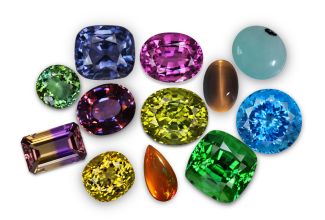
Pick up a beryl crystal, any beryl crystal, in any color, and you are holding one of the most chemically stable, structurally elegant, and mineralogically versatile gem minerals that nature produces. The formula is Be₃Al₂Si₆O₁₈: beryllium, aluminum, silicon, oxygen, arranged into six-membered rings of silicate tetrahedra stacked into columns along a hexagonal c-axis, with channels running through the structure large enough to accommodate water molecules, alkali ions, and the trace elements that transform a single colorless mineral into emerald, aquamarine, morganite, heliodor, red beryl, goshenite, pezzottaite, and mint beryl. That structural detail, the channels, is the key to everything the beryl family is. Without them, beryl would be a single, unremarkable colorless mineral. With them, it is the most color-diverse gem species in existence.
This guide covers the complete mineralogy and crystal chemistry of beryl, the trace element color mechanisms for every variety, geological formation environments from Colombian black shales to Utah rhyolites, the full global source map, gemological properties, clarity standards by variety, the complete treatment landscape, and the value spectrum that spans from accessible goshenite and mint beryl through collector-grade aquamarine and morganite to the extraordinary rarity of red beryl and pezzottaite at the apex of the family. Explore our full natural beryl gemstone collection across all varieties with complete treatment disclosure.
Mineralogy and Crystal Structure
Beryl is a cyclosilicate, a silicate mineral whose structure is built around rings of SiO₄ tetrahedra rather than the chains (inosilicates) or sheets (phyllosilicates) found in other silicate classes. Six SiO₄ tetrahedra link into a ring, and these rings stack in columns along the hexagonal c-axis with beryllium atoms in tetrahedral coordination between ring levels and aluminum atoms in octahedral coordination linking the columns laterally. The result is a framework of remarkable stability, resistant to chemical attack, mechanically strong, and structurally capable of growing into the very large, well-formed prismatic crystals that beryl-bearing pegmatites are famous for producing. The world's largest known naturally occurring crystal of any mineral is a beryl from Malakialina, Madagascar, 18 meters long, 3.5 meters in diameter, weighing approximately 380,000 kilograms.
The channels running parallel to the c-axis between the silicate ring columns are the structural feature most important for understanding beryl's gemological diversity. These channels are large enough to accommodate water molecules (which can be detected by infrared spectroscopy and used to help identify gem beryl origin), alkali ions including sodium, potassium, lithium, and cesium, and the trace metal ions that function as chromophores, the color-producing agents that transform the colorless beryl lattice into the gem varieties. The specific identity of those chromophore ions, and the site within the lattice where they substitute, determines the color of each beryl variety.
Complete Color Chemistry — Every Variety Explained
Pure beryl (Be₃Al₂Si₆O₁₈ with no trace elements) is colorless, this is goshenite. Color in all other beryl varieties results from trace element substitutions, primarily within the aluminum octahedral sites or within the structural channels.
Emerald — chromium and vanadium green. The vivid green of fine emerald is produced by Cr³⁺ substituting for Al³⁺ in the octahedral aluminum sites of the beryl lattice. Chromium creates strong absorption bands at approximately 430 nm (violet) and 600 nm (red-orange), transmitting green and producing the characteristic vivid emerald color. Vanadium (V³⁺) produces similar but slightly less intense green through comparable absorption band positions. Colombian emerald is predominantly chromium-colored; some Brazilian and Zambian material owes its green primarily to vanadium. Both chromium and vanadium are accepted as qualifying coloring agents for the emerald designation by GIA, SSEF, Gübelin, and other leading gem laboratories. The emerald color requires minimum saturation thresholds that distinguish it from pale green beryl.
Aquamarine — ferrous iron blue. The blue of aquamarine is produced by Fe²⁺ (ferrous iron) in the beryl crystal lattice, specifically by Fe²⁺/Fe²⁺ charge transfer interactions between iron ions in adjacent positions in the structural channels. The amount of Fe²⁺ present determines color intensity. Most natural aquamarine rough also contains Fe³⁺ (ferric iron), which produces a yellow-green component creating the characteristic blue-green of untreated material. Heat treatment at 371–426°C in a reducing (oxygen-free) environment selectively converts Fe³⁺ to Fe²⁺, removing the yellow-green component and producing the pure blue the market prefers.
Heliodor — ferric iron yellow. Fe³⁺ in specific octahedral coordination within the beryl lattice produces yellow to golden-yellow by absorbing blue wavelengths. Heliodor with a slight green undertone contains both Fe²⁺ and Fe³⁺. Golden beryl with a pure yellow contains primarily Fe³⁺.
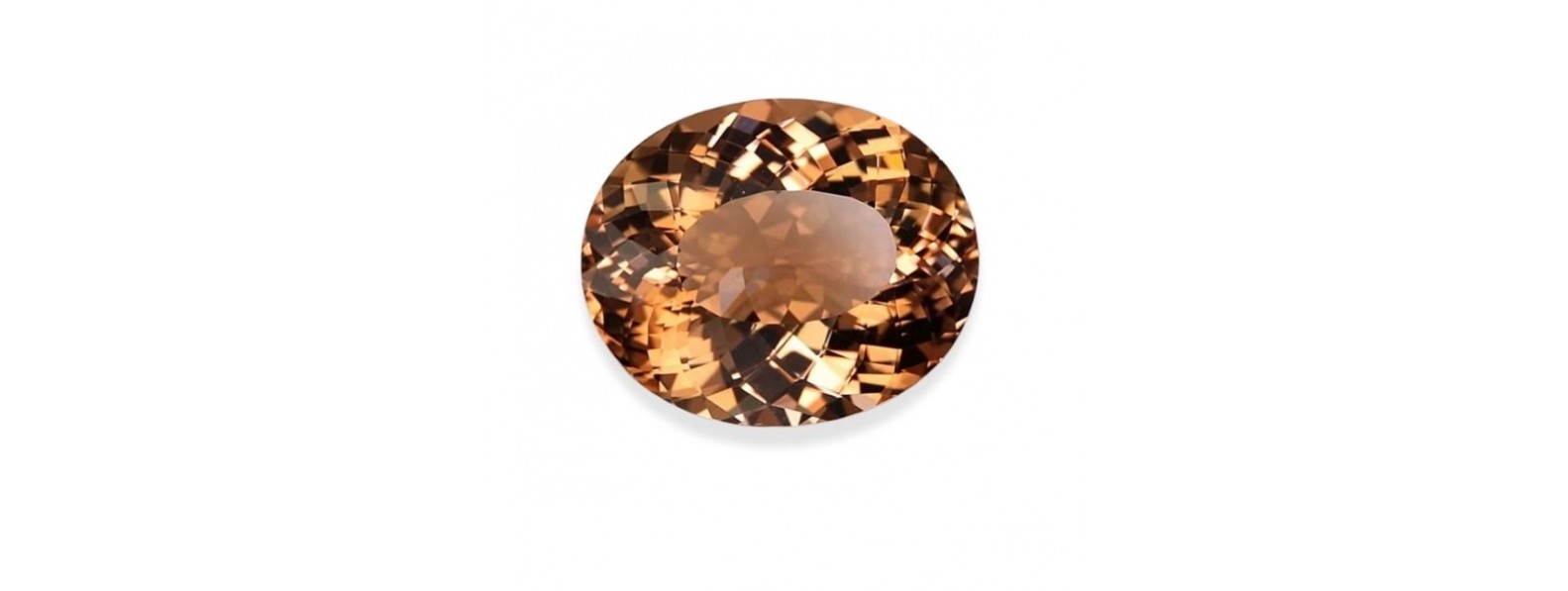
Morganite — manganese pink. Mn²⁺ (or Mn³⁺) substituting for Al³⁺ produces the pink to peach-pink color range. The manganese ion absorbs blue and green wavelengths, transmitting pink and red. The presence of iron alongside manganese introduces yellow-orange components producing peach and salmon tones. Heat treatment selectively destroys iron-related yellow color centers while leaving manganese-driven pink intact, producing purer pink.
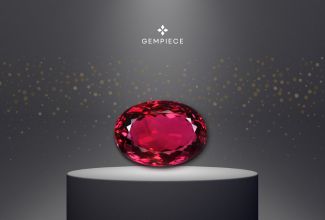
Red beryl — manganese in rhyolite. Manganese at higher concentrations than in morganite, combined with specific structural conditions in rhyolite-hosted deposits, produces the vivid cherry-red to raspberry-red color. The geological environment, silica-rich volcanic rhyolite rather than granitic pegmatite, is entirely unique within the beryl family and is the reason red beryl forms at only one commercially significant location on Earth.
Mint beryl — dilute iron green. Low concentrations of iron, without the chromium or vanadium needed for the emerald designation, produce the pale to medium mint-green color. The green is softer and cooler than emerald, reflecting a different chromophore mechanism at lower intensity.
Pezzottaite — The Beryl-Group Rarity
Pezzottaite (CsLiBe₂Al₂Si₆O₁₈) is not a variety of beryl but a distinct mineral species within the broader beryl group, formally recognized by the International Mineralogical Association in 2003 following its discovery in Madagascar in 2002. Named in honor of Italian mineralogist Federico Pezzotta, pezzottaite shares beryl's general structural framework but differs fundamentally in composition, cesium dominates the structural channels instead of water and light alkalis, and lithium partially substitutes for beryllium. These compositional differences produce measurable physical property changes: pezzottaite crystallizes in the trigonal system rather than hexagonal, has higher specific gravity (2.90–3.10 vs beryl's 2.63–2.92), and higher refractive index (1.601–1.620 vs beryl's 1.565–1.602). The deep raspberry-pink to purplish-pink color, more saturated than morganite, is produced by Mn³⁺ color centers modified by natural radiation. The Madagascar primary deposit is largely exhausted, with minor secondary production from Afghanistan. Explore our pezzottaite collection.
Gemological Properties — Complete Data
Species: Beryl. Chemical formula: Be₃Al₂Si₆O₁₈. Crystal system: Hexagonal (dihexagonal dipyramidal class). Crystal habit: Prismatic, often with flat or beveled terminations; striated parallel to c-axis. Hardness (Mohs): 7.5 to 8. Specific gravity: 2.63 to 2.92 (varies by variety and trace element content; morganite slightly denser at 2.71–2.90 due to cesium). Refractive index: 1.565–1.602 (uniaxial negative). Birefringence: 0.005 to 0.009. Luster: Vitreous. Transparency: Transparent to translucent depending on variety and clarity. Cleavage: Imperfect to indistinct on {0001}. Fracture: Conchoidal to uneven. Streak: White. Fluorescence: Variable by variety, emerald sometimes weak red; aquamarine typically inert; morganite sometimes weak pink or lilac; heliodor sometimes weak yellow-green. Special optical phenomena: Chatoyancy (cat's eye beryl), asterism (star beryl), rare.
Geological Formation — How Beryl Grows
Most beryl grows in granitic pegmatites, the coarse-grained, slow-cooled, volatile- and rare-element-enriched bodies that form from the final residual fraction of crystallizing granite magmas. The extreme enrichment of pegmatite-forming fluids in rare elements including beryllium, lithium, cesium, and boron creates the chemical environment where beryl crystals can grow large, slowly, and with the specific trace element profiles that produce gem-quality varieties. The slow crystallization rate of pegmatites allows crystal growth to proceed for long periods without disruption, producing the exceptionally large, well-formed crystals that beryl pegmatites are famous for.
The important exception is emerald. The finest Colombian emeralds do not form in pegmatites but in black organic-rich bituminous shales and associated hydrothermal veins, where beryllium-bearing fluids from granitic intrusions interact with chromium-bearing sedimentary rocks under very specific temperature and pressure conditions. This unusual geological setting explains why Colombian emeralds have a distinctive three-phase inclusion landscape (liquid, gas, and solid daughter crystals, the characteristic jardin) that reflects the unusual chemistry of their formation environment, and why laboratory origin testing can reliably identify Colombian origin through spectroscopic and inclusion analysis.
Red beryl is the most geologically anomalous beryl variety, forming in topaz-bearing rhyolite volcanic rocks in Utah where the coincidence of beryllium, manganese, silica, and specific oxidation conditions occurs in one of the rarest geological environments known for any gem mineral.
Global Sources — Full Origin Map
Emerald: Colombia (Muzo, Chivor, Coscuez, world benchmark), Zambia (Kagem, fine color, lower inclusion density), Brazil (Belmont, Carnaíba), Afghanistan (Panjshir Valley), Ethiopia (Shakiso), Zimbabwe (Sandawana), Madagascar, Pakistan (Swat Valley). Explore our emerald collection.
Aquamarine: Brazil (Minas Gerais, Santa Maria benchmark), Pakistan (Gilgit-Baltistan), Afghanistan (Nuristan/Kunar), Mozambique (Zambezia, Santa Maria Africana), Nigeria, Madagascar, Namibia, Russia (Ural Mountains). Explore our aquamarine collection.
Morganite: Brazil (Minas Gerais, largest commercial source), Afghanistan (Nuristan, finest deep pink), Madagascar (type locality), Mozambique, Namibia, Nigeria, USA (California, Himalaya Mine). Explore our morganite collection.
Heliodor: Brazil, Namibia (Erongo, finest material), Madagascar, Ukraine (Volyn), Nigeria, Sri Lanka, Zimbabwe. Explore our heliodor collection.
Red Beryl (Bixbite): Wah Wah Mountains and Thomas Range, Beaver County, Utah, USA, the only commercial source globally. Explore our red beryl collection.
Goshenite: Brazil, Madagascar, Canada, USA, Pakistan, China, Namibia. Explore our goshenite collection.
Pezzottaite: Madagascar (type locality, largely exhausted), Afghanistan (secondary source), Myanmar (minor). Explore our pezzottaite collection.
Mint Beryl: Afghanistan (primary), with minor occurrences in Brazil and Africa. Explore our mint beryl collection.
Clarity Standards Across the Beryl Family
Beryl clarity standards are one of the most important, and most misunderstood, aspects of evaluating gems from this family, because the standards differ dramatically between varieties. Aquamarine, heliodor, goshenite, morganite, and mint beryl are GIA Type I gemstones. Inclusions are not expected in these varieties and eye-clean clarity is the commercial and collector standard. Visible inclusions significantly reduce value. Emerald is a GIA Type III gemstone. Inclusions are expected as inherent characteristics of the mineral's geological formation environment and are evaluated on their type, location, and impact on transparency rather than their mere presence. The characteristic emerald inclusions, three-phase inclusions, growth tubes, fingerprints, and needle-like crystals, form the jardin (garden) that gemologists evaluate as part of origin assessment. Eye-clean emerald exists and commands exceptional premiums. Red beryl is typically heavily included, eye-clean red beryl is an extraordinary rarity. Pezzottaite is typically available in moderately included to eye-clean quality.
Treatment Landscape — Complete Disclosure
Emerald: Clarity enhancement with colorless oils, synthetic resins, or polymers is the most universally practiced treatment in the colored gemstone world. Virtually all commercial emerald receives some degree of enhancement. The degree is documented on major laboratory certificates as: F (no evidence of clarity enhancement), minor, moderate, or significant. Significant fracture filling fundamentally alters the stone and dramatically reduces value. Aquamarine: Heat treatment to convert Fe³⁺ to Fe²⁺, removing green and producing pure blue, is standard, accepted, stable, and permanent. Morganite: Heat treatment to eliminate iron-related yellow-orange color centers is standard, accepted, stable, and permanent. Heliodor: Irradiation and heat treatment are both used to improve or modify yellow color, these must be disclosed. Goshenite: Generally not treated. Red beryl: Generally not treated, natural color. Pezzottaite: Not treated. Mint beryl: Typically untreated.
Value Spectrum Across the Family
The beryl family spans one of the widest price ranges of any gem species. Fine unenhanced Colombian emerald at museum quality: $5,000 to $100,000+ per carat. Fine red beryl: $8,000 to $10,000+ per carat. Pezzottaite: $300 to $3,000 per carat depending on quality. Fine Santa Maria aquamarine: $100 to $800 per carat at collector grade. Fine deep pink morganite: $100 to $500 per carat. Heliodor and goshenite: $20 to $200 per carat. Mint beryl: $30 to $150 per carat depending on quality and size. Across all varieties, untreated natural status with laboratory documentation commands premiums. Large, clean stones in fine color are consistently rewarded with exponential size premiums.
Durability, Care, and Jewelry Applications
All beryl varieties share Mohs hardness 7.5 to 8, above quartz (7) and tourmaline (7–7.5), placing them in the practical jewelry gemstone tier. The primary care consideration is impact resistance: beryl has no cleavage but is somewhat brittle, particularly in heavily included varieties. Emerald, the most brittle beryl due to its typical inclusion landscape, benefits significantly from protective bezel or bezel-assisted prong settings in rings. Aquamarine, morganite, and heliodor are significantly tougher than emerald at typical commercial quality and suit all jewelry applications with standard care. Clean beryl with warm water, mild soap, and a soft brush. Ultrasonic cleaning is safe for eye-clean aquamarine, morganite, heliodor, and goshenite without fractures. Never use ultrasonic cleaning on emerald, vibration can exploit fractures and dislodge enhancement fillings. Steam cleaning is not recommended for any beryl variety.
Explore the Full Beryl Family
Emerald, aquamarine, morganite, heliodor, red beryl (bixbite), goshenite, pezzottaite, and mint beryl.