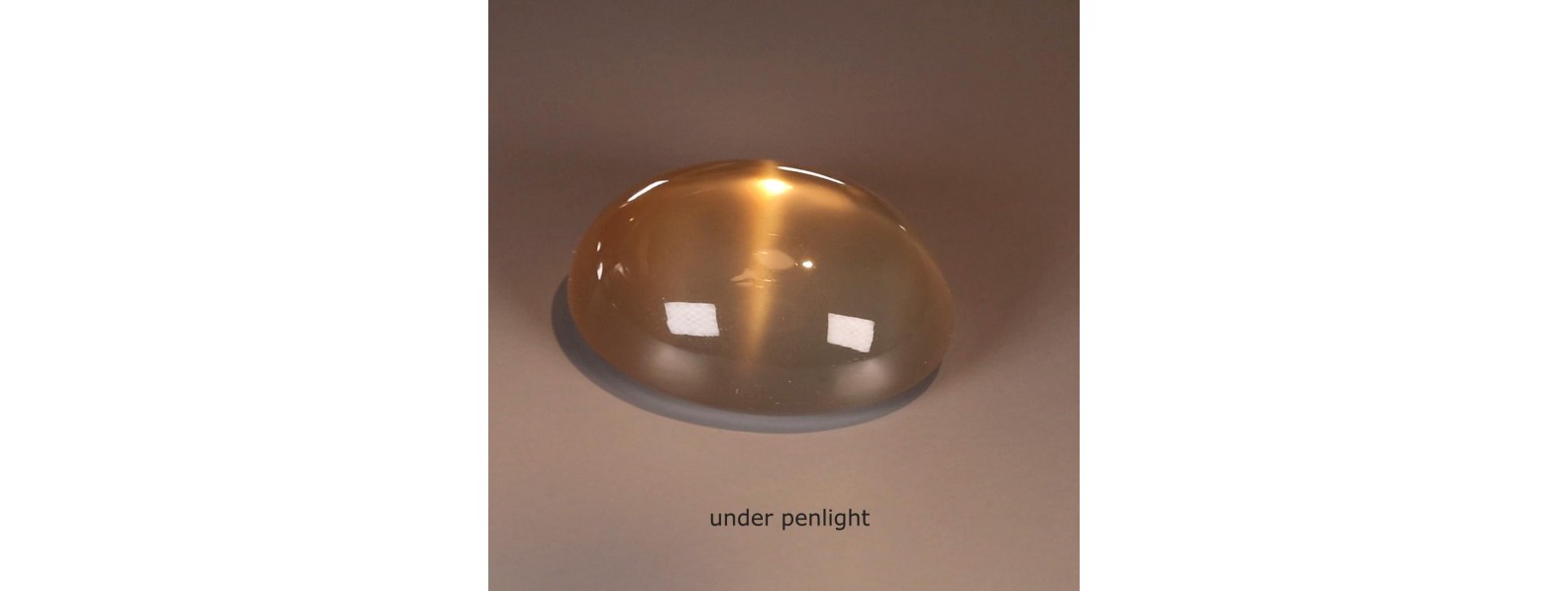
Star Moonstone – Asterism and Adularescence in Orthoclase Feldspar
Star moonstone is among the most optically remarkable gemstones in the collector world — a variety of orthoclase feldspar that simultaneously displays two distinct natural phenomena: adularescence, the glowing floating light that defines all fine moonstone, and asterism, the multi-rayed star pattern produced by intersecting sets of parallel inclusions within the crystal. The concurrence of both phenomena in a single specimen is rarer than either phenomenon alone and places fine star moonstone in a genuinely specialized collector tier. This guide covers the mineralogy of star moonstone, the mechanism of asterism in feldspar, quality grading, sources, and value.
Explore our star moonstone collection or the full moonstone family including moonstone cat's eye.
Mineral Composition
Star moonstone is a variety of orthoclase feldspar (KAlSi₃O₈) — the same mineral species as standard moonstone — whose internal microstructure includes both the alternating lamellar layers of orthoclase and albite responsible for adularescence, and additionally one or more sets of fibrous inclusions or aligned structural features oriented to produce asterism. The feldspar belongs to the monoclinic crystal system with hardness 6 to 6.5, perfect cleavage in two directions at approximately 90 degrees, specific gravity 2.56 to 2.59, and refractive index 1.518 to 1.526.
How the Star Forms in Moonstone
Asterism in moonstone is produced by intersecting sets of parallel fibrous inclusions, needle-like mineral crystals, or aligned structural channels within the orthoclase crystal — features that reflect light as narrow lines when a single directional light source strikes the curved surface of a cabochon. When two sets of such features intersect at approximately 90 degrees, they produce a four-rayed star. When three sets intersect at 60 degrees, they produce the rarer and more valuable six-rayed star. The quality of the star depends on the density and alignment precision of the inclusion sets — very tightly packed, uniformly parallel features produce sharp, well-defined star arms with clear contrast against the adularescent body.
The simultaneous presence of adularescence requires the specimen to also contain the lamellar orthoclase-albite exsolution microstructure responsible for the moonstone glow — a separate structural requirement from the inclusions that cause asterism. For both to co-exist at high quality in the same specimen is the defining rarity of fine star moonstone.
Quality Grading
The five factors that determine star moonstone quality in order of importance are: star sharpness and definition — the arms should be clearly distinct, bright, and well-defined rather than fuzzy or diffuse; star centering — a star positioned at the center of the cabochon dome commands premiums over off-center material; number of rays — six-rayed stars are rarer and more valuable than four-rayed; adularescence strength — the strength and color of the adularescent background matters; and body color transparency — more transparent body material allows greater depth of visual interest than opaque or heavily included body material.
Sources
India — particularly Rajasthan and Tamil Nadu — is the primary commercial source of star moonstone across a range of body colors including white, cream, peach, and grey. Sri Lanka produces fine white star moonstone with blue-white adularescence and sharp star effects that represent collector benchmark quality. Myanmar produces star moonstone of fine quality comparable to Sri Lankan material in certain localities. Madagascar and Tanzania are secondary sources with limited commercial output.
Treatment Status
Star moonstone is not treated. Both the adularescence and the asterism are entirely natural structural phenomena. No treatment is used or applied to quality star moonstone material. GemPiece provides full disclosure on all star moonstone specimens.
Value Factors
Star sharpness and centering are the primary drivers — a sharply defined, well-centered six-rayed star with strong adularescence commands significant collector premiums. Large specimens above 20 carats combining both phenomena at collector quality are genuinely rare and represent meaningful acquisitions. Sri Lankan material in white body with blue-white adularescence represents the premium origin tier.
Explore Related Gemstones
Moonstone (view collection), moonstone cat's eye (view collection), and star ruby (view collection).