
Pigeon Blood Ruby – The Internationally Defined Standard for Ruby's Finest Red
Pigeon blood ruby is not a separate gemstone variety — it is the highest formal color quality designation that can appear on a ruby laboratory report, and it is the color standard against which every fine ruby in the world is ultimately measured. Introduced as a measurable laboratory notation by GRS (Gem Research Swisslab) in 1996 and first publicly documented on a certificate at Sotheby's London in June 1998, the pigeon blood designation transformed an ancient trade description — used by Mogok miners for centuries to identify the finest rubies by comparison to the vivid red of fresh pigeon blood — into a precise, quantifiable standard with direct commercial implications. A pigeon blood notation on a GRS, Gübelin, or SSEF certificate is, at the finest quality levels, one of the most commercially significant single lines of text in the colored gemstone market.
This guide covers the exact chemical and colorimetric requirements that define pigeon blood status, which laboratories issue the designation and how their criteria differ, the relationship between pigeon blood color and geographic origin, and the compounding effect of pigeon blood designation combined with unheated status on per-carat value. For full ruby background, see our Ruby Gemstone Guide.
Explore our natural ruby collection including pigeon blood-certified material with full treatment disclosure.
The Technical Definition — What Pigeon Blood Actually Means
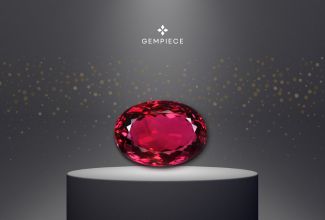
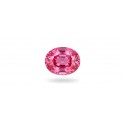
The GRS pigeon blood standard — the most widely referenced in the trade — requires all of the following to be simultaneously present in a ruby: vivid red color graded in daylight using master stone reference sets, with no brown or orange overtones; high chromium content of approximately 0.3 to 0.5 wt% or higher; a chromium-to-iron ratio (Cr/Fe) greater than 1; and medium to strong UV fluorescence at 365nm. The color must be assessed face-up under standardized lighting conditions and meet the colorimetric threshold for "vivid red" — a specific range of hue, tone, and saturation that places the stone in the narrow band between pink-red and purplish-red.
The Cr/Fe ratio requirement is the chemically critical parameter. Chromium drives both the red color and the fluorescence. Iron, when present in the same crystal, quenches the UV fluorescence by competing for the photon energy that would otherwise stimulate chromium emission. A Cr/Fe ratio greater than 1 means chromium dominates — producing the vivid, self-luminous quality that gives pigeon blood ruby its distinctive glowing appearance in natural daylight. Stones with high iron, even if they display vivid red face-up under artificial light, lose the daylight fluorescence glow and cannot meet the pigeon blood standard.
Which Laboratories Issue Pigeon Blood Designation
GRS (Gem Research Swisslab, Bangkok): Originated the formal pigeon blood standard and is the primary issuing laboratory globally. GRS uses two types: Type 1 for marble-hosted rubies with strong to very strong fluorescence; Type 2 for other deposits with medium fluorescence that qualify on color alone. The front page of the GRS report states "GRS-type Pigeon's Blood" as a color quality notation.
Gübelin Gem Lab (Lucerne): Issues a color quality notation of "Pigeon's Blood Red" on qualifying reports using comparable colorimetric and spectroscopic criteria.
SSEF (Swiss Gemmological Institute, Basel): Also uses the pigeon blood designation on qualifying material. Sotheby's notes that SSEF certification confirming pigeon blood is one of the documentation standards relied upon for auction lot descriptions of top-tier ruby.
GIA (Gemological Institute of America): Evaluates ruby color quality but does not use the pigeon blood terminology in its standard reports. GIA describes color using hue, tone, and saturation descriptors. A GIA report on a fine ruby will describe the color as "vivid red" or similar — the pigeon blood label does not appear. For highest-value rubies, a GRS or Gübelin report with pigeon blood notation is therefore more commercially significant than a GIA report alone.
Pigeon Blood, Origin, and the Premium Stack
The pigeon blood designation is commercially origin-independent — GRS applies it to qualifying material from any source. However, in the market, origin and color designation interact in a compounding premium structure. A Burmese (Mogok) pigeon blood ruby commands the highest price per carat. A Mozambique pigeon blood ruby commands the next tier — typically 30 to 50% below Burmese equivalent at comparable quality. A Vietnamese pigeon blood ruby commands a mid-tier premium. For rubies from other origins receiving the designation, premiums are more modest.
This premium stack reflects market history and geological reality rather than arbitrary preference. Mogok's marble-hosted, low-iron geology naturally produces the chemical fingerprint that the pigeon blood standard was originally designed to describe — the standard and the origin are historically co-evolved. A Mozambique ruby meeting the same standard is a genuine achievement of quality, but the Mogok material represents both the historical archetype and a geologically finite resource. Both matter to collectors; which matters more depends on the buyer's priorities.
Pigeon Blood and Treatment Status — The Full Premium
The pigeon blood designation is entirely separate from treatment status. A heated ruby can receive a pigeon blood color notation if its post-treatment color meets the criteria — and many fine heated rubies do qualify. Unheated ruby can also receive pigeon blood designation. The two certifications together — pigeon blood color and no indications of heating — represent the maximum documentation premium. Unheated pigeon blood ruby, particularly from Mogok above 3 carats, is the rarest category in the commercial ruby market. At auction, the combination commands prices that dwarf heated pigeon blood material of identical post-treatment color: the unheated premium for fine Burmese pigeon blood ruby above 5 carats can be a factor of 5 to 10 or more above heated equivalents.
The Sunrise Ruby — The Market Benchmark
The Sunrise Ruby — a 25.59-carat cushion-cut unheated Burmese pigeon blood ruby with GRS certification — was sold at Sotheby's Geneva on May 12, 2015, for CHF 28.25 million (approximately USD 30.335 million). This set the world record for any colored gemstone and any ruby sold at auction at the time, achieving a per-carat price of approximately USD 1.18 million. The stone carried both a GRS pigeon blood color notation and a GRS confirmation of no indications of heating — the two certifications together representing the maximum premium stack the market recognizes.
Buying Pigeon Blood Ruby — What to Verify
Always verify the certificate independently. A GRS, Gübelin, or SSEF report stating pigeon blood color designation must match the stone's report number in the issuing laboratory's online verification database before any significant purchase is finalized. The pigeon blood terminology is used loosely in marketing by dealers without certification — the designation is only meaningful when it appears on an actual laboratory report from one of the recognized issuing laboratories. For any ruby above 1 carat marketed as pigeon blood, a certificate from GRS, Gübelin, or SSEF is non-negotiable. GemPiece provides documentation on all pigeon blood-designated ruby in our collection.
Explore Related
Ruby Gemstone Guide, Burmese Ruby, Mozambique Ruby, Star Ruby, natural ruby collection.