
Understanding Yellow Opal
Yellow opal is the warmest member of the opal family — a stone that carries the color of sunlight, of golden afternoon, of ripe honey, in a material that formed over millions of years from silica-rich water slowly depositing in ancient rock cavities. It does not compete with the spectral complexity of rainbow opal or the transparent drama of fire opal. Instead, it offers something more intimate: a consistent, glowing warmth that complements yellow gold settings naturally, works beautifully in everyday jewelry, and provides the opal family's gentler, more wearable alternative to its more visually intense relatives.
Yellow opal also carries an unusual naming story. Its commercial nickname "Canary Opal" has a double etymology — the vivid yellow color of the canary bird, and the actual geological occurrence of yellow opal in the Canary Islands of Spain, an archipelago whose volcanic geology produces opal from the same type of hydrothermal processes that generate fire opal in Mexico and water opal in volcanic settings globally. The double meaning makes it one of the more memorably named gemstone varieties, even if most commercial Canary Opal today comes from Australia, Ethiopia, and Mexico rather than the Atlantic islands.
Explore our yellow opal collection and related varieties including water opal, fire opal, and rainbow opal. For related guides see Water Opal Guide, Fire Opal Guide, Peruvian Blue Opal Guide, and the complete Opal Gemstone Guide.
What Is Yellow Opal
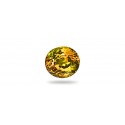
Yellow opal is a variety designation applied to opal (hydrated amorphous silica, SiO₂·nH₂O) that displays yellow as its dominant body color, regardless of whether it also displays play of color. Yellow body tone in opal results from ferric iron (Fe3+) trace content in the silica matrix, operating at concentrations lower than those that produce the orange of fire opal. The iron absorbs blue and blue-green wavelengths while transmitting yellow and warm tones, producing the characteristic warm body color. Lower iron content produces pale canary yellow; moderate iron content produces golden yellow; higher concentration approaches orange, overlapping with pale fire opal.
Yellow opal falls into two commercial categories with meaningfully different optical characters. Precious yellow opal has a yellow body tone (N6 to N8 on the body tone scale) with play of color — the silica sphere array in these stones produces spectral diffraction colors that appear against the warm yellow background. Common yellow opal has yellow body color without play of color — the silica sphere arrangement is disordered (potch-like) and produces no diffraction display, but the iron-tinted silica body is itself attractive and commercially useful.
Canary Opal: Name, History, and Geology
The Canary Opal name predates modern international gem marketing and reflects a genuine geographical discovery. Yellow opal from the Canary Islands of Spain — the Atlantic archipelago lying approximately 100 kilometers off the northwest African coast — represents a legitimate and historically documented occurrence of yellow common opal from volcanic rock formations. The Canary Islands' volcanic geology, product of the same Atlantic hotspot system that built the archipelago over millions of years, includes the siliceous volcanic rock types (trachytes, phonolites, and rhyolites) in which opal forms by hydrothermal precipitation. Yellow opal from these formations carries a double yellow identity: the canary-yellow color and the canary-yellow island of origin.
In modern commercial use, "Canary Opal" as a trade name has been adopted for vivid yellow common opal from multiple sources, including Australia, Ethiopia, Mexico, Brazil, and other producing regions. The Moonrise Crystals gemological resource documents the dual meaning explicitly: the name applies both because of the color and because of the actual Canary Islands origin. William Shakespeare mentioned opal as the "queen of gems" in general, and ancient Roman texts specifically praised yellow opal — what Pliny described as the yellow topaz-like quality among opal's color combinations — as one of the stone's most appealing attributes.
Precious Yellow Opal vs Common Yellow Opal
The distinction between precious and common yellow opal is fundamental to understanding the variety's commercial and optical spectrum.
Precious yellow opal is relatively uncommon as a standalone category — it tends to be described by its base opal type (black yellow opal, crystal yellow opal, white yellow opal) rather than simply as "yellow opal." Australian precious yellow opal from Coober Pedy and Lightning Ridge occurs when the silica formation environment produced a yellow-tinted opal seam with play of color rather than the more common white or colorless base. Ethiopian precious yellow opal from the Welo Province is more commercially significant: Welo stones with warm amber-orange to honey-golden body tones carry vivid play of color in green, blue, red, and orange directions, producing a visually complex stone where the warm yellow background makes the spectral colors appear warmer and richer than they would against a colorless or white base.
The Jewelers Mutual color guide documents that precious yellow opal can show green, blue, red, and orange play of color — a full or near-full spectrum against the yellow background. When this occurs in a vivid, clean, well-formed stone, the result is one of the most commercially appealing yellow gemstone experiences available — the warm glow of the yellow base combined with the spectral complexity of precious opal's play of color.
Common yellow opal — the straightforward yellow body color stone without play of color — is the more widely available and more affordably priced form. At its best, fine common yellow opal has a clean, rich, even golden to canary yellow color with good translucency and strong surface luster. At commercial grades, it is more opaque and the color more variable. The value in common yellow opal is its warm, consistent, easily wearable color at accessible price points.
Yellow Opal and the Fire Opal Spectrum
Yellow opal and fire opal represent a continuous color spectrum rather than two sharply divided categories. Fire opal is defined by orange to reddish-orange body color with transparency; yellow opal is defined by yellow body color with opacity to translucency. The commercial boundary between them is approximately at the color transition from yellow- orange to orange, and at the transparency transition from opaque/translucent to transparent.
In practice, pale transparent yellow material is often marketed as "yellow fire opal" or as a light fire opal, using the fire opal label to invoke the premium association of Mexican fire opal and to indicate the transparency that separates it from standard common yellow opal. Non-transparent yellow material without play of color is straightforwardly common yellow opal.
Both yellow opal and fire opal carry the same iron oxide color mechanism at different concentrations — fire opal has higher iron and produces orange; yellow opal has lower iron and produces yellow. Both are entirely natural and untreated.
Physical and Optical Properties
Chemical Formula: SiO₂·nH₂O with trace ferric iron (Fe3+) as primary chromophore for yellow body color.
Hardness: 5.5 to 6.5 Mohs, consistent with all opal types.
Refractive Index: approximately 1.37 to 1.47 for common yellow opal; toward the lower end of this range for material with low iron content.
Specific Gravity: 1.98 to 2.25.
Transparency: Opaque to translucent for common yellow opal. Fine translucent material has the soft glow that represents the visual peak of the variety. Transparent material at the yellow fire opal boundary.
Luster: Waxy to vitreous. Common yellow opal tends toward waxy luster; fire opal-adjacent transparent material shows vitreous luster.
Absorption: The iron content responsible for yellow body color absorbs in the blue-violet region. In yellow opal at lower iron concentrations, the cutoff is in the deep blue (around 480nm), transmitting yellow through red cleanly.
Fluorescence: Some yellow opals show greenish to yellowish fluorescence under UV light, consistent with common opal fluorescence behavior generally.
Global Sources
Australia produces precious yellow opal as a byproduct of the main white and black opal production at Coober Pedy and Lightning Ridge. Some Australian material with a yellow-golden body tone shows strong play of color, representing the premium end of Australian yellow opal production.
Ethiopia (Welo Province) produces significant volumes of precious yellow opal with warm amber-honey to golden body tones and vivid play of color. Ethiopian yellow opal is hydrophane and requires the same careful care as other Ethiopian opal varieties. The combination of warm yellow body tone with vivid play of color makes Ethiopian precious yellow opal one of the most visually appealing yellow gemstones available.
Mexico produces both common yellow opal and pale yellow transparent fire opal from its volcanic opal fields. Mexican yellow material shares the volcanic formation environment and lower water content stability of Mexican fire opal.
Canary Islands, Spain is the historical namesake source of Canary Opal. Volcanic geology of the archipelago produces common yellow opal from rhyolitic and trachytic host rocks, though current commercial production from this source is limited compared to Australian, Ethiopian, and Mexican output.
Other sources include Austria, France, Hungary, Italy, New Zealand, Oregon (USA), Peru, Russia, Brazil, Japan, and Indonesia.
Yellow Opal in Jewelry
Yellow opal is one of the most wearable and versatile opal varieties for everyday jewelry. Its consistent body color eliminates the orientation-dependency and directional sensitivity of precious opal — you can wear a yellow opal ring without thinking about which angle shows the best color, because the warm yellow is consistent from all directions. This practical advantage makes it particularly suited to channel settings, bezel settings, and pave arrangements where play-of-color opal would be visually wasted.
Yellow opal in yellow gold creates a harmonious, monochromatic warmth. In rose gold, the combination is deeply warm and rich. In white gold or platinum, the contrast creates a sophisticated setting where the stone's golden warmth is emphasized by the cool metal.
For daily wear in rings, the standard opal care advice applies: bezel or protective settings reduce surface scratching risk from the 5.5 to 6.5 Mohs hardness.
Value and Buying
Common yellow opal in standard quality ranges from $5 to $50 per carat. Fine translucent common yellow opal with vivid, even golden color and strong luster reaches $20 to $100 per carat. Ethiopian precious yellow opal with vivid play of color ranges from $80 to $500 per carat for well-formed stones in attractive sizes. Australian precious yellow opal follows Australian opal pricing conventions with applicable origin premiums.
When selecting yellow opal, the key criterion is color richness and evenness — the yellow should be clean, consistent, and warm throughout the stone without gray or brownish patches. Translucency adds value; opacity reduces it. For precious yellow opal, evaluate play of color independently: the spectral display against a warm yellow background should be vivid and directionally broad.
Browse our yellow opal collection or explore related guides: Water Opal Guide, Fire Opal Guide, Rainbow Opal Guide, and the complete Opal Gemstone Guide.