
Kyanite – Variable Hardness, Vivid Blue and Nepal Origins
Kyanite is a gemstone that presents gemologists and collectors with a paradox — a mineral whose finest specimens produce a vivid, deeply saturated blue that rivals the most prestigious sapphires, yet which remains almost entirely outside mainstream gem commerce due to a physical property that makes it genuinely difficult to cut and relatively fragile in jewelry use. That property is variable hardness: kyanite measures 4 to 4.5 on the Mohs scale along the crystal length and 6 to 7 across it — a directional hardness variation unique among commercial gemstones that reflects the fundamental anisotropy of its triclinic crystal structure. For collectors who understand and appreciate what the mineral offers, fine Nepalese kyanite in deep blue represents one of the most compelling undervalued blue gemstones in the current market. This guide covers kyanite's mineralogy, variable hardness, color chemistry, global sources, and value.
Explore our natural kyanite collection from Nepal, Brazil, and Kenya.
Mineral Composition and Physical Properties
Kyanite is an aluminum nesosilicate with the chemical formula Al₂SiO₅ — sharing this composition with its polymorphs andalusite and sillimanite, which form under different pressure-temperature conditions. Kyanite forms at high pressure and moderate temperature in the blueschist and eclogite metamorphic facies — its presence in a rock is a direct indicator of high-pressure subduction zone metamorphism, making it a key petrogenetic indicator for geologists studying ancient tectonic events. It belongs to the triclinic crystal system and forms typically blade-like or prismatic crystals, often with a characteristic blue color zoning.
The defining physical property is its anisotropic hardness: 4 to 4.5 along the crystal length (parallel to the elongation), 6 to 7 perpendicular to it. This property, combined with perfect cleavage parallel to the long axis, makes kyanite both scientifically distinctive and practically challenging for lapidaries. Specific gravity is 3.56 to 3.68. The refractive index is 1.716 to 1.731, biaxial negative, with birefringence 0.012 to 0.017.
Color Chemistry
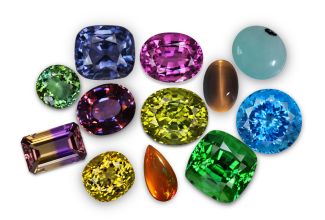
The blue color of kyanite is produced by iron-titanium charge transfer — a mechanism in which electrons are transferred between Fe²⁺ and Ti⁴⁺ ions in adjacent sites within the crystal lattice, absorbing orange-red wavelengths and transmitting blue. This is the same charge-transfer mechanism responsible for the blue of sapphire, producing a similarly vivid, deep blue in fine kyanite material. The intensity of the blue depends on iron and titanium concentrations — the finest Nepalese kyanite achieves a vivid, deep royal blue or indigo-blue that is among the most saturated natural blues available in any gem species at accessible prices. Green kyanite from Brazil and Kenya contains different trace element profiles producing the green color. Orange kyanite from Tanzania is colored by manganese.
Sources and Quality
Nepal's Kali Gandaki river valley and associated metamorphic terrains produce what is widely regarded as the world's finest gem-quality blue kyanite — deeply saturated, vivid blue material with excellent transparency that has drawn comparison with Kashmir sapphire color in tone, if not in geological origin or price. Brazil (Minas Gerais) is the largest commercial producer by volume, offering a wide range of blue and green kyanite quality. Kenya produces fine green kyanite of notable clarity. Tanzania's Loliondo area is the primary source of orange kyanite. India, Russia, Myanmar, Austria, and the United States produce kyanite mineralogically but with limited commercial gem-quality output.
Treatment Status
Kyanite is not treated. The blue color from iron-titanium charge transfer requires no enhancement. Untreated natural status is universal for all commercial kyanite. GemPiece provides full disclosure on every stone.
Value Factors
Color depth and saturation are the primary value determinants — vivid deep blue Nepal material commands the highest per-carat prices. Transparency and eye-clean clarity are standard expectations for faceted material. Cutting quality — specifically whether the lapidary has oriented the hard direction face-up and maximized color face-up — significantly affects the practical value of any faceted kyanite. Green kyanite commands moderate premiums for color rarity. Orange kyanite is valued for its unusualness within the species.
Durability and Care
Clean with warm water, mild soap, and soft brush. Avoid ultrasonic and steam cleaning due to cleavage. Store separately from harder gemstones. Use protective settings for ring jewelry. Avoid sharp impacts along cleavage direction.
Explore Some Blue Collector Gemstones
grandidierite (view collection), spinel (view collection), sapphire (view collection), and topaz (view collection).