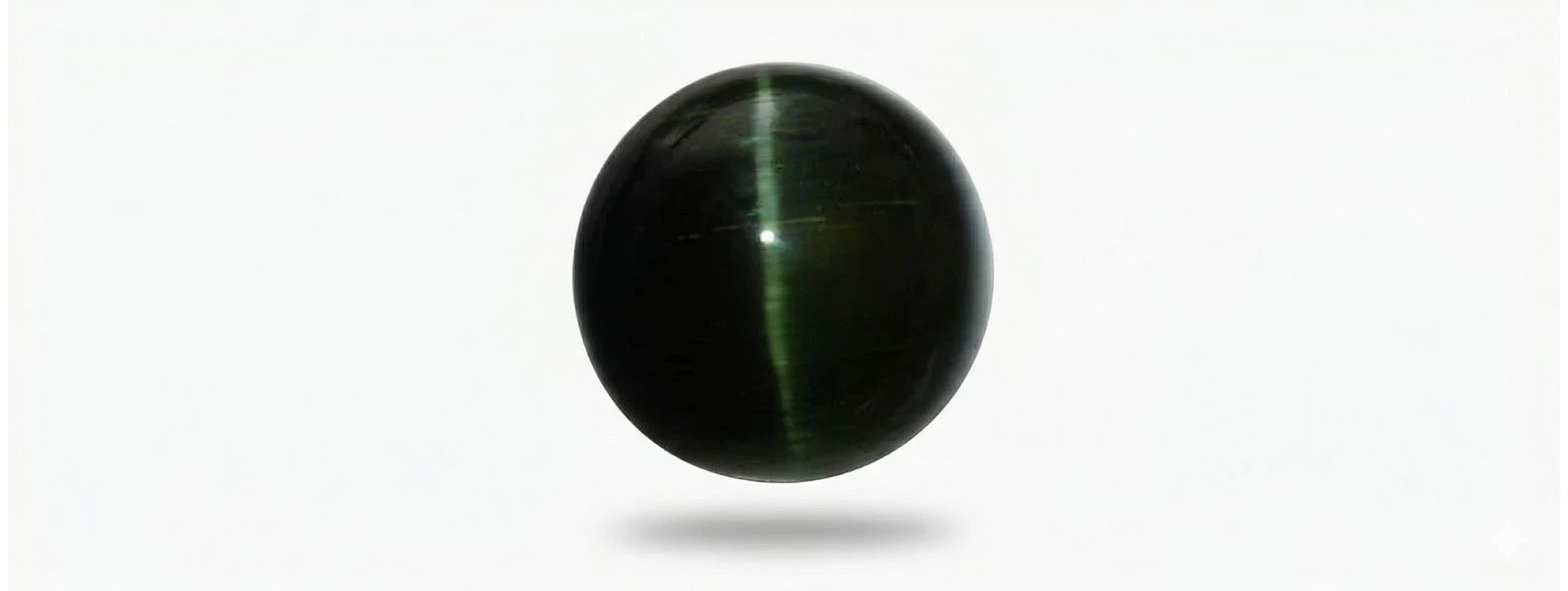
Understanding Apatite Cat’s Eye Gemstone
Apatite cat's eye combines two independently remarkable properties within one stone: the wide, vivid color range of the apatite mineral family and the dynamic, animated optical phenomenon of chatoyancy that transforms a static colored object into one that appears to have an inner life, responding to light with a bright moving band that follows every shift in the viewing angle. Understanding why this combination occurs in apatite, how the chatoyant effect is produced at the physics level, and what it means for cutting, evaluation, and collection requires understanding both the mineral's inclusion characteristics and the optics of chatoyancy itself.
Explore our apatite cat's eye collection and our main apatite collection with its Apatite Gemstone Guide. Browse related chatoyant gemstones including tourmaline cat's eye at Tourmaline Cat's Eye Guide. See our rare gemstone collection.
What Is Apatite Cat's Eye
Apatite cat's eye is a subcategory of the apatite gemstone family in which parallel needle-like inclusions within the crystal structure are sufficiently dense, well-aligned, and uniformly distributed to produce the optical phenomenon of chatoyancy in a properly cut cabochon. The chatoyancy appears as a bright, narrow band of light that sits at the highest point of the cabochon dome when the stone is viewed with a single directional light source directly overhead, and that moves across the dome smoothly and continuously as the stone is rotated.
The term "cat's eye" without further qualification in the gemstone trade typically refers to chrysoberyl cat's eye (cymophane), which is considered the finest and sharpest cat's eye of any gem species. When referring to chatoyant stones of any other species, the species name must accompany "cat's eye" for accurate identification: apatite cat's eye, tourmaline cat's eye, aquamarine cat's eye, and so on. This naming convention is important for buyers because it prevents the confusion of apatite cat's eye with the far more expensive chrysoberyl cat's eye.
The Physics of Chatoyancy
Chatoyancy is an optical reflectance phenomenon rooted in constructive interference and focused reflection from parallel arrays of sub-surface reflecting elements. When a gemstone contains a large number of parallel fibrous, needle-like, or tubular inclusions, each individual inclusion reflects incident light in a direction perpendicular to its length. When the inclusions are parallel to each other, all of these individual reflections occur in the same direction simultaneously.
If the stone were flat and the light source were a narrow beam, this parallel reflection would produce a diffuse glow across the stone's surface in the direction perpendicular to the inclusion orientation. The crucial element that converts this diffuse glow into the sharp "eye" is the curved dome of the cabochon. The dome acts as a cylindrical lens that focuses the parallel reflections toward a single focal point at the apex of the dome. The result is a convergent, high-intensity band of light at the dome's highest point, the cat's eye.
As the stone is rotated around the axis perpendicular to the dome (or equivalently as the light source moves), the focal geometry changes and the convergence point moves along the dome surface. This is why the eye appears to "move" across the cabochon when the stone is rotated. In a perfectly cut stone with the inclusion orientation exactly perpendicular to the long axis of the finished cabochon, the eye travels exactly along the long axis of the dome from one end to the other in a straight line. An off-center or curved eye path indicates a cutting orientation error.
Needle Inclusions in Apatite
The chatoyancy-producing inclusions in apatite cat's eye are needle-like crystals that form parallel to the crystallographic c-axis of the apatite host. These inclusions have been described in gemological literature as rutile-like in habit based on their visual appearance under magnification, though chemical analysis of specific inclusions has not always confirmed rutile composition. The term "rutile-like needle inclusions" is used in the trade as a descriptive reference to the visual appearance of the inclusions rather than necessarily as a definitive mineralogical identification.
The formation of these parallel needles within apatite crystals reflects the growth history of the specific crystal. During crystal growth, trace elements or secondary mineral phases can exsolve from the growing crystal or be incorporated from the crystallization environment in a manner that follows the crystallographic symmetry of the host mineral. The hexagonal symmetry of apatite, with its c-axis as the primary symmetry axis, creates a preferential orientation for inclusion growth that naturally produces the c-axis-parallel alignment required for chatoyancy.
Needle density is the most critical variable in chatoyancy quality. A minimum threshold of needle density is required to produce any visible eye effect; below this threshold, the reflections are too dispersed to converge into a visible band. Above this threshold, increasing needle density progressively narrows and brightens the eye up to a maximum quality level where the eye is as sharp and bright as the specific optical geometry of the stone can produce.
Cutting Requirements and Lapidary Challenges
Cutting apatite cat's eye correctly is technically demanding and requires specific knowledge of the inclusion geometry within each individual piece of rough. The process begins with orientation: the cutter must identify the direction of the inclusion array using fiber-optic illumination held at different angles against the rough. When oriented correctly, the chatoyancy effect can be seen in the uncut rough as a diffuse moving glow that reveals the inclusion direction. Once the inclusion direction is identified, the cutting axis is set perpendicular to the inclusions for the long axis of the planned cabochon.
The dome height is the second critical variable. For apatite with its specific refractive index (1.628 to 1.649) and the typical depth at which the needle inclusion zone is located within the rough, a specific dome profile produces optimal eye focusing. A dome that is too flat produces an eye that appears broad and diffuse because the focal geometry is not steep enough. A dome that is too high moves the focal point above the stone's surface at normal viewing distance. The optimal dome for apatite cat's eye is typically a medium-high profile that positions the focal point precisely at the dome surface under normal viewing conditions.
Apatite's 5 Mohs hardness creates specific challenges during cabochon cutting. The relatively soft surface requires careful management of grinding and polishing pressure to prevent scratching during the grinding stages, and careful lap speed control during final polishing to achieve the high gloss surface that maximizes the visual contrast between the bright eye and the body color of the cabochon.
Apatite Cat's Eye vs Chrysoberyl Cat's Eye
Chrysoberyl cat's eye (cymophane) is the benchmark against which all other cat's eye gems are measured, and the comparison with apatite cat's eye is instructive for collectors evaluating both species.
Chrysoberyl cat's eye produces the sharpest, most precisely defined eye of any gem species because the rutile needle inclusions in chrysoberyl are extremely fine, uniformly dense, and distributed through a highly transparent host with excellent refractive properties. The resulting eye in fine chrysoberyl cat's eye is often described as appearing painted on the surface, a band so narrow and precisely defined that it seems almost artificial in its perfection.
Apatite cat's eye generally produces a broader, somewhat more diffuse eye. This is characteristic of the species and reflects the coarser average diameter of the chatoyancy-producing inclusions in apatite compared to the rutile needles in chrysoberyl. The eye in fine apatite cat's eye is still clearly defined and visually impressive, but a discerning comparison between fine specimens of both species will reveal the difference in sharpness.
The competitive advantage of apatite cat's eye is its color range and accessibility. Chrysoberyl cat's eye is essentially limited to honey-yellow and yellowish-green. Apatite cat's eye covers honey, yellow, green, and teal, with the rare addition of blue-green Paraiba-hued material. Apatite cat's eye is significantly more affordable than comparable quality chrysoberyl cat's eye, making the chatoyant phenomenon accessible to a much wider range of collector and jewelry budgets.
Sources in Detail
Africa provides the majority of commercially available apatite cat's eye, with deposits across East Africa (Tanzania, Kenya, Mozambique) and West Africa contributing material in yellow, honey, and green tones. African apatite cat's eye is generally available in the widest size range of any source, making larger cabochons above 5 carats obtainable for buyers who want meaningful stone sizes.
Sri Lanka's alluvial gem gravels have historically produced apatite cat's eye alongside chrysoberyl cat's eye, tourmaline cat's eye, and other chatoyant gems. Sri Lankan apatite cat's eye in honey and greenish-yellow tones can show excellent eye quality reflecting the same geological conditions that produce fine chrysoberyl cat's eye in this region.
Myanmar contributes apatite cat's eye from various deposit types in the gem-rich Mogok and surrounding regions. Tanzania's Umba Valley, known for its diversity of gem species, produces apatite cat's eye in several color varieties. India, Brazil, and Canada also contribute smaller quantities of apatite cat's eye material to the commercial market.
Physical and Optical Properties
Chemical Formula: Ca₅(PO₄)₃(F,Cl,OH)
Crystal System: Hexagonal
Hardness: 5 Mohs
Refractive Index: 1.628 to 1.649 (uniaxial negative)
Specific Gravity: 3.17 to 3.23
Cleavage: Imperfect
Cut: Cabochon exclusively
Optical Phenomenon: Chatoyancy from parallel needle inclusions along c-axis
Eye Quality Range: Weak diffuse to sharp and well-centered depending on inclusion density and cutting
Colors: Honey, yellow, green, teal; rarely blue-green Paraiba hue
Sources: Africa (primary), Sri Lanka, Myanmar, Tanzania, Kenya, India
Treatment: None; chatoyancy and body color are natural
Value and Market Pricing
Apatite cat's eye offers chatoyancy at accessible prices relative to most other cat's eye species. Standard quality with visible but soft eye and good body color: $15 to $50 per carat. Good quality with sharp, well-centered eye in attractive yellow or honey color: $30 to $150 per carat. Fine quality with strong sharp eye, vivid body color, and good size above 5 carats: $50 to $200 per carat. Green and teal cat's eye apatite in fine quality commands the upper end due to more limited availability and greater color distinctiveness.
For collectors, the most valuable apatite cat's eye specimens combine three factors simultaneously: a sharp, well-centered, high-contrast eye; vivid, attractive body color; and meaningful size above 5 carats. Stones achieving all three factors are genuinely uncommon and represent the finest available within the species.
Buying Apatite Cat's Eye
Always evaluate apatite cat's eye under a single directional point light source, a penlight or directional desk lamp in an otherwise dim environment. The eye should appear as a clean, bright, well-defined band that moves smoothly across the full width of the dome as you rotate the stone. Verify that the eye is centered at the apex of the dome when light is directly overhead. An off-center or curved-path eye indicates a cutting orientation error that cannot be corrected without recutting.
Assess body color separately under diffuse all-directional light by moving the stone away from the point light source. The body color should be attractive and consistent across the face of the cabochon without patches, zones, or color irregularities that would detract from the overall appearance.
Browse our apatite cat's eye collection and main apatite collection. Read our Apatite Gemstone Guide for the full parent species coverage. Explore related chatoyant gems at Tourmaline Cat's Eye Guide and our rare gemstone collection.