
Ruby – Mogok Stone Tract, Pigeon Blood and Collector Benchmark
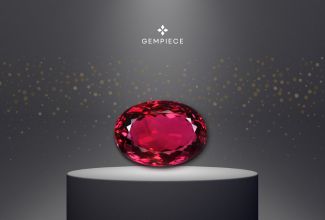
Burmese ruby from the Mogok Stone Tract is the single most prestigious origin in the colored gemstone world. No other ruby source commands comparable per-carat premiums at the finest quality levels, no other origin has a longer or more documented production history, and no other geological environment has consistently produced the specific combination of low iron, high chromium, and marble-hosted chemistry that makes the finest Mogok material glow with an intensity that collectors and gemologists describe as a stone lit from within. Fine unheated Mogok pigeon blood ruby above 3 carats is among the rarest and most valuable collector acquisitions available in the natural gemstone market — a category where per-carat prices routinely exceed diamonds of equivalent weight.
The Sunrise Ruby — a 25.59-carat unheated Burmese pigeon blood ruby — sold at Sotheby's Geneva in May 2015 for USD 30.335 million, setting the world auction record for any colored gemstone and any ruby sold at that time. This benchmark sale established the price ceiling for what the finest Burmese ruby can command in the international market.
This guide covers Mogok's marble-hosted geology and why it produces ruby of unmatched optical quality, the chromium-fluorescence mechanism unique to low-iron Burmese material, treatment landscape for Mogok ruby, and value. For full ruby background, see our Ruby Gemstone Guide.
Explore our natural ruby collection including Burmese material with full origin and treatment documentation.
Mogok Stone Tract — Geology and History
The Mogok Stone Tract covers approximately 400 square kilometers in Mandalay Region, northern Myanmar, at elevations between 900 and 1,500 meters. Ruby formed in a specific geological environment — calcareous sedimentary rocks (originally limestone and dolomite) that were metamorphosed to marble under high pressure and temperature during regional Himalayan tectonics. During this metamorphism, aluminum-rich minerals recrystallized to form corundum. The marble host rock chemistry is critical: marble contains very little iron, so the corundum that formed within it inherited an exceptionally low iron composition. Chromium was available from adjacent metamorphic rocks during fluid migration.
This marble-hosted, low-iron, high-chromium geological fingerprint is the direct cause of Mogok ruby's optical properties — and it is why Mogok material behaves differently from rubies formed in other geological environments. Mining in Mogok has been documented since the 6th century AD. From 1889 to 1931, the Mogok mines were formally operated under British colonial administration by Burma Ruby Mines Ltd. Today, mining continues under various operators, but gem-quality production at the finest grades is severely constrained by both geological depletion and the difficulty of the terrain.
The Mogok Glow — Chromium Fluorescence
The defining visual characteristic of fine Burmese ruby is its extraordinary fluorescence — the quality that collectors describe as a stone appearing lit from within, a glowing coal, or a self-lit red. This effect is directly produced by the combination of high chromium concentration and very low iron in Mogok material. Chromium (Cr³⁺) in corundum causes both the red transmitted color and intense red fluorescence under UV light. Iron, when present in the same crystal, partially quenches this fluorescence by absorbing the UV energy before it can stimulate chromium emission. Mogok's marble-hosted geology produces ruby with Cr/Fe ratios significantly greater than 1 — sometimes dramatically so — allowing chromium fluorescence to express almost without quenching.
The result is a ruby that fluoresces so intensely it enhances its apparent red color even in natural daylight (which contains UV). IGS notes that Myanmar rubies often fluoresce so intensely that this effect becomes noticeable in natural sunlight — they literally appear to glow from within. Thai basaltic ruby, by contrast, has high iron and very low fluorescence — visually distinct to trained eyes in daylight despite potentially similar face-up color under artificial light.
Pigeon Blood and Mogok
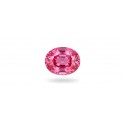
The pigeon blood color designation originated in Mogok — local miners described the finest rubies by the vivid pure red of fresh pigeon blood. GRS formalized this as a measurable laboratory standard in 1996, requiring vivid red color, high chromium content (approximately 0.3 to 0.5 wt% or higher), Cr/Fe ratio greater than 1, and medium to strong UV fluorescence. These chemical requirements map almost perfectly onto the Mogok geological fingerprint — which is why Burmese origin and pigeon blood designation co-occur so frequently in top-tier auction material.
Pigeon blood designation is technically origin-independent — GRS grants it to qualifying material from Vietnam, Mozambique, Afghanistan, and other sources. But a Burmese pigeon blood ruby commands a substantial additional premium over a Mozambique pigeon blood ruby of identical color grade, because Mogok material is both historically unique and geologically finite. Both a GRS pigeon blood certificate and a separate GRS/Gübelin origin report confirming Burmese (Mogok) origin together represent the documentation package that maximizes per-carat value.
Treatment Landscape for Mogok Ruby
The majority of Mogok ruby in the commercial market has been heat-treated — this is true even for material of fine color. Standard heat treatment dissolves silk inclusions that cause cloudiness, improves color saturation, and is permanent and universally disclosed on laboratory certificates. Heated Mogok ruby with laboratory documentation of origin and heat treatment is a legitimate collector acquisition at appropriate pricing.
Unheated Mogok ruby — confirmed by intact silk inclusions, unaltered growth zones, and other heat-sensitive internal features preserved in the laboratory report as "no indications of heating" — commands premiums that can be 5 to 10 times or more above heated material of identical appearance. For unheated Mogok pigeon blood ruby above 3 carats, the premium is essentially uncapped — demand consistently exceeds supply at every quality level. GemPiece provides explicit heating disclosure on all ruby and does not carry glass-filled material.
What Distinguishes Burmese Ruby from Other Origins
The combination that only Mogok consistently delivers at the finest quality tier: marble-hosted geology producing low iron; high chromium saturation; intense UV fluorescence creating visible daylight glow; and over 1,500 years of documented production establishing historical prestige and market trust. Mozambique has produced spectacular rubies and the finest Montepuez Type A material approaches Mogok chemistry in the laboratory — but the Mogok origin premium reflects both the geological rarity of that specific marble environment and the accumulated centuries of market recognition that no newer source can replicate.
Explore Related
Ruby Gemstone Guide, Mozambique Ruby, Pigeon Blood Ruby, Star Ruby, natural ruby collection, natural spinel.