
Chrome Diopside – Siberian Emerald, Chromium Green and Untreated
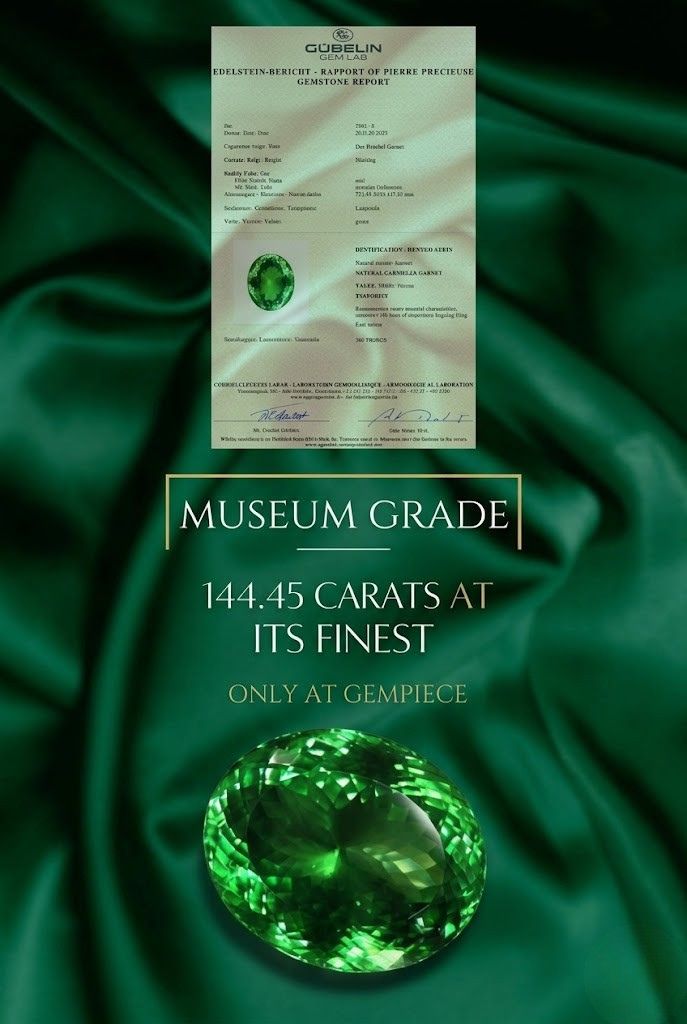
Chrome diopside is one of the most visually striking and completely natural green gemstones in the world — a chromium-bearing pyroxene from eastern Siberia whose rich, saturated color rivals emerald while remaining free of any treatment, enhancement, or artificial processing. Discovered in commercial quantities in 1988 at the Inagli deposit in the Republic of Sakha, Russia, chrome diopside entered the global gem market as a revelation: an intensely green, naturally colored gemstone from one of the most remote and extreme environments on Earth, available at prices that made genuine vivid green accessible to buyers at every level. This guide covers chrome diopside's mineralogy, chromium coloring, Siberian origins, the size-darkening phenomenon, clarity, and value.
Explore our natural chrome diopside collection from verified Siberian sources.
Mineral Composition and Physical Properties
Diopside is a calcium magnesium silicate mineral (CaMgSi₂O₆) belonging to the pyroxene group — a major family of rock-forming silicate minerals found widely in igneous and metamorphic rocks worldwide. Chrome diopside is the chromium-bearing variety, in which trace amounts of Cr³⁺ replace some magnesium or iron in the crystal lattice to produce the characteristic green color. It belongs to the monoclinic crystal system and forms typically prismatic crystals. The word "diopside" derives from the Greek di (two) and opsis (vision), referring to the stone's two possible orientations of optical axes — this double refraction can be observed as slight facet doubling under magnification in cut stones.
Chrome diopside measures 5.5 to 6.5 on the Mohs hardness scale and has good to perfect cleavage in two directions — a factor that makes cutting challenging and contributes to the limited supply of well-faceted specimens. The specific gravity is 3.22 to 3.38. The refractive index is 1.664 to 1.730. Birefringence ranges from 0.024 to 0.031. Pleochroism is moderate — viewed along different axes, chrome diopside can appear slightly different shades of green and yellow-green.
The Chromium Color Mechanism
The green color of chrome diopside is produced by chromium (Cr³⁺) substituting for magnesium within the pyroxene crystal structure. Chromium in this oxidation state absorbs red and blue-violet wavelengths of visible light, transmitting green — the same mechanism that colors emerald, tsavorite garnet, and chrome tourmaline. The intensity of the green is directly related to the chromium concentration. At lower concentrations, lighter, brighter greens are produced. At higher concentrations, the color becomes deeply saturated — vivid and rich — but in larger stones, the deep saturation begins to absorb too much light, causing the stone to appear very dark or nearly black face-up.
Siberian Origins — The Inagli Mine
The Republic of Sakha in eastern Russia is the world's only known commercial source of gem-quality chrome diopside. The Inagli deposit lies in one of Earth's most extreme environments — winter temperatures in the region reach minus 60 degrees Celsius, making mining physically impossible for much of the year. Gemstone extraction occurs only during the short Siberian summer, creating a seasonally constrained supply that cannot be scaled up regardless of market conditions. This geological exclusivity, combined with the seasonal mining restriction, places chrome diopside in a supply category similar to tanzanite — inherently limited and potentially finite.
The Size Limitation
Chrome diopside has a well-understood commercial limitation that all buyers should know: stones above approximately 2 carats tend to appear very dark or nearly black in face-up viewing due to the depth of chromium saturation absorbing transmitted light. This phenomenon is inherent to the chromium coloring mechanism and cannot be addressed through treatment. Skilled lapidaries manage it by cutting larger stones with shallower pavilions to reduce the optical path length through the stone and preserve color brightness. Well-cut chrome diopside above 2 carats with good color requires expertise in the cutting process and is less commonly found in the market than smaller sizes.
Clarity Characteristics
Chrome diopside is typically moderately included. Common inclusion types include black needle-like magnetite crystals that may exhibit slight magnetism, metallic-like inclusions, liquid inclusions, two-phase inclusions, gas inclusions, and healed fractures. Eye-clean chrome diopside is available and commands premiums, but lightly included material with vivid color is the commercial norm and is widely accepted. The extraordinary color intensity is the primary evaluative criterion — buyers should not apply the same clarity standards used for topaz or aquamarine to chrome diopside.
Treatment Status
Chrome diopside is completely untreated. No heat treatment, irradiation, fracture filling, surface coating, or any other enhancement is applied to natural chrome diopside. The vivid green is produced entirely by natural chromium content — a fact that represents significant value in a market where most green gemstones require treatment to achieve comparable saturation.
Value Factors
Color intensity and brightness are the primary value drivers for chrome diopside. The most desirable stones display a vivid, bright emerald-like green in the 0.50 to 2.00 carat range. Eye-clean clarity adds value but is secondary to color. Size is a complex factor — larger stones require shallow cutting and careful evaluation of color behavior face-up. Origin from Siberia's Inagli deposit is standard and expected for quality material.
Durability and Jewelry Use
With a hardness of 5.5 to 6.5 and good cleavage in two directions, chrome diopside requires care in jewelry use. Protective settings — particularly bezels — are recommended for ring applications. Earrings and pendants are the most practical applications for everyday wear. Avoid situations involving abrasive contact or sharp impacts.
Care and Maintenance
Clean chrome diopside with warm water, mild soap, and a soft brush. Avoid ultrasonic cleaners and steam cleaning due to cleavage sensitivity. Store separately from harder gemstones. Avoid prolonged sun exposure and contact with harsh chemicals.
Explore Related Green Gemstones
Chrome sphene (view collection), kornerupine (view collection), and andalusite (view collection).