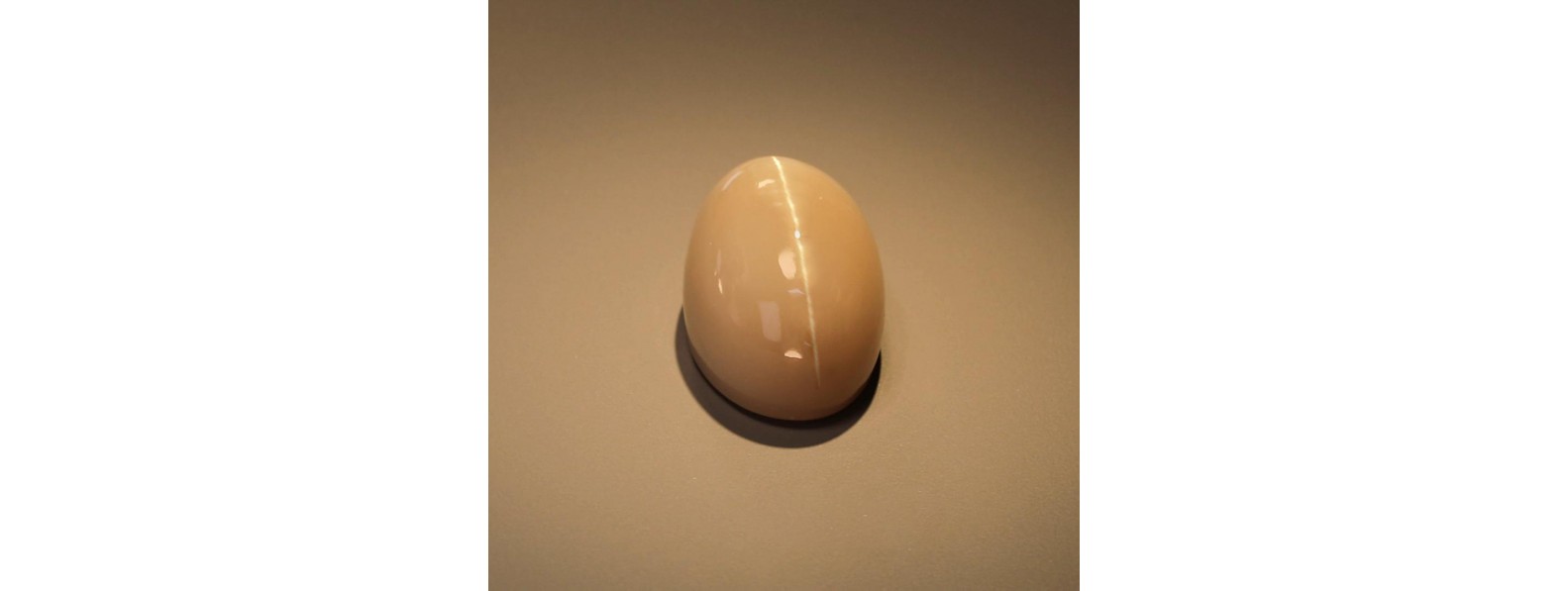
Moonstone Cat's Eye – Chatoyancy and Adularescence Combined
Moonstone cat's eye is the chatoyant variety of orthoclase feldspar moonstone — a gemstone displaying a single, sharp, mobile band of reflected light across the cabochon surface, produced by a single set of parallel aligned fibrous inclusions or structural channels within the crystal, combined with the characteristic adularescent glow that defines all fine moonstone. Of the three primary optical phenomenon varieties within the moonstone family — standard adularescence, asterism (star moonstone), and chatoyancy (cat's eye) — the cat's eye variety is the least common in fine quality and represents a distinctive collector specialty within the feldspar gem family.
Explore our moonstone cat's eye collection or the full moonstone family including star moonstone.
Mineral Composition
Moonstone cat's eye is orthoclase feldspar (KAlSi₃O₈) in the monoclinic crystal system — the same mineral species as all moonstone. Hardness 6 to 6.5, perfect cleavage in two directions, specific gravity 2.56 to 2.59, refractive index 1.518 to 1.526. The defining structural requirement for cat's eye moonstone is the simultaneous presence of: the lamellar orthoclase-albite exsolution microstructure responsible for adularescence, and a single set of parallel fibrous inclusions or aligned lamellar features sufficiently dense and uniform to produce a sharp chatoyant band.
The Chatoyancy Mechanism
Chatoyancy — the cat's eye effect — is produced when a single set of parallel fibrous inclusions or structural channels reflects light as a concentrated, narrow band across the surface of a correctly oriented cabochon when illuminated by a single directional light source. Unlike asterism, which requires multiple intersecting sets of inclusions, chatoyancy requires only one well-aligned set. The quality of the cat's eye depends on the density and precision of the inclusion alignment — very tightly packed, uniformly parallel inclusions produce the sharpest and most mobile cat's eye band. A cabochon must be oriented with the inclusions running parallel to the base of the dome for the eye to appear centered and sharp on the crown.
In moonstone cat's eye, this chatoyant band co-exists with the adularescent glow from the lamellar feldspar microstructure — creating a stone that shows both a mobile, focused eye and the soft, glowing background body characteristic of fine moonstone. This combination of two optical effects in one stone is what makes moonstone cat's eye a specialist collector variety of genuine optical distinction.
Sources
India — particularly Rajasthan and Tamil Nadu — is the primary commercial source of moonstone cat's eye across white, grey, and peach body colors. Sri Lanka produces fine quality moonstone cat's eye with clean bodies and strong adularescence backgrounds. Myanmar is a secondary source of quality material. The cat's eye phenomenon in moonstone is less common than adularescence alone, and specimens showing both a sharp eye and strong adularescence simultaneously are not frequently encountered.
Treatment Status
Moonstone cat's eye is not treated. Both the adularescence and the chatoyancy are entirely natural structural properties of the crystal. No treatment creates or enhances either phenomenon. GemPiece provides full disclosure on all moonstone cat's eye specimens.
Value Factors
Eye sharpness and definition are the primary quality drivers — a crisp, well-centered, mobile cat's eye band against a strongly adularescent body represents the premium tier. Body color matters secondarily — white or near-colorless body with blue adularescence and a sharp eye is the most desirable combination. Sri Lankan material with blue-white adularescence commands origin premiums. Fine moonstone cat's eye above 10 carats combining strong eye quality with good adularescence is a meaningful collector acquisition.
Explore Related Gemstones
Moonstone (view collection), star moonstone (view collection), and sillimanite cat's eye (view collection).