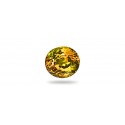
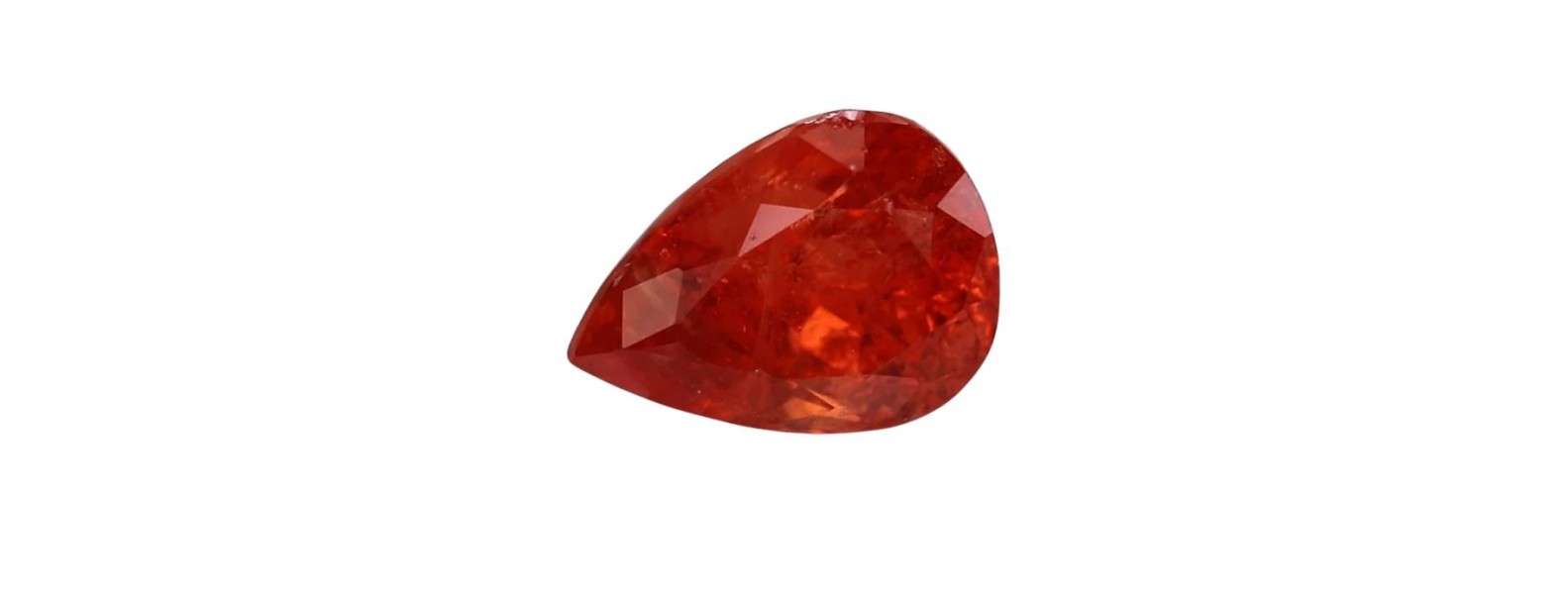
Triplite – One of the World's Rarest Faceted Gemstones
Triplite represents one of the most extreme cases of rarity in the collector gemstone world — a phosphate mineral that is not uncommon geologically but is found in transparent, facetable form so seldom that finished faceted specimens are among the scarcest gemstones ever handled by professional gemologists. When a transparent triplite does emerge from a Pakistani pegmatite in cuttable form and is successfully faceted, the result is a gemstone of genuine scientific significance, collector prestige, and irreplaceable natural character. This guide covers triplite's mineralogy, optical properties, formation, sources, and the factors that determine its extraordinary collector value.
Explore our natural triplite gemstone collection — contact our team for current availability as supply is extremely limited.
Mineral Composition and Physical Properties
Triplite is a manganese iron fluoro-hydroxyl phosphate mineral with the chemical formula (Mn,Fe,Mg,Ca)₂(PO₄)(F,OH). It belongs to the monoclinic crystal system and is a member of the triplite group of phosphate minerals, structurally related to wagnerite. The name triplite derives from the Greek word triplos, meaning threefold, a reference to the mineral's three cleavage directions — a characteristic that makes cutting faceted gems from triplite exceptionally challenging.
Triplite has a Mohs hardness of approximately 5 to 5.5 and a specific gravity of 3.5 to 4.0 — notably dense for a phosphate mineral, reflecting its iron and manganese content. The refractive index ranges from approximately 1.643 to 1.700, biaxial positive. The birefringence is moderate and can produce visible facet doubling in cut specimens under magnification. Luster on polished surfaces is vitreous to resinous.
Color and Optical Properties
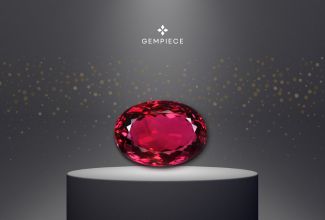
Triplite's color in gem-quality form ranges from deep reddish-brown through brownish-red, warm orange-brown, and occasionally orange or yellowish-brown. The color is caused by the variable ratios of manganese to iron in the crystal structure — manganese-dominant specimens tend toward warmer orange-red tones, while iron-dominant material tends toward darker brown. Minor pleochroism is observed in some specimens, showing subtle color shifts between two directions under polarized light. The stone's luster, combined with its warm body color, gives well-cut triplite a distinctive glowing character.
The birefringence of triplite makes it diagnostically interesting to gemologists — facet junctions show doubling under magnification, a characteristic shared with sphene and a limited number of other high-birefringence gemstones. Some triplite specimens display chatoyancy or even asterism when the orientation of inclusions permits these optical effects, though such specimens are rare.
Formation and Geological Occurrence
Triplite forms primarily as a primary phosphate mineral in lithium-bearing granite pegmatites and, less commonly, in hydrothermal veins. It occurs in association with other phosphate minerals including triphylite, lithiophilite, and various secondary phosphates that form by alteration. The mineral is not uncommon in its opaque or granular form across many pegmatite localities globally. However, the transparent, gem-quality crystalline form required for faceting is extraordinarily rare — most triplite in nature is too opaque, too heavily fractured, or too small to produce a faceted gemstone of meaningful size.
Sources
Pakistan is the primary source of transparent gem-quality triplite, with material from pegmatite localities producing the orange-brown faceted specimens occasionally found in collector markets. Triplite has been documented mineralogically in Germany, France, Portugal, the United States (New Hampshire, Connecticut, Maine), and various other countries, but transparent cuttable material from these localities is rarely if ever available in gemstone form.
Cutting Challenges
Faceting triplite is a significant lapidary challenge. The three distinct cleavage directions mean the rough can cleave or chip unexpectedly during any stage of the cutting process. A skilled lapidary must orient the stone carefully to minimize cleavage risk while simultaneously maximizing color and optical performance in the finished gem. The combination of rare transparent rough, challenging cutting geometry, and high risk of loss during cutting means that finished faceted triplite specimens represent a substantial investment of skill, time, and material.
Treatment Status
Triplite is not commercially treated. No established treatments exist for this species, and no synthetic triplite is produced commercially. Every faceted triplite in the market is natural and untreated — a straightforward disclosure that benefits both seller and collector.
Collector Value
The value of faceted triplite is driven almost entirely by rarity. A well-cut transparent specimen of any meaningful size is a genuine collector's acquisition. Warm orange-brown color, good transparency, and clean cutting are the primary quality factors. Origin documentation from Pakistan adds collector provenance value. Given the extreme scarcity of the material, pricing is determined case by case rather than by established per-carat benchmarks.
Durability and Jewelry Use
With a Mohs hardness of 5 to 5.5 and three cleavage directions, triplite is fragile by gemstone standards. It is best suited as a collector stone, display gem, or occasional-wear pendant or earring in a fully protective setting. Daily ring wear is not recommended. Handle with care and avoid contact with harder gemstones.
Care and Maintenance
Clean triplite with a soft, damp cloth. Avoid ultrasonic cleaners, steam, and harsh chemicals. Store separately from harder gemstones. Protect from sharp impacts and avoid sudden temperature changes.
Explore Related Ultra-Rare Gemstones
Collectors of rare phosphate and silicate minerals may also find interest in clinohumite (view collection), grandidierite (view collection), and sphene (view collection).