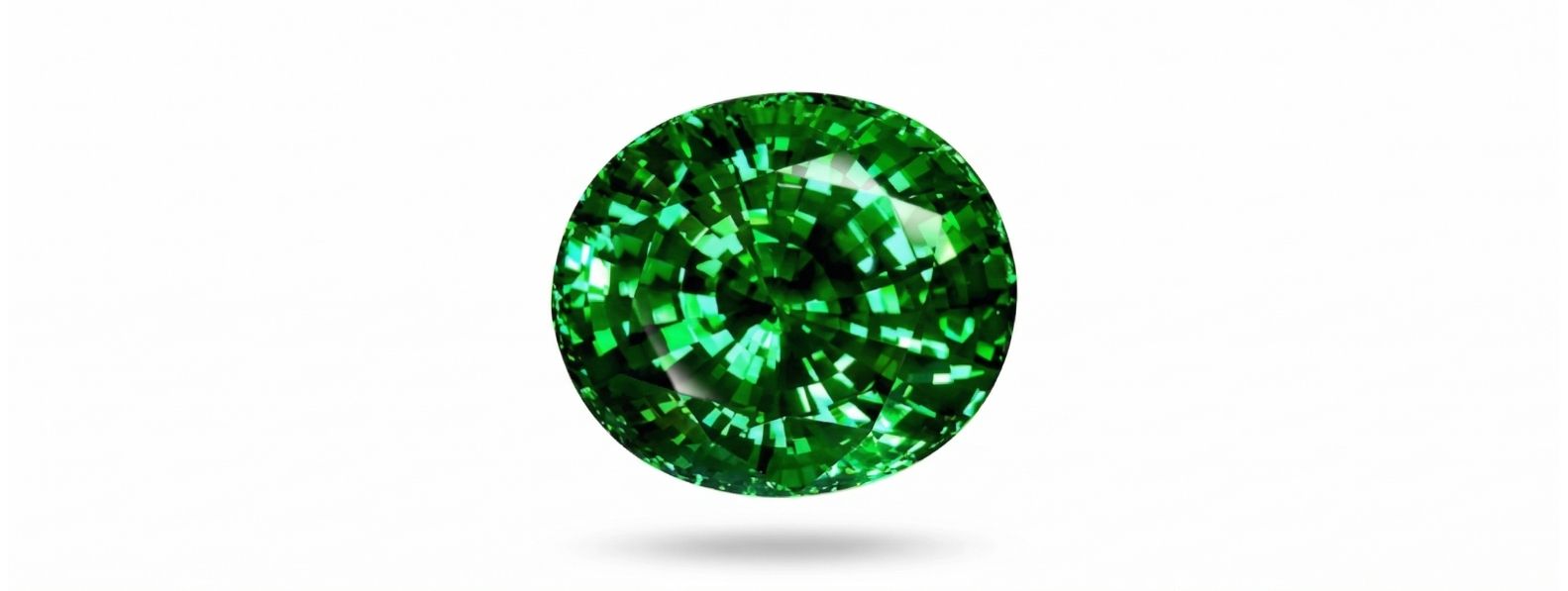
Understanding Tsavorite Garnet
Tsavorite garnet is the gemstone Campbell Bridges gave his life for — literally. He discovered it in 1967 in Tanzania, spent decades developing mines under conditions that included armed conflicts, disputes, and constant challenges, and was murdered in 2009 in a mining-related attack on his property. The stone he left behind is one of the most significant gemological discoveries of the 20th century: a vivid, naturally untreated green gem of exceptional clarity, found in one of the most geologically constrained deposits on earth, rarer than emerald by a factor of hundreds to thousands, and capable of producing the finest natural green available to the gemstone world without a single drop of treatment oil.
Explore our tsavorite garnet collection and related varieties including our grossular garnet collection and demantoid garnet collection. For related guides see Grossular Garnet Guide, Demantoid Garnet Guide, and the complete Garnet Gemstone Guide.
Discovery and History
Campbell Bridges was a Scottish geologist and gemologist working in East Africa in the 1960s. In 1967, while prospecting in the mountains of northeastern Tanzania near the Taita Hills, he encountered unusual potato-like nodules of rock. Inside these nodules, which gemologists now recognize as characteristic of the calc-silicate bearing host rock of the Mozambique Belt, he found green crystal fragments and grains that he did not immediately recognize. Gemological analysis confirmed they were green grossular garnet — a species known to exist but never previously found in this color or this quality.
The discovery was significant, but Tanzania's mining regulations at the time prevented export of the material. Bridges continued his work, following the geological belt of metamorphic rocks northward across the Tanzania-Kenya border. In late 1970, near the Taita Hills of Kenya adjacent to the Tsavo Game Reserve, he found a large deposit of the same green grossular in accessible terrain. He secured a mining permit in 1971 and began commercial production.
The commercial breakthrough came when Bridges partnered with Henry Platt of Tiffany and Co. It was Tiffany who named the stone "tsavorite" after the Tsavo region where the main Kenyan deposits were found, and who introduced it to the international luxury jewelry market with the resources and prestige of one of the world's most recognized jewelry brands. The name stuck immediately. By the mid-1970s, tsavorite was established as a distinct commercial variety with its own collector base and market identity.
Bridges continued mining and developing tsavorite deposits in Kenya for decades, becoming one of the foremost authorities on the stone's geology and quality factors. In August 2009, he was attacked and killed at his property in the Tsavo area in what investigators described as a dispute over illegal mining activity on his land. His death was a significant loss for the gemological community and the tsavorite industry. His mining operations have been continued by his family and are a significant source of important Kenyan tsavorite material.
Chemical Composition and Color Chemistry
Tsavorite is a variety of grossular garnet, a calcium aluminum silicate with the formula Ca₃Al₂(SiO₄)₃. The vivid green color is produced by trace chromium (Cr3+) and vanadium (V3+) substituting for aluminum in the Y-site of the crystal lattice. These are the same chromophores that produce green color in emerald (a beryl variety), ruby and alexandrite (corundum), and demantoid garnet (andradite variety). The chemical similarity in color production between tsavorite and emerald explains the visual comparison between the two gemstones — they share chromophores in different mineral hosts.
The precise color of any tsavorite depends on the Cr:V ratio and total concentration of chromophores. Higher chromium content drives the color toward deeper, more bluish greens similar to fine Colombian emerald; higher vanadium produces a slightly brighter, more yellowish green. The most prized tsavorite color in the market is a vivid, medium-toned pure green — not so dark it loses transparency and brilliance, not so pale it appears insignificant. This optimal combination requires a specific balance of chromophore content that is achieved naturally only in the most favorable geological environments.
Unlike emerald, tsavorite's color is entirely stable and requires no maintenance. Chromium and vanadium substitutions in the grossular lattice are chemically stable under all normal conditions of light, heat, and chemical exposure encountered in jewelry wear. The green does not fade, does not require re-treatment, and does not change character over time.
Physical and Optical Properties
Hardness: 7 to 7.5 Mohs. Suitable for all jewelry applications. Importantly, unlike emerald which has hardness of 7.5 to 8 Mohs but with pervasive fracturing that compromises practical toughness, tsavorite's absence of significant cleavage and typical freedom from fracturing makes it genuinely more durable in jewelry use than most commercial emerald.
Refractive Index: approximately 1.734 to 1.759. This is higher than emerald (1.577 to 1.583) and contributes to tsavorite's stronger brilliance. The higher RI means light bends more sharply as it enters and exits the stone, producing more intense internal reflections and stronger face-up brightness.
Specific Gravity: approximately 3.57 to 3.61. Notably lighter than demantoid garnet (3.84), allowing simple density measurements to distinguish the two green garnets when needed.
Dispersion: 0.028 — adequate for good sparkle in a well-cut stone. Lower than demantoid (0.057) but higher than emerald (0.014), meaning tsavorite produces more fire than emerald while producing less than demantoid.
Clarity: Tsavorite typically achieves eye-clean to VVS clarity without treatment. The most common inclusions when present are graphite needles, fingerprint-type healed fractures, and occasionally mineral crystal inclusions. The absence of the pervasive fracturing that characterizes emerald is the defining clarity advantage.
Cleavage: None. Unlike emerald, which has no cleavage but extensive natural fracturing, tsavorite forms clean crystals with minimal internal fracturing. This structural integrity is the practical basis for tsavorite's superior durability.
Luster: Vitreous. Well-cut tsavorite displays a bright, glassy surface brilliance that is immediately apparent and significantly stronger than the subdued luster of oiled or fractured emerald.
Formation Geology
Tsavorite forms under specific and unusual geological conditions within the East African Mozambique Belt — an ancient orogenic (mountain-building) terrane formed approximately 550 to 700 million years ago during the Pan-African tectonic event when East Gondwana assembled through the collision of multiple continental fragments. The metamorphic conditions within the Mozambique Belt created the specific rock types and chemical environments required for tsavorite crystallization.
The host rocks for tsavorite are graphitic gneisses and calc-silicate marble assemblages within the Mozambique Belt. The graphite (reduced carbon) in these rocks is geochemically significant: reducing conditions created by the graphite keep chromium and vanadium in their trivalent (Cr3+, V3+) states, which are the oxidation states that substitute for aluminum in the grossular lattice and produce green color. Without the reducing environment maintained by the graphite, chromium and vanadium would be oxidized to less color-effective states and tsavorite could not form.
This geological requirement — the coincidence of calcium-aluminum silicate metamorphic chemistry, reducing graphite-bearing conditions, trace chromium and vanadium availability, and appropriate metamorphic grade — defines the narrow geological window within which tsavorite can crystallize. Within the Mozambique Belt, only specific zones meet all these conditions simultaneously, which is why tsavorite deposits are geographically limited within an already restricted geological terrain.
The Kenya-Tanzania border area where tsavorite is found contains particularly favorable geology: contact zones between graphitic gneisses and calcareous marble units within the Mozambique Belt create the reducing, calcium-aluminum-chromium-vanadium chemical environment that tsavorite requires. Mining is concentrated in the Taita-Taveta County of Kenya and the Merelani Hills and Manyara areas of Tanzania.
Global Sources in Detail
Kenya (Taita-Taveta County, Voi, Kuranze areas): The original and most historically important source. Kenyan tsavorite from the Tsavo region that Bridges developed is associated with the finest, most intensely colored material known. The specific geology of the Taita-Taveta area — with particularly favorable graphite-bearing calc-silicate host rocks — produces chromium-vanadium balances that yield the most saturated and vivid greens. Kenyan production supports the community economically and has been recognized for contributing to rural development in a challenging region.
Tanzania (Merelani Hills, Manyara region): The Merelani Hills in northern Tanzania near Arusha share geological continuity with the Mozambique Belt terrain that produces tsavorite in Kenya. Tanzania provides significant commercial volume of tsavorite across a range of quality levels, from commercial material to excellent stones. The Merelani area also produces tanzanite, making it one of the most gemologically productive geological zones in the world. Additional Tanzanian deposits in the Manyara region have contributed significant production.
Madagascar: Minor production of tsavorite exists in Madagascar from deposits within the island's Precambrian metamorphic terrane, which shares geological heritage with the East African Mozambique Belt. Madagascar tsavorite has not achieved the prominence of Kenyan or Tanzanian material in the international market.
Tsavorite vs Emerald: The Definitive Analysis
The comparison between tsavorite and emerald must be understood in terms of both gemological facts and market context.
Color: Both produce vivid green colored by chromium and vanadium. Fine tsavorite and top-color Colombian emerald are visually comparable in saturated medium green. Tsavorite tends toward slightly more yellow-green or pure green; fine Colombian emerald can display the characteristic bluish undertone. Color preference between the two is personal.
Clarity: Tsavorite wins comprehensively. Virtually all commercial emerald contains significant fracturing (the jardin) requiring treatment. Clean emerald without treatment is extraordinarily rare and priced accordingly. Standard commercial tsavorite achieves eye-clean clarity without treatment. This is not a marginal advantage — it represents a fundamental difference in how the two gemstones are produced, sold, and maintained.
Treatment: Tsavorite is untreated; emerald is routinely treated. The implications extend beyond initial purchase: emerald's fracture-filling treatments (cedar oil, synthetic resin, epoxy) deteriorate over time, are destroyed by ultrasonic cleaning, and require periodic re-treatment. Tsavorite requires none of this.
Brilliance: Tsavorite produces stronger brilliance than emerald due to higher RI (1.734 to 1.759 versus 1.577 to 1.583) combined with cleaner clarity that allows light to travel freely. Fine emerald's characteristic inclusion content scatters and absorbs light, reducing the lively sparkle that tsavorite naturally displays.
Durability: Tsavorite is more durable in practical jewelry terms. While emerald has slightly higher hardness (7.5 to 8 Mohs), its natural fracturing makes it vulnerable to chipping at fracture planes and sensitive to the chemicals in cleaning agents. Tsavorite's clean crystal structure and absence of fracturing make it the more practical jewelry stone for regular wear.
Rarity: Tsavorite is between 200 and 1,000 times rarer than emerald by geological occurrence. Yet tsavorite is typically less expensive at equivalent visual quality because the enormous premium commanded by treatment-free clarity in emerald drives emerald prices disproportionately high at the top end.
Price: At equivalent visual quality (vivid green, eye-clean, good brilliance), tsavorite is generally more affordable than fine untreated emerald. At the very top of the market, exceptional Colombian emerald commands the highest prices due to historical prestige. For buyers who evaluate quality rationally, tsavorite delivers significantly more per dollar.
Rarity and Supply Constraints
Tsavorite's rarity is not an industry claim — it is geological reality. The formation requirements (graphitic calc-silicate host rocks, Mozambique Belt metamorphic grade, trace chromium and vanadium, reducing conditions) align only in specific limited zones of a geographically restricted terrain. Within Kenya and Tanzania's Mozambique Belt, only a subset of the total geological area provides conditions suitable for tsavorite crystallization.
Within the suitable geological zones, crystals large enough to yield finished stones above 2 carats are uncommon. Most tsavorite rough produces finished stones under 1 carat. Even 1-carat tsavorites in fine color are considered rare by the geological standard of how few crystals of that size form in the deposit. The size distribution follows a steeply declining curve: stones from 0.5 to 1 carat are the most common commercial category; 1 to 2 carat stones are notably scarcer; 2 to 5 carat stones are genuinely rare; above 5 carats in fine color, stones are exceptional.
Supply has not kept pace with growing demand. As Asian collector markets — particularly China and Southeast Asia — have developed increasing awareness of tsavorite, demand has grown substantially. The artisanal mining operations in Kenya and Tanzania are not easily scalable: the geological setting limits mechanization, the terrain is challenging, and the yield of gem-quality material from total rough production is low. The combination of inelastic supply and growing demand creates the favorable investment fundamentals that attract collectors and investors to fine tsavorite.
Investment Considerations
Tsavorite garnet has established credentials as an investment-grade gemstone by any credible analysis. The investment case rests on five interconnected factors: genuinely constrained global supply that cannot be increased by drilling more mines; growing collector demand from emerging market economies; the entirely natural, untreated status that the most sophisticated segment of the collector market prizes above all else; laboratory-verifiable quality parameters that allow objective comparison between specimens; and a history of consistent appreciation in fine material over multiple decades.
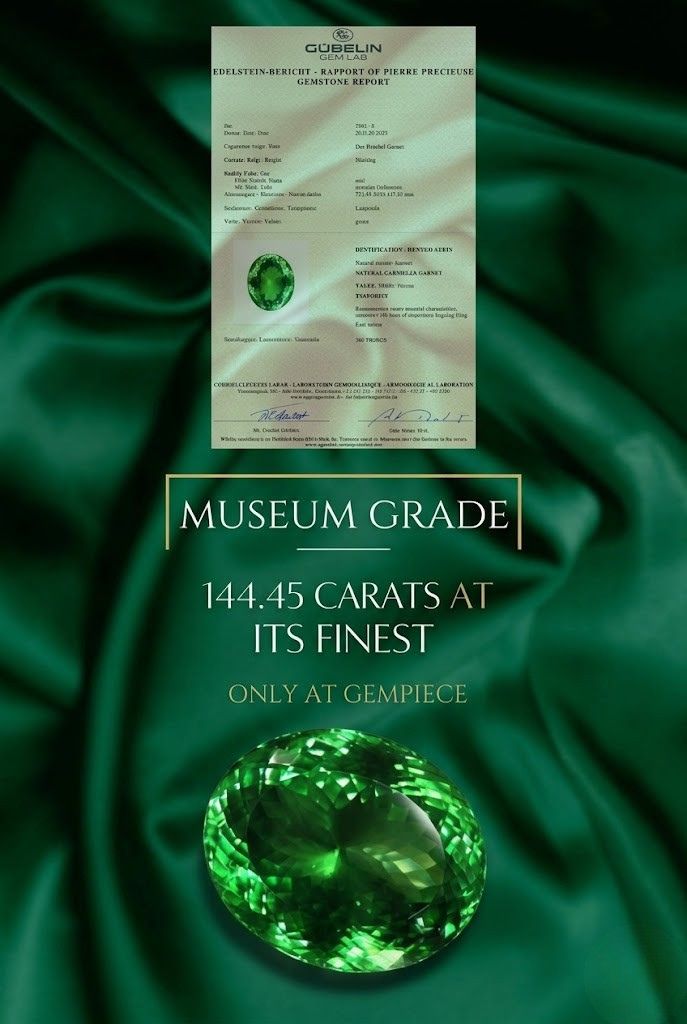
For investment purposes, the most important stones are those above 2 carats in vivid color with excellent clarity and a reputable laboratory report (GIA, Gübelin, GRS, AGL) confirming species, variety (tsavorite), and treatment status (none). These pieces represent the segment of the market where both rarity and documentation combine most effectively to support long-term value.
Care and Maintenance
Tsavorite requires no unusual care. Clean with warm water, mild soap, and a soft brush. Rinse thoroughly and dry with a soft cloth. Unlike emerald, tsavorite can be cleaned in ultrasonic cleaners when the stone is free of significant fracturing — but caution is warranted if any visible inclusions are present. Steam cleaning is not recommended.
No oil, no resin, no periodic re-treatment — ever. Store separately from harder stones to prevent surface scratching. Tsavorite's properties are entirely stable under normal jewelry conditions.
Buying Tsavorite Garnet
When evaluating tsavorite, color tone and saturation are the primary criteria. The ideal stone displays a vivid, open green in natural light — bright enough to command attention, saturated enough to look genuinely precious, not so dark it loses transparency and brilliance. Medium-to-medium-dark tone with even color distribution across the face-up position is the target. Assess under both natural daylight and incandescent light to see how the stone performs in different environments.
Clarity is the secondary factor: eye-clean material is strongly preferred and commands meaningful premiums. Cut quality significantly affects performance — a well-proportioned tsavorite will dramatically outperform a poorly cut stone of identical color and clarity. Look for symmetrical facets, good depth proportions, and a face-up presentation that maximizes color visibility and brilliance simultaneously.
For stones above 1 carat with collector-grade ambitions, a laboratory report from GIA, Gübelin, GRS, or AGL confirming species and treatment status (none) adds meaningful assurance and long-term value support.
At GemPiece, we source tsavorite directly from established suppliers in Kenya and Tanzania. Every stone is accurately represented for quality and origin. Browse our tsavorite garnet collection or explore related guides: Grossular Garnet Guide, Demantoid Garnet Guide, Color Change Garnet Guide, and the complete Garnet Gemstone Guide.