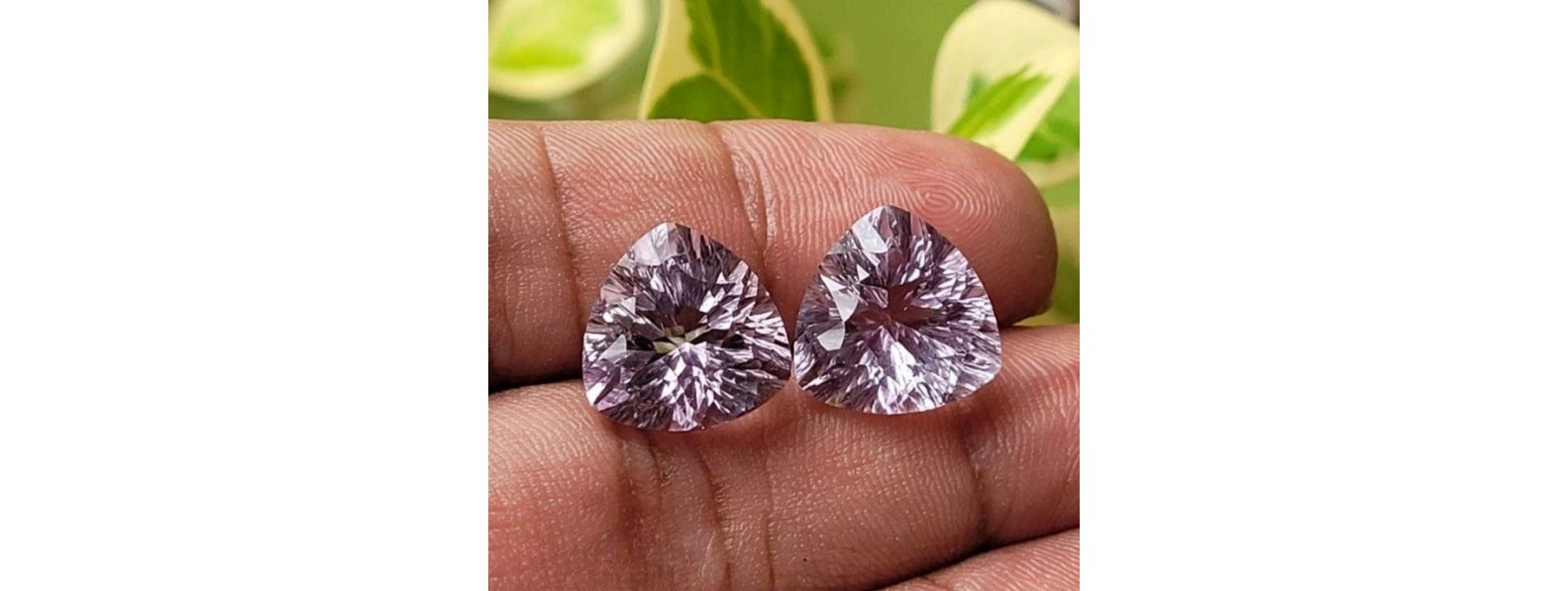
Quartz – Lavender, Prasiolite - Lemon Quartz, Rose Quartz and All Varieties
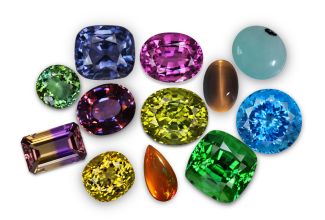
Quartz is the most abundant mineral in Earth's continental crust and the source of one of gemology's most diverse and commercially significant species families. Silicon dioxide (SiO₂) crystallizes in the trigonal system to produce macrocrystalline quartz — individual crystals large enough to see and facet — in a remarkable range of natural colors and optical characters that collectively form the quartz gem family: colorless rock crystal, purple amethyst, yellow-orange citrine, brown-grey smoky quartz, pink rose quartz, pale violet lavender quartz, green prasiolite, and natural bicolor ametrine. Each variety has its own color origin, geological occurrence, treatment landscape, and market positioning. This guide covers quartz mineralogy and all major gem varieties with professional detail on each.
Explore our quartz variety collections: all quartz, lavender quartz (view collection), prasiolite (view collection), and rose quartz (view collection).
Mineral Composition and Physical Properties
Quartz is silicon dioxide (SiO₂) in its macrocrystalline trigonal form. The crystal structure consists of SiO₄ tetrahedra linked in a three-dimensional framework — one of the most stable mineral structures known, accounting for quartz's ubiquity in Earth's crust, its resistance to weathering, and its practical durability as a gemstone. Mohs hardness is 7. Specific gravity is 2.65 — consistent across all macrocrystalline varieties. Refractive index is 1.544 to 1.553, uniaxial positive, birefringence 0.009. No cleavage — fracture is conchoidal. The lack of cleavage combined with hardness 7 gives quartz excellent toughness for all jewelry applications.
Lavender Quartz
Lavender quartz is a pale violet to soft lavender macrocrystalline quartz variety whose color occupies a distinctive space between the vivid purple of amethyst and the neutral grey-brown of smoky quartz. The color mechanism involves iron color centers and possibly hydrogen-related defects within the crystal lattice, producing a cool, muted violet tone of considerable charm. Natural lavender quartz from Brazil and Madagascar occurs without treatment and offers a distinctive, soft alternative to amethyst for jewelry designers and collectors who prefer subtlety over intensity. The color is stable and does not fade under normal conditions. Lavender quartz is typically faceted from clean, transparent rough and provides excellent clarity comparable to other quartz varieties.
Prasiolite — Green Quartz
Prasiolite is the green variety of macrocrystalline quartz. The name derives from the Greek words for leek and stone — an accurate description of its pale to medium yellowish-green color. Natural prasiolite occurs when iron-bearing quartz is naturally heated or naturally irradiated under specific geological conditions — this occurs in a small number of localities including the Lower Silesia region of Poland and a specific Brazilian locality near Montezuma, Minas Gerais. However, the vast majority of commercial prasiolite is produced by artificial heat treatment of iron-bearing amethyst from Brazil at approximately 500 degrees Celsius, which converts the purple Fe³⁺ color centers to the green Fe²⁺ configuration. The resulting green is a pale, pleasant yellowish-green — warm and distinctive — and is stable under normal conditions.
Prasiolite is sometimes marketed as "green amethyst" or "vermarine" — trade names that are technically inaccurate (amethyst by definition is purple) but widely used. GemPiece uses the accurate name prasiolite and provides explicit treatment disclosure for all prasiolite material distinguishing natural from heat-treated product.
Rose Quartz
Rose quartz is the pink variety of macrocrystalline quartz — one of the world's most recognized and beloved gemstone materials, valued for its soft, romantic pink color, massive crystal sizes, and widespread availability at accessible prices. Unlike most quartz varieties where color is produced by trace elements in solution within the crystal lattice, the pink color of rose quartz is produced by microscopic inclusions of dumortierite or a related borosilicate mineral fiber distributed through the crystal. These fine inclusions give rose quartz its characteristic translucent to semi-transparent appearance — the same inclusions that produce the pink color also prevent the full transparency seen in amethyst, citrine, and other quartz varieties. Truly transparent faceted rose quartz is uncommon and is prized by collectors.
The finest rose quartz for cabochon use comes from Madagascar — particularly the Sahatany Valley — and from Minas Gerais, Brazil. Star rose quartz — displaying a four or six-rayed asterism produced by aligned rutile needle inclusions — is a collector variety of notable interest. The star effect in rose quartz can be exceptionally sharp when the inclusion density and alignment are ideal.
Treatment Landscape
Citrine: typically heat-treated amethyst or smoky quartz — see the citrine guide (view collection) for full detail. Prasiolite: typically heat-treated amethyst — natural prasiolite is rare. Lavender quartz: natural, no treatment required. Rose quartz: natural, no treatment required. All treatments are disclosed explicitly by GemPiece on every stone.
Value Factors Across Quartz Varieties
For all faceted quartz varieties, color saturation and distribution are the primary value drivers. Eye-clean clarity is the commercial standard for transparent varieties. Natural untreated status commands premiums over heat-treated material within the same variety. Large sizes are generally accessible in quartz at reasonable prices — an advantage relative to most other colored gemstone species. Rose quartz value is driven by color depth, transparency level, and — for star rose quartz — the quality of the star effect.
Durability and Care
All macrocrystalline quartz: clean with warm water, mild soap, and soft brush. Ultrasonic cleaning is generally safe for natural untreated varieties. Avoid prolonged direct sunlight for heat-treated material. Store separately from diamond and corundum.
Explore Related Gemstones
citrine (view collection), lavender quartz (view collection), and ametrine (view collection).