
Citrine – Natural vs Heat-Treated Yellow Quartz, Ametrine and Sources
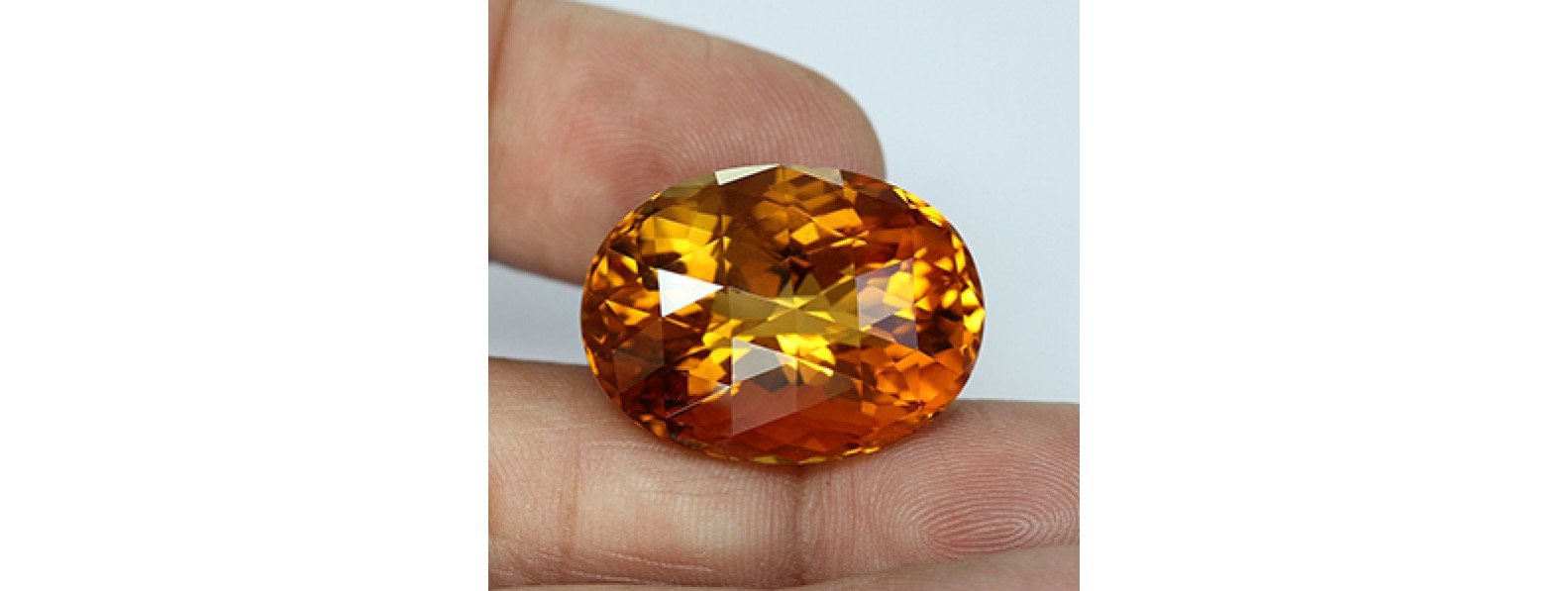
Citrine is the yellow to golden-orange variety of macrocrystalline quartz — a gemstone with an ancient history of use, a modern identity complicated by widespread heat treatment of amethyst, and a collector tier defined by the genuine rarity of naturally occurring yellow quartz. The name derives from the Latin citrina and Old French citrin, meaning lemon-colored — an apt description for the pale to medium yellow of truly natural material, which differs in character from the deeper oranges and reddish-oranges of heat-treated commercial product. As the November birthstone and one of the most commercially versatile colored gemstones in production, citrine occupies a dual position: an affordable, practical jewelry stone in its commercial form, and a genuinely collectible natural gemstone when encountered in authenticated untreated form. This guide covers quartz mineralogy, natural vs heat-treated citrine, ametrine, sources, color varieties, and value.
Explore our natural citrine collection with full treatment disclosure on every stone.
Mineral Composition and Physical Properties
Citrine is a variety of macrocrystalline quartz — silicon dioxide (SiO₂) in its trigonal crystal form with crystals large enough to be visible to the naked eye, as distinguished from the microcrystalline chalcedony varieties. Quartz is the most abundant mineral on Earth's continental crust, but citrine is an uncommon variety within the quartz family — the specific conditions required for natural yellow coloration to develop are less common than those producing colorless quartz, amethyst, or smoky quartz.
Citrine shares the physical properties of all macrocrystalline quartz: Mohs hardness 7, specific gravity 2.65, refractive index 1.544 to 1.553 (birefringence 0.009), trigonal crystal system. No cleavage — fracture is conchoidal. The lack of cleavage gives quartz excellent toughness relative to its hardness. The chemical formula is SiO₂ with trace iron (Fe³⁺) responsible for the yellow color in natural material.
Color Origin — Natural vs Heat-Treated
The yellow to golden color of natural citrine is produced by trace ferric iron (Fe³⁺) impurities in specific coordination within the quartz crystal lattice. This configuration develops naturally through low-level radioactive irradiation combined with geological heat over millions of years — a process that produces the characteristic pale to medium yellow of genuine natural citrine. The color centers responsible for natural citrine yellow are stable under normal conditions.
Heat-treated citrine is produced by converting amethyst or smoky quartz — both more abundant than natural citrine — through artificial heating above approximately 470 to 560 degrees Celsius. Amethyst contains ferrous iron (Fe²⁺) color centers in a different structural configuration that produce purple; heating converts these to the ferric configuration that produces yellow, orange, or reddish-orange, depending on the original iron content and heating temperature. The resulting color is stable and permanent. Heat-treated citrine from amethyst can be identified by: the absence of natural pleochroism (natural citrine shows weak pleochroism; heat-treated material does not), color concentration at crystal tips rather than even distribution, a tendency toward reddish-orange rather than pale yellow, and the presence of angular color-zone boundaries rather than the gradual zoning of natural material.
Color Varieties and Trade Names
Lemon citrine describes pale, clean yellow material at the lightest end of the color range — typically natural or very lightly treated. Golden citrine covers warm medium yellow to yellow-orange — the most commercially popular range. Madeira citrine is a trade name for deep reddish-orange to brownish-orange material (named after Madeira wine) — almost invariably heat-treated amethyst from Brazil. Palmeira or fire citrine describes vivid orange material. Congo citrine refers to material from specific African localities with distinctive color characteristics. These trade names are useful commercial descriptors but carry no standardized grading definitions and do not substitute for explicit treatment disclosure.
Ametrine — Natural Bicolor Quartz
Ametrine is a naturally occurring bicolor quartz gemstone in which zones of amethyst (purple, from Fe²⁺ color centers) and citrine (yellow-orange, from Fe³⁺ color centers) coexist within a single crystal. The color zonation is entirely natural and untreated — it develops in the Anahi mine in the Santa Cruz department of Bolivia, where a specific geological temperature gradient during crystal growth causes different zones of the same crystal to develop different iron oxidation states and therefore different colors. The Anahi mine is the world's only significant commercial source of natural ametrine. Fine ametrine with clear, well-defined color zones of vivid purple and golden yellow is a genuinely attractive natural gemstone and a legitimate collector's stone in its own right.
Sources
Brazil dominates global citrine production — both natural material from Rio Grande do Sul and the large-scale heat treatment of Brazilian amethyst. Bolivia's Anahi mine is the definitive source of natural ametrine and also produces natural citrine. Madagascar, Russia, Spain (Salamanca), the United States, and several African localities produce natural citrine in smaller quantities. The November birthstone association has sustained consistent global commercial demand across all quality tiers.
Clarity Characteristics
Citrine is generally a clean gemstone. Both natural and heat-treated material typically displays good to excellent transparency with minimal inclusions. Natural citrine may contain typical quartz inclusions including fingerprints, two-phase inclusions, and occasional growth tubes. Heat-treated material is typically very clean — the heating process can actually improve clarity by dissolving some inclusion types. Eye-clean material is the commercial standard and is widely available across the full size range.
Treatment Status and Disclosure
Treatment disclosure is the most important aspect of any citrine purchase. Natural citrine commands collector premiums and should be documented by laboratory certification. Heat-treated citrine — the dominant commercial form — is legitimate, stable, and widely accepted but must be disclosed as treated. GemPiece provides explicit treatment disclosure on every citrine stone. Natural and heat-treated material are clearly distinguished in our collection with appropriate pricing for each.
Value Factors
For natural citrine, laboratory-confirmed untreated status is the primary premium driver. Medium yellow to golden natural color with good transparency represents the quality benchmark. For commercial heat-treated citrine, color saturation, clarity, and cut quality determine value — Madeira orange commands the highest commercial prices within the treated tier. Size is commercially accessible in citrine across a wide range — large clean citrine is readily available at reasonable prices, distinguishing it from most other colored gemstones.
Durability and Jewelry Use
Mohs hardness 7 with no cleavage makes citrine one of the most practical colored gemstones for all jewelry applications. Suitable for daily-wear rings, pendants, earrings, and bracelets. Clean with warm water, mild soap, and soft brush. Ultrasonic cleaning is generally safe for natural and heat-treated material without fractures. Avoid prolonged direct sunlight for heat-treated material, which can potentially fade under extreme UV exposure over time.
Explore Related Quartz and Yellow Gemstones
quartz varieties (view collection), amethyst (view collection), ametrine (view collection), yellow opal (view collection), and danburite (view collection).