Burmese Red Spinel: Origin, Color, Properties and Value
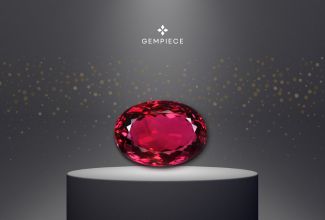
Burmese red spinel is the most historically prestigious variety of spinel in existence — a chromium-colored gem from the legendary marble-hosted deposits of Myanmar's Mogok Stone Tract that has been prized by royalty, emperors, and collectors for over a thousand years, often without being recognized for what it actually is. The Black Prince's Ruby, set at the front of the British Imperial State Crown since 1367, is a 170-carat Burmese red spinel. The Timur Ruby, 352 carats, inscribed with the names of its Mughal imperial owners and presented to Queen Victoria in 1851, is a Burmese red spinel. These are not historical accidents — they reflect the simple fact that fine Burmese red spinel is so vivid, so pure, and so brilliantly beautiful that the greatest jewelers and monarchs in history assumed it must be ruby. Modern gemology has given Burmese red spinel its correct identity without diminishing its magnificence in the slightest. If anything, knowing the full story makes fine Burmese red spinel more remarkable than before.
Today, Burmese red spinel from Mogok is recognized as the global benchmark for the species — the origin against which all other red and pink spinels are measured, the source that produces the most vivid, purest chromium-red color of any spinel locality on earth, and the most actively sought-after collector spinel for buyers who understand origin hierarchy in the colored stone market. Exceptional Burmese red spinel now commands prices exceeding $20,000 per carat at international auction for the finest material — a reflection of the gem's genuine geological rarity, its historical significance, and a global collector market that has come to understand what the Mughal emperors already knew.
This guide covers the geology of the Mogok Stone Tract, the color mechanism of Burmese red spinel, its gemological properties, its historical role in royal collections worldwide, value factors and market positioning, comparison with ruby, and care. Explore our full natural spinel collection or return to the complete spinel gemstone guide. See also Mahenge spinel, cobalt blue spinel, and Madagascar blue spinel for related variety guides.
The Mogok Stone Tract: Geology of the World's Greatest Spinel Source
The Mogok Stone Tract — a roughly 400-square-kilometer gemstone-bearing zone in the Mandalay Region of Myanmar, approximately 200 km north of Mandalay — is the most historically important and gemologically significant gem-producing region on earth. For over a thousand years, Mogok has produced the world's finest ruby, and for equally as long, the same marble-hosted deposits have yielded the world's finest red and pink spinel in the same geological formations, often extracted from the same mines.
The geology of Mogok is defined by Precambrian marble and calc-silicate rocks of the Mogok Metamorphic Belt, subjected to high-temperature, high-pressure contact metamorphism related to the Himalayan orogeny — the same geological process that built the Himalayan mountain chain as the Indian and Eurasian tectonic plates collided. This metamorphic event generated the pressure and temperature conditions required to recrystallize limestone into marble and, in the presence of the right trace element chemistry, to crystallize both corundum (ruby) and spinel simultaneously. The magnesium-rich marble provides the Mg²⁺ for spinel's MgAl₂O₄ formula; the aluminum-bearing metamorphic fluids provide the Al³⁺ for both spinel and corundum; and chromium from surrounding rocks colors both red through the same Cr³⁺ chromophore mechanism. The result is the geological co-occurrence of ruby and red spinel in the same marble pockets — the geological reason why they were confused for so long, and why both gems from Mogok share a color purity that no other geological setting reliably produces.
Spinel from Mogok occurs both in primary marble-hosted deposits — where crystals form directly in the metamorphic rock — and in the secondary alluvial deposits (locally called "byon") where weathering has concentrated gem minerals in river gravels and clay-rich soils. Primary Mogok spinel crystals display characteristic octahedral crystal habit, often of exceptional quality with vitreous luster and minimal surface alteration. Alluvial material is typically well-rounded but may show greater transparency from natural water polishing of surfaces.
Color: What Makes Burmese Red Spinel Distinctive
The color of fine Burmese red spinel is driven by chromium (Cr³⁺) substituting for aluminum in the octahedral sites of the spinel crystal lattice — the same chromophore mechanism that colors ruby red in corundum. The absorption bands of Cr³⁺ in spinel — at approximately 400–410 nm (violet) and 540–560 nm (yellow-green) — transmit red wavelengths and produce the characteristic vivid red that distinguishes Mogok material from all other sources. The precise chromium concentration in Mogok spinel produces a color that many gemologists describe as a pure, slightly brick-red to slightly purplish-red — different from ruby's characteristic slightly bluish or purplish-red at medium saturations, and different from Mahenge's more pinkish-red, but directly comparable in intensity and vividness to the finest red gems available from any species.
Chromium in Mogok spinel also drives strong red fluorescence under both long-wave and short-wave UV light — the same fluorescence mechanism as Mogok ruby, which is one of ruby's most celebrated characteristics. This UV fluorescence amplifies the apparent vividness of Burmese red and pink spinel under natural outdoor lighting conditions (which contains UV), contributing to the extraordinary luminosity that distinguishes Mogok material from stones where fluorescence is absent or weak. Burmese pink spinel from Mogok — in the slightly lower chromium concentration range that produces pink rather than red — displays this same fluorescence effect with spectacular results, producing stones that appear to generate their own light under natural conditions.
Jedi Spinel: The Elite of Burmese Production
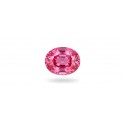
Within the broad category of Burmese spinel, a distinct sub-variety known as Jedi spinel (from the Mansin mining area within the Mogok Stone Tract) has become the most sought-after and highest-priced spinel in the world. Jedi spinel is characterized by an extraordinary neon hot pink to vivid pinkish-red color — not quite the pure red of classic Burmese red spinel, and not quite the orange-tinged pink of Mahenge, but a distinctive electric, highly saturated pink-red that many collectors consider the most beautiful single color in the spinel species. The Jedi designation reflects the stone's almost otherworldly color intensity — the neon quality that makes these stones appear luminous even in subdued lighting. Laboratory certification confirming Jedi or Mansin origin (primarily through GRS and Lotus Gemology origin reports) commands premium pricing that can exceed even classic Mogok red spinel for the finest specimens.
Rarity: Why Large Burmese Spinel Is an Anomaly
Spinel forms under specific metamorphic conditions in Mogok's marble-hosted deposits and, while these environments produce gems of exceptional color, they rarely yield large clean crystals. Most spinel rough extracted from Mogok is small and fragmented. Crystals capable of producing finished stones above 5 carats are already uncommon. Above 10 carats with fine color and clarity, Burmese spinel enters a category defined not by availability but by anomaly — stones where the geological conditions conspired to produce an unusually large, unusually clean crystal in an environment that routinely does not. This geological reality underpins the exponential price premiums that fine large Burmese spinel commands at international auction, and explains why a clean 10-carat Burmese red spinel with strong color is a more significant gemstone find than a comparable ruby might suggest.
Historical Role in Royal Collections
The history of Burmese red spinel in royal and imperial collections is the most extraordinary provenance story in gemology. Because Mogok produces ruby and red spinel from identical geological environments using identical chromophores, the two gems have been extracted, traded, and valued together for over a millennium — and because no practical test existed to distinguish them until modern gemology, the finest red spinels in the world were consistently acquired by the wealthiest and most powerful buyers as rubies. The Mughal emperors — who controlled the Mogok region through political relationships with Burma's rulers — were the greatest collectors of large red spinels in history, inscribing their names and titles on polished spinel surfaces as marks of imperial ownership. The Timur Ruby, the Hope Spinel, the Imperial Crown of Russia's 400-carat stone, and the Black Prince's Ruby in the British Imperial State Crown all trace their origins ultimately to the same geological province: Mogok, Myanmar.
Gemological Properties
Chemical formula: MgAl₂O₄. Crystal system: Cubic. Hardness (Mohs): 8. Specific gravity: 3.58–3.61. Refractive index: 1.719. Optic character: Singly refractive (isotropic). Color: Vivid red to slightly purplish-red; pink material (lower Cr concentration) ranges from hot neon pink to vivid purplish-pink. Color mechanism: Chromium (Cr³⁺). Fluorescence: Strong red under long-wave and short-wave UV. Clarity: Typically eye-clean; characteristic inclusions include octahedral negative crystals, calcite needles from marble host, apatite crystals. Treatment: Typically none — natural color in virtually all commercial production.
Value Factors
Color purity and saturation are the primary drivers. Pure vivid red — neither too dark nor too light, without brownish or orangey modifiers — commands the highest premiums. Laboratory origin confirmation (GRS, Lotus Gemology) is critical for premium pricing: confirmed Burmese origin with no heat treatment commands meaningful premiums over equivalent non-origin material. Carat weight carries exponential premiums above 3 carats; above 5 carats becomes genuinely rare; above 10 carats with fine quality is exceptional. Eye-clean clarity is expected standard. Cut quality matters for how the stone's natural brilliance and fluorescence are expressed.
Explore the Collection
Explore our natural spinel gemstones, return to the complete spinel guide, or explore companion variety guides: Mahenge Spinel, Cobalt Blue Spinel, Madagascar Blue Spinel. See also ruby and sapphire.