
Understanding Mali Garnet
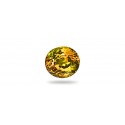
Mali garnet is a gemstone that rewards close examination. Its yellow-green to golden color is attractive in a quiet way — it does not announce itself with the vivid intensity of tsavorite green or the electric orange of mandarin spessartite. What mali garnet does instead is perform. Under good directional lighting, a well-cut mali garnet produces spectral fire that is immediately striking, disproportionate to the stone's modest surface color, driven by the same andradite heritage that makes demantoid the most optically exceptional garnet. Understanding why mali garnet behaves this way requires understanding both parent species and how their hybrid chemistry creates something greater than either alone.
Explore our mali garnet collection and related varieties including our grossular garnet collection and andradite garnet collection. For related guides see Grossular Garnet Guide, Andradite Garnet Guide, Demantoid Garnet Guide, and the complete Garnet Gemstone Guide.
Discovery and History
Mali garnet was discovered in 1994 in the Republic of Mali in West Africa. The discovery was significant for multiple reasons. Mali was not a country with an established gemstone mining industry. The deposit produced a garnet composition — grossular-andradite hybrid — that had not previously been recognized as a commercial gem variety. And the specific combination of the two rarest garnet species, both of which produce important individual gem varieties (tsavorite from grossular, demantoid from andradite), generated genuine excitement in the gemological community when the first analysis results were published.
The first formal gemological description of mali garnet as a commercially distinct variety was published by Mary Johnson and colleagues in the late 1990s, establishing the compositional framework that has guided subsequent understanding. The paper confirmed the grandite (grossular-andradite) hybrid nature of the material and identified the andradite component as responsible for the elevated dispersion that distinguishes mali from standard grossular garnet.
Commercial mining of the Malian deposit was active primarily through the late 1990s and the 2000s. Most of the commercially available mali garnet in today's market was mined during this period. Current production from the original deposit is limited, and the most accessible alluvial material has been substantially worked through, contributing to the stone's increasing scarcity in fine quality and larger sizes.
Chemical Composition and the Grandite Hybrid
Mali garnet sits within the grossular-andradite solid-solution series of the ugrandite garnet group. Both grossular (Ca₃Al₂Si₃O₁₂) and andradite (Ca₃Fe₂Si₃O₁₂) share calcium in the X-site of the garnet crystal lattice. This shared X-site chemistry allows free solid-solution mixing between the two species, with aluminum and ferric iron substituting for each other in the Y-site across the full compositional range from pure grossular to pure andradite.
Mali garnet composition clusters heavily toward the grossular end of this continuum. Most analyzed mali garnet specimens average approximately 82% grossular and 18% andradite, though individual stones can range from perhaps 5% to 30% andradite content. This composition (overwhelmingly grossular with minority andradite) is why most gemologists classify mali garnet as a variety of grossular rather than as a 50:50 grandite hybrid — despite the common use of "grandite" as a trade descriptor.
The color of mali garnet is primarily driven by ferric iron (Fe3+) from the andradite component, which absorbs in the blue region and produces the yellow to yellow-green to golden tones. Higher andradite content means more iron and pushes color toward deeper yellow and eventually brown; lower andradite content with more aluminum allows for purer, lighter yellow-green tones. A Chelsea filter examination reveals traces of chromium in most mali garnets regardless of color, including brown stones, suggesting chromium plays a minor but consistent role in the color chemistry of this variety. Inter-valence charge transfer between Fe2+ and Fe3+ may also contribute to the color in some specimens.
The Dispersion Advantage
Dispersion is the optical property that measures a gemstone's ability to split white light into its spectral components — the same property responsible for the rainbow of colors visible from a cut diamond or the spectacular fire of demantoid garnet. It is measured as the difference in refractive index between red light (at 686.7nm, the B Fraunhofer line) and violet light (at 430.8nm, the G Fraunhofer line).
Pure grossular has a dispersion of 0.028. Pure andradite has a dispersion of 0.057 — significantly higher than diamond's 0.044. When grossular and andradite form a hybrid, the dispersion of the resulting material falls between these two end-member values, interpolated according to the proportion of each component. At the most commonly encountered mali composition of approximately 82% grossular and 18% andradite, the expected dispersion is approximately 0.033 to 0.038 — meaningfully higher than pure grossular and close to the level of diamond.
Stones with higher andradite content (30% or more) can achieve dispersion approaching 0.040 to 0.050, producing fire that rivals fine diamond in the appropriate color range. This is why light-colored mali garnets often appear to sparkle with unusual intensity: the body color is light enough to allow the dispersed spectral light to be seen clearly, and the dispersion value is high enough to produce genuinely impressive flashes.
Dark-colored mali garnets (olive and brown material) often have higher andradite content and therefore higher dispersion, but the deeper body color absorbs some of the dispersed light, partially masking the fire effect. This creates an interesting valuation consideration: the stones that appear to show the most fire are often the lighter-colored, lower-andradite material rather than the darker, higher-andradite stones.
Physical and Optical Properties in Detail
Hardness: 6.5 to 7.5 Mohs. The hardness varies with composition — higher andradite content reduces hardness toward 6.5; higher grossular content maintains hardness toward 7 to 7.5. At the most common 82:18 grossular-to-andradite composition, effective hardness is approximately 7 Mohs. Suitable for all jewelry applications with modest care.
Refractive Index: 1.740 to 1.890. This wide range reflects the compositional variability of mali garnet. Most common specimens show an RI of approximately 1.770, between grossular's 1.690 to 1.734 and andradite's 1.880 to 1.940. The RI of individual specimens can be used to estimate andradite content — higher RI indicates more andradite.
Specific Gravity: 3.61 to 3.84. Again variable with composition. Pure grossular sits at approximately 3.61; pure andradite at approximately 3.86. Most mali garnet falls in the 3.65 to 3.75 range at typical compositions.
Dispersion: 0.028 to 0.057, varying with andradite content. This is the defining optical property of mali garnet from a commercial perspective.
Clarity: Mali garnet often achieves good to excellent clarity. Eye-clean material is regularly available, and the alluvial formation and recovery process tends to favor clean stones. Stones with strong dispersion and clean faces provide the best visual performance.
Crystal habit: Mali garnet rough from alluvial deposits typically shows rounded, waterworn shapes — smooth and sometimes nearly spherical — that reflect the mechanical abrasion of alluvial transport over geological time.
Color change: Rare mali garnets display a color change from grayish-green in fluorescent light to brown in incandescent light, driven by the iron-dominant absorption profile of higher-andradite compositions. This is distinct from the pyrope-spessartite color change effect and typically less dramatic, but it adds collectibility for the specific stones where it is clearly visible.
Chelsea filter: Most mali garnets show red through the Chelsea filter, indicating chromium content regardless of body color. This is a distinctive characteristic that aids identification.
Formation Geology
Mali garnet forms in metamorphic and skarn environments where the conditions favor the co- crystallization of both grossular-type and andradite-type chemistry within the same crystal lattice. This requires a geological environment that provides calcium (the shared X-site cation of both species), along with both aluminum (grossular's Y-site cation) and ferric iron (andradite's Y-site cation) in appropriate proportions.
Skarn environments — contact metasomatic zones where igneous intrusions react with calcium- rich carbonate country rocks — naturally provide mixed aluminum and iron chemistry from both the intruding magma (iron-rich) and the metamorphosed carbonate wallrock (aluminum-bearing from clay impurities). This chemical environment favors the grandite solid-solution series, which explains why the Mali deposit produces a hybrid rather than a pure grossular or pure andradite.
The specific geological environment of the Mali deposit has not been extensively published in open gemological literature, but the alluvial occurrence of the gem material indicates erosion from primary skarn-type metamorphic host rocks within the ancient West African craton. Research has identified grandite-composition material at sites in Nigeria, Tanzania, Madagascar, Russia, Afghanistan, and Brazil, suggesting that the geological conditions producing this hybrid are not unique to Mali — but that the Mali deposit happened to produce commercially significant volumes of gem-quality material while these other occurrences have not yet yielded commercial quantities.
Global Source Discussion
Mali garnet in the commercial sense is a geographically specific name. Despite grandite- composition material being identified in multiple countries, only material from Mali itself is sold under the "mali garnet" trade name in the international market. Material from other locations with similar composition is sold as grossular, grandite, or grossular-andradite without the mali designation.
The Mali deposit itself is alluvial. Alluvial mining — recovering gem rough from river and stream gravels — is inherently limited by the pace of erosion from primary sources. As the most accessible alluvial concentrations in the Malian deposit have been worked through, new production requires either accessing fresh alluvial areas or moving to primary hard-rock mining, which is substantially more expensive. The combination of single-source geography and worked-through alluvial accessibility is why fine mali garnet has become progressively harder to source at the supply level over the past decade.
Mali Garnet vs Similar Gemstones
Mali garnet occupies a unique color and optical space in the yellow-green gemstone world. Its primary visual competitors for buyers seeking a yellow-green or golden gemstone with strong brilliance are peridot, yellow-green tourmaline, and occasionally chrysoberyl.
Against peridot: mali garnet's dispersion is meaningfully higher than peridot's 0.020, producing more visible fire. Mali garnet has no cleavage; peridot has imperfect cleavage in one direction. Mali garnet is singly refractive; peridot is doubly refractive.
Against yellow-green tourmaline: tourmaline has higher hardness (7 to 7.5 Mohs) but produces less fire than mali garnet due to lower dispersion. Tourmaline's strong pleochroism can make orientation critical; mali's isotropic optics mean color is consistent from all viewing directions.
Against chrysoberyl: chrysoberyl has higher hardness (8.5 Mohs) and produces some fire, but its dispersion (0.015) is substantially lower than mali garnet. Mali's fire advantage over chrysoberyl is one of its most commercially relevant characteristics.
Mali Garnet in Jewelry
Mali garnet's yellow-green to golden color palette pairs naturally with yellow gold settings, where the warm tones of both stone and metal create a harmonious combination. The stone's fire is most visible in lighter-toned specimens, making them ideal for settings where the stone is the focal point rather than a decorative accent.
In white gold or platinum, mali garnet creates effective contrast — the cool metal makes the stone's warm yellow-green more vivid by comparison. For buyers who want the fire to be the primary visual experience, a simple, open setting in white metal that maximizes light entry and exit will produce the most impressive results.
Most mali garnet rough produces finished stones under 1.5 carats, reflecting the typical crystal size from alluvial deposits. Stones above two carats are significantly scarcer and command premium pricing. For designers working with the most commercially available sizes, mali garnet makes excellent accent stones and secondary positions in multi-stone pieces, where its fire adds visual dynamism without requiring large individual sizes.
Value and Market Pricing
Mali garnet pricing reflects its rarity, single-source geography, and diminishing supply of fine new material. Fine vivid yellow-green or golden mali with strong dispersion and eye-clean clarity in sizes from 0.5 to 1.5 carats typically ranges from $60 to $500 per carat. Stones from 1.5 to 3 carats in good quality command $200 to $1,000 per carat. Rare fine-quality stones above 3 carats in vivid color with strong fire reach $500 to $1,800 per carat or higher depending on the specific combination of qualities. Brown mali in smaller sizes is more affordable and still displays attractive fire due to high andradite content, making it accessible for collectors at entry-level pricing.
The diminishing supply of new fine material from the primary Malian deposit creates favorable long-term scarcity dynamics for the variety, particularly for larger clean stones with vivid color and strong dispersion.
Care and Maintenance
Mali garnet requires standard gemstone care. Clean with warm water, mild soap, and a soft brush. Avoid ultrasonic cleaners for stones with visible inclusions. Store separately from harder stones to protect the polished surface. No treatment or re-treatment is required. Mali's color and optical properties are entirely stable.
Buying Mali Garnet
When evaluating mali garnet, fire and brilliance should be assessed first, under directional light that will reveal the stone's dispersion. A stone that shows clearly visible spectral flashes in this evaluation is performing well. Color tone is the secondary criterion — vivid yellow-green or clean golden tones are preferred over strongly brownish or olive-dominated material. Clarity in the face-up position matters because inclusions can interrupt the path of the dispersed light and reduce the fire effect.
Cut quality is particularly important for mali garnet. A well-proportioned cut maximizes the path length of light through the high-dispersion material, producing more visible fire. A shallow or poorly cut stone wastes the optical potential of what is, at its best, a genuinely impressive natural gemstone.
Browse our mali garnet collection or explore related guides: Grossular Garnet Guide, Andradite Garnet Guide, Demantoid Garnet Guide, and the complete Garnet Gemstone Guide.