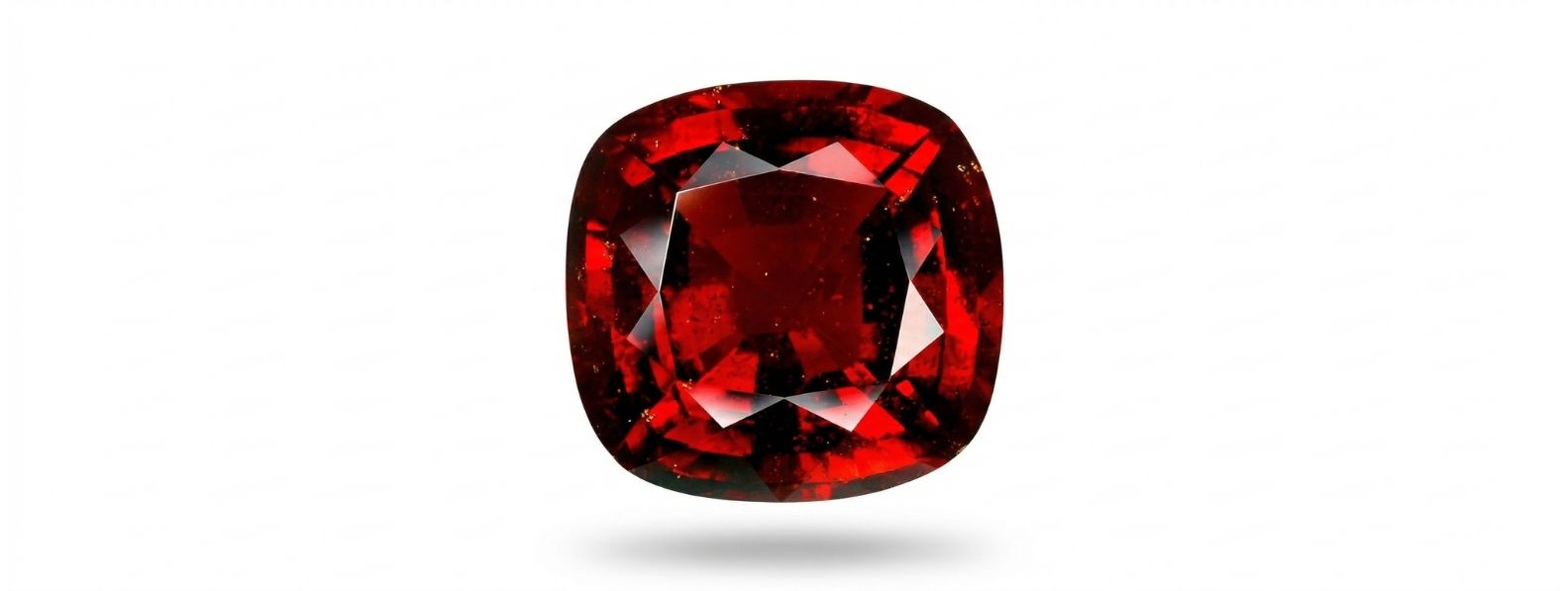
Understanding Hessonite Garnet Gemstone
Hessonite garnet has a longer history of human use than almost any other orange gemstone. Ancient Roman cameo cutters carved it into portraits and mythological scenes. Sri Lankan traders brought it to Arab and Indian markets along ancient gem routes. Indian Vedic astrologers assigned it a planetary role that still drives significant market demand two thousand years later. Modern spectroscopists have recently discovered that its most characteristic visual feature — the heat-wave effect — is the result of a polycrystalline microstructure unprecedented in single-crystal gemology. Few gemstones combine so many layers of interest: historical depth, cultural significance, scientific novelty, and a genuinely distinctive beauty that rewards careful examination.
Explore our hessonite garnet collection and related varieties including our grossular garnet collection and tsavorite garnet collection. For related guides see Grossular Garnet Guide, Tsavorite Garnet Guide, and the complete Garnet Gemstone Guide.
What Is Hessonite Garnet
Hessonite is an orange to reddish-orange to cinnamon-brown variety of grossular garnet, a calcium aluminum silicate mineral. Its chemical formula follows the grossular template Ca₃Al₂(SiO₄)₃, with color produced by ferric iron (Fe3+) and manganese (Mn2+) substituting within the crystal lattice. Ferric iron in the Y-site produces the orange and brown tones by absorbing blue and violet wavelengths; manganese in the X-site deepens the orange saturation. The precise balance and concentration of these substituting elements determines whether a stone displays pale golden yellow, rich honey-orange, classic cinnamon, or deep reddish-brown.
The name hessonite derives from the Greek "hēssōn," meaning inferior — an unflattering etymology that refers strictly to the stone's lower hardness (6.5 to 7 Mohs) and specific gravity (3.57 to 3.73) compared to other garnets then recognized, not to any visual shortcoming. The commercially far more popular name "cinnamon stone" reflects the characteristic warm orange-brown color of the finest Sri Lankan specimens, which closely matches the color of ground cinnamon. In Sanskrit and the Indian gemological tradition, the stone is known as Gomed, Gomedh, or Gomedhikam — names derived from a Sanskrit term referencing the color of cow's bile or fat.
Ancient History and Cultural Significance
Hessonite is one of the oldest continuously used gemstones in human jewelry history. In the ancient Greek and Roman world, orange to reddish gemstones were classified under the broad category "hyacinth" or "jacinth" — a term applied to several different orange gem species. Modern gemological reexamination of surviving classical carved gems has identified many pieces originally catalogued as zircon, jacinth, or brown tourmaline as hessonite garnet. The warm orange-brown color and the stone's availability in large, clean pieces made it particularly suited to the intaglio carving tradition that dominated Hellenistic and Roman gem use.
In South Asian gem history, hessonite's association with the Vedic astrological system significantly predates its modern gemological classification. Sanskrit texts from the first millennium CE reference Gomed as a powerful gem associated with the planetary node Rahu. Sri Lanka — historically called Ceylon and long recognized as the world's foremost gem island — has been supplying hessonite to Indian, Arab, and Southeast Asian markets for at least two millennia through established gem trading networks.
The Vedic astrological tradition has maintained hessonite's commercial relevance in the Indian subcontinent and diaspora in a way that has no parallel for other garnet varieties. While Western gemological demand for hessonite is primarily visual and collector-driven, South Asian demand is partially astrological — buyers seeking Gomed for Rahu remediation are often less focused on visual quality criteria and more focused on natural origin, absence of treatment, and astrological prescription compliance.
The Science of the Heat-Wave Effect
The heat-wave or treacly internal appearance of hessonite is its most famous and most scientifically interesting property. The effect has been observed and documented since the early days of gemological study, but its precise physical cause was only definitively established by research published in the journal Minerals in June 2025.
The 2025 study, using electron backscatter diffraction (EBSD) and energy-dispersive X-ray spectroscopy (EDS) on multiple hessonite samples, established that hessonite is not a single crystal — the form normally assumed for faceted gemstones — but a polycrystal composed of submillimeter-sized grossular granules with random crystallographic orientations. These granules are separated by micropores (tiny gaps) where crystal growth did not completely fill available space. Importantly, the study found only limited variations in iron and aluminum contents between granules, confirming that the heat-wave effect is not caused by compositional differences between adjacent crystal domains.
The optical consequence of this polycrystalline structure is that light entering the stone encounters multiple crystal boundaries with different orientations. At each boundary, the speed and direction of light changes slightly as it transitions between one crystallographic orientation and another. At the micropores, light reflects off granule surfaces and refracts within granules simultaneously. The cumulative result of these multiple interactions is the characteristic swirling, roiled light pattern observed as the heat-wave or treacly appearance — a visual effect that emerges directly from the stone's microstructural complexity.
This discovery places hessonite in a uniquely interesting position in gemology. Most faceted gemstones are single crystals. Hessonite, despite appearing as a faceted gem like any other, is fundamentally a mineral aggregate. The heat-wave effect that results from this structure is not an imperfection to be graded against — it is a distinctive optical phenomenon that is specific to this mineral and this formation environment. No other commercially significant faceted gemstone displays anything comparable.
Physical and Optical Properties in Detail
Hardness: 6.5 to 7 on the Mohs scale. Adequate for all jewelry applications. For daily-wear rings, settings that provide some protection to the girdle — such as bezels or gallery settings — are preferable to fully exposed prong configurations.
Refractive Index: approximately 1.734 to 1.759. The RI is higher than pure grossular (which would sit near 1.690) because the ferric iron content of hessonite raises the optical density of the material. Different hessonite specimens from different sources show slightly different RI values reflecting their iron content.
Specific Gravity: 3.57 to 3.73. Sri Lankan material with higher iron content tends toward the higher end of this range. This SG range is slightly higher than very pure grossular (3.49 to 3.57) due to the iron substitution.
Absorption Spectrum: Hessonite shows characteristic absorption bands at 407nm and 430nm, attributed to manganese in the crystal structure. These bands are diagnostically useful in separating hessonite from other orange gemstones. A broad strong band centered at 443nm in the deep blue is also present, associated with iron.
Optical Character: Singly refractive (isotropic), though anomalous double refraction is common in hessonite due to the polycrystalline structure and internal strain. Under the polariscope, hessonite frequently shows complex ADR (anomalous double refraction) patterns that reflect its polycrystalline nature.
Fluorescence: Hessonite typically shows inert to weak orange fluorescence under long-wave UV and inert to weak orange under short-wave UV.
Cleavage: None. Like all garnets.
Fracture: Conchoidal to uneven.
Luster: Vitreous to greasy. The polycrystalline structure contributes to a slightly diffused surface luster in some hessonite specimens, distinct from the sharper vitreous luster of single-crystal gemstones.
Formation Geology
Hessonite forms in the same broad geological environments as other grossular garnets: metamorphosed impure calcareous rocks and calc-silicate skarns. The specific conditions required for hessonite — high iron and manganese in a calcium-aluminum silicate environment — occur most commonly in regionally metamorphosed argillaceous limestones (impure calcium carbonate rocks with clay content) where iron-bearing minerals react with the calcium-aluminum silicate framework during metamorphism.
Sri Lanka's hessonite deposits occur within the ancient Highland Complex metamorphic terrain, one of the world's most gemologically productive geological units. The Highland Complex is a Precambrian granulite-facies metamorphic terrane that has been exposed by erosion over hundreds of millions of years, concentrating gem minerals in the alluvial gravel deposits of the Ratnapura district and surrounding areas. The hessonite in these gravels was originally formed within calc-silicate marble assemblages — metamorphosed limestone sequences that provided the calcium-aluminum silicate framework, with iron and manganese derived from associated metasedimentary rocks.
The polycrystalline nature of hessonite, now established by the 2025 EBSD study, likely reflects the growth conditions in these calc-silicate environments. Rapid crystallization from multiple nucleation sites, or crystallization under conditions that inhibited the growth of a single, large crystal, may produce the polycrystalline aggregate structure. The specific conditions that produce hessonite's polycrystalline character versus the single-crystal grossular of tsavorite deposits reflect differences in the rate of crystallization, fluid composition, and pressure-temperature conditions between the two environments.
Global Sources and Origin Characteristics
Sri Lanka (Ratnapura district and surrounding areas): The world's primary and most important hessonite source. Sri Lankan hessonite from the ancient alluvial gem gravels of the Sabaragamuwa Province produces material with the richest cinnamon-orange to honey color, strongest surface luster, and availability in sizes that frequently exceed 10 carats — unusual for any gem variety. The Sri Lankan material also tends to show the clearest, most visually appealing expression of the heat-wave effect, where the internal character is attractive and well-defined rather than murky. Sri Lanka supplies an estimated 40% or more of the world's commercial hessonite production at the premium quality level.
Tanzania (Umba Valley and Tunduru regions): Tanzania produces hessonite in the reddish-brown to orange-brown color range. Tanzanian hessonite can be attractive but tends toward richer, more brownish tones than the cinnamon character of Sri Lankan material. The Umba Valley in Tanzania is a multi-gem producing region, also yielding rhodolite, malaya, and color change garnet.
India (Rajasthan and Andhra Pradesh): India produces hessonite primarily consumed in the domestic Vedic astrological market. Indian material varies widely in quality, from excellent to heavily included, and is traded extensively within South Asia under the Gomed trade name. The astrological market's focus on natural origin rather than visual quality maintains demand for a wide range of Indian hessonite material.
Madagascar: Produces consistent volumes of hessonite in orange to brownish- orange tones. Madagascar material is accessible and available in the commercial market, typically priced below Sri Lankan equivalents.
Canada (Quebec): Quebec's metamorphic terrains have produced excellent hessonite including large, well-cut stones. The Smithsonian Institution holds hessonite from the Asbestos area of Quebec in sizes of 23.94, 13.40, and 8.50 carats.
Brazil and other sources: Brazil, California and Maine in the United States, and parts of Europe produce hessonite in limited quantities. These sources are primarily significant for mineral specimen collecting rather than commercial gem production.
Hessonite vs Other Orange Gemstones
Hessonite occupies a specific visual niche among orange gemstones that has no direct competitor. The warm, complex cinnamon-orange with internal heat-wave character is not replicated by any other stone.
Spessartite garnet (mandarin garnet) produces a brighter, purer, more vivid orange without hessonite's warm brown-red undertone or heat-wave texture. Spessartite is a single crystal with clear, sharp brilliance. The two stones are visually very different despite both being classified as "orange garnet."
Citrine is a yellow quartz that can overlap with pale hessonite in yellow-orange tones but lacks the warmth and depth of hessonite's color. At 7 Mohs hardness, citrine is actually harder than hessonite, but lacks hessonite's distinctive internal character.
Imperial topaz (orange-yellow to orange) is harder (8 Mohs) and more brilliant than hessonite but lacks the heat-wave character and is often treated. Fine orange sapphire produces a more intensely saturated orange but is substantially more expensive and often heat-treated.
For buyers specifically seeking the warm, glowing, cinnamon-character orange with natural polycrystalline depth, hessonite has no substitute.
Hessonite in Jewelry Design
Hessonite's warm orange-cinnamon tones pair naturally with yellow gold, creating a rich, warm combination that works beautifully in both vintage-inspired and contemporary designs. Rose gold also enhances hessonite's warm tones. White gold or platinum settings create an effective contrast but can make the stone appear slightly cooler — acceptable for designers seeking a more neutral presentation.
The stone's availability in larger sizes makes it practical for center-stone applications in rings, pendants, and statement earrings where tsavorite or demantoid of equivalent size would be prohibitively expensive. A 5-carat hessonite in excellent cinnamon color represents an accessible, distinctive, and entirely natural gemstone center stone at a price point that few other gems in the orange family can match.
Hessonite pairs well with contrasting gemstones. Deep red pyrope or almandine garnet creates a warm analogous palette. Tsavorite or peridot provides complementary cool contrast. White diamonds or colorless topaz in accent positions highlight hessonite's warm tone effectively.
Value and Market Pricing
Hessonite pricing reflects its position as a genuinely beautiful but commercially accessible natural gemstone. Fine Sri Lankan hessonite with rich cinnamon color, good luster, and reasonable clarity ranges from $15 to $200 per carat for standard commercial sizes of 1 to 5 carats. Stones above 10 carats in exceptional quality with vivid, even color and strong luster command $100 to $300 per carat. Very large stones above 25 carats in top quality are uncommon and reach higher prices on the collector market.
African material from Tanzania and Madagascar is generally priced 20% to 50% below Sri Lankan equivalents reflecting the color and luster difference. Indian material for astrological use covers a wide range from affordable commercial-grade stones to premium quality pieces, with pricing driven by natural origin certification and treatment-free status in addition to visual quality.
The depth of demand for hessonite from both the visual gem market and the Vedic astrological market provides a stable and multi-source commercial base that distinguishes it from most collector-oriented garnets.
Care and Maintenance
Hessonite requires no unusual care, though its polycrystalline structure warrants specific caution with ultrasonic cleaning. The vibration produced by ultrasonic cleaners can propagate through the micropores between crystal granules in hessonite's polycrystalline structure, potentially causing micro-fractures or loosening the internal fabric over repeated cleaning cycles. Warm water, mild soap, and a soft brush are entirely adequate and far safer for hessonite. Steam cleaning is not recommended.
Store hessonite separately from harder stones to prevent surface scratching. No oil treatment or re-treatment is required. The stone's color and internal character are entirely stable under normal conditions of wear and storage.
Buying Hessonite Garnet
When selecting hessonite, the primary evaluation criteria are color richness and luster. The stone should display a warm, saturated cinnamon-orange to honey-orange tone when viewed in natural light — not so pale it appears washed out, and not so dark it reads as brown rather than orange. Strong surface luster, which reflects directly in Sri Lankan material's reputation, is the secondary criterion. The internal heat-wave texture is expected and should be visible under direct light; a hessonite that appears completely clean and uniform without any internal movement would be unusual and worth examining carefully.
For astrological purposes, natural origin and complete absence of treatment are the primary requirements and should be verified by a reputable gemological laboratory report, particularly for stones intended for prescriptive astrological wear in significant carat weights.
Browse our hessonite garnet collection or explore related guides: Grossular Garnet Guide, Tsavorite Garnet Guide, Spessartite Garnet Guide, and the complete Garnet Gemstone Guide.