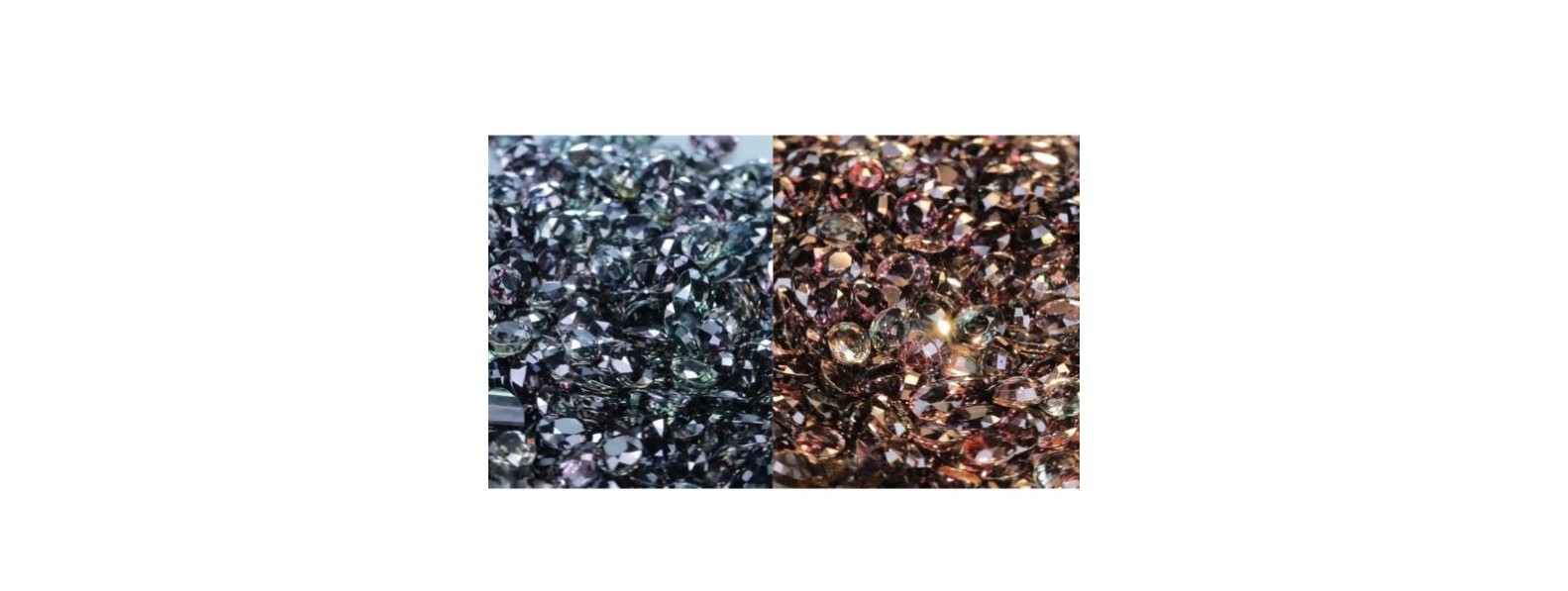
Color Change Sapphire – Chromium Vanadium Phenomenon in Corundum
Color change sapphire represents one of the most scientifically fascinating phenomena in corundum gemology — a natural variety of sapphire whose trace element composition creates a spectral absorption profile that interacts differently with daylight and incandescent light, producing a clearly visible and sometimes dramatic shift in the color perceived by the human eye. Documented from multiple sources including Sri Lanka, Madagascar, and Tanzania, color change sapphire combines the color-change optical phenomenon with corundum's exceptional hardness of 9 — making it one of the few gemstones that offers both a remarkable natural optical effect and genuine practical durability for everyday jewelry. This guide covers the corundum mineralogy, the chromium-vanadium color change mechanism, sources, treatment landscape, and value factors for color change sapphire in the professional market.
Explore our natural color change sapphire collection from Sri Lanka, Madagascar, and Tanzania.
Mineral Composition and Physical Properties
Color change sapphire is a variety of corundum — aluminum oxide (Al₂O₃) — the same mineral species as blue sapphire, ruby, padparadscha, and all other sapphire colors. Corundum belongs to the trigonal crystal system and forms typically barrel-shaped, bipyramidal, or tabular crystals. The defining characteristic of the sapphire name within corundum is the absence of the red color that would qualify the stone as ruby — all non-red gem corundum is sapphire, regardless of color.
Corundum measures 9 on the Mohs hardness scale — the second hardest natural mineral after diamond (10). The specific gravity is 3.99 to 4.01. The refractive index is 1.762 to 1.770, birefringence 0.008. These physical constants are consistent across all sapphire varieties including color change material. The exceptional hardness and lack of cleavage make corundum one of the most durable gemstone species available for all jewelry applications.
The Color Change Mechanism
The color change in sapphire is produced by the simultaneous presence of chromium (Cr³⁺) and vanadium (V³⁺) as trace impurities within the corundum crystal lattice. Each element creates a distinct absorption band in the visible spectrum. Chromium absorbs strongly in the yellow-green region, which in pure form would produce a red or pink color (as in ruby). Vanadium absorbs in both the green and red regions. The combined effect of these two overlapping absorption profiles creates a transmission window that spans both the blue-violet region and the red-orange region simultaneously.
The human visual system's response to this dual transmission window is highly sensitive to the spectral composition of the illuminating light. Daylight and fluorescent light are relatively rich in short-wavelength blue and green photons — under these conditions, the eye perceives the stone as blue to violet-blue. Incandescent light is deficient in short wavelengths and rich in long-wavelength red and orange photons — under these conditions, the chromium-driven component of the absorption profile dominates the visual response, and the eye perceives the stone as violet, purple, or reddish-purple. The result is a clearly visible color change that can be dramatic in strongly color-changing specimens.
Color Change Intensity Classification
Color change intensity in sapphire is typically described on a scale from weak through moderate to strong. Weak color change — a subtle shift that requires careful observation under controlled lighting to detect — is the most common grade and commands modest premiums over non-color-changing sapphires of similar color. Moderate color change — clearly visible under standard lighting transitions and producing a noticeably different color appearance — represents the commercially significant middle tier. Strong color change — a dramatic, vivid shift between clearly distinct colors that is immediately apparent to any observer moving the stone between light sources — represents the premium collector grade and commands the highest per-carat prices. The GIA and major gemological laboratories assess and document color change strength in certification reports, and this documentation is important for significant purchases.
Origins and Source Characteristics
Sri Lanka (Ceylon) is the historic benchmark source for color change sapphire, producing material with vivid blue-to-purple transitions and excellent clarity. Sri Lankan color change sapphires are typically well-formed crystals with high transparency and are found in the alluvial deposits of the gem-bearing gravels (illam) that have made Sri Lanka one of the world's most important sapphire sources for centuries. Sri Lankan origin with laboratory certification commands consistent premiums in the collector market.
Madagascar emerged as a major color change sapphire source following the Ilakaka rush in the late 1990s, producing large quantities of material across the full range of color change intensities and color combinations. Tanzanian material — particularly from the Umba Valley and Tunduru deposits — produces distinctive color change sapphires with unusual color shift combinations including teal-to-red and green-to-brownish-red changes that are scientifically interesting though less commercially mainstream than the blue-to-purple shift. Minor production comes from Myanmar, Australia, and various East African localities.
Treatment Landscape
Heat treatment is the standard and universally accepted treatment for sapphire across all color varieties. Heating at high temperatures dissolves silk inclusions, improves transparency, and can refine or enhance color. The color change property itself cannot be created by heat treatment — it is an intrinsic characteristic of the stone's trace element composition. Heat treatment may, however, affect the intensity or character of an existing color change in some stones. Unheated color change sapphires — confirmed by laboratory testing through the presence of intact silk and other heat-sensitive inclusions — command substantial premiums over heat-treated material, particularly in fine quality above 3 carats. Beryllium diffusion treatment, fracture filling, and other more invasive treatments are occasionally encountered and must be disclosed. GemPiece provides explicit treatment disclosure and recommends laboratory certification for all significant color change sapphire purchases.
Clarity Characteristics
Color change sapphire is a Type II gemstone — inclusions are expected but eye-clean material is available and represents the commercial standard for faceted stones. Common inclusions include silk (fine rutile needles), fingerprints, crystals, and growth zoning. Unheated sapphires typically retain intact silk inclusions — their presence under magnification is used by gemological laboratories as evidence of unheated status. Eye-clean unheated color change sapphire combines the premium treatment attribute with visual clarity, representing the highest combined value tier.
Value Factors
Color change intensity is the primary value determinant — strong, vivid shifts command exponentially higher prices than weak shifts. Origin is the second factor — Sri Lankan material commands the strongest premiums followed by fine Madagascar material. Treatment status is critical — unheated certification can double or triple the price of an equivalent heat-treated stone above 3 carats. Clarity, cut quality, and size complete the value picture. Fine unheated color change sapphire above 3 carats from Sri Lanka with strong blue-to-purple shift and GIA or equivalent laboratory certification is a genuine collector-grade gemstone.
Care and Maintenance
Corundum's hardness of 9 makes color change sapphire highly resistant to scratching and suitable for all cleaning methods. Ultrasonic and steam cleaning are safe for untreated and heat-treated stones without fractures or fillings. Avoid ultrasonic cleaning for fracture-filled material. Warm water, mild soap, and a soft brush are the universal safe cleaning method. Store separately from other gemstones to avoid contact with diamond.
Explore Related Color Change and other Corundum Gemstones
Collectors of color change gemstones may also appreciate diaspore (view collection), color change garnet (view collection), and star sapphire (view collection).