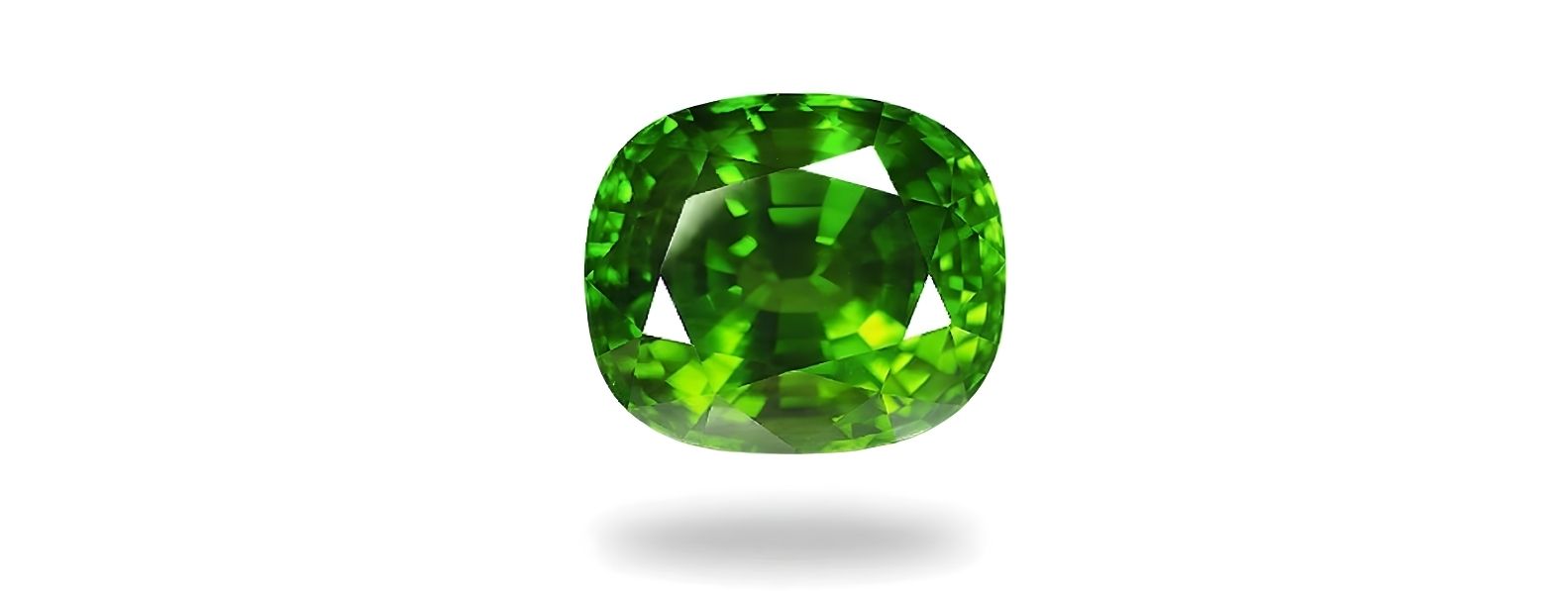
Green Tourmaline Color, Composition and Sources
Green tourmaline holds a unique commercial position in the gemstone world. It is simultaneously one of the most widely available green gemstones and one of the most genuinely beautiful, offering a color range broad enough to satisfy every green preference from the most delicate mint to the deepest forest, in material that is consistently cleaner in clarity than most other green gems at comparable price points. Understanding what makes fine green tourmaline genuinely valuable, and how to identify it, requires understanding both the color chemistry that drives its range and the geological and commercial landscape of its production.
Explore our green tourmaline collection and related varieties including chrome tourmaline, Paraiba tourmaline, and bi-color tourmaline. For related guides see Chrome Tourmaline Guide, Paraiba Tourmaline Guide, Pink Tourmaline Guide, and the complete Tourmaline Gemstone Guide.
What Is Green Tourmaline
Green tourmaline is the commercial designation for elbaite tourmaline displaying green as the dominant body color, where the green is produced primarily by iron rather than by chromium, vanadium, or copper. The gemological trade name verdelite, from the Italian "verde" meaning green, applies specifically to this iron-colored green variety and distinguishes it from chrome tourmaline (chromium/vanadium colored) and from Paraiba tourmaline (copper colored), both of which may also appear green but through completely different chromophore mechanisms.
The chemical distinction matters because different chromophores produce different qualities of green. Iron-based green in tourmaline produces the wide, naturally variable range from pale mint through vivid forest green and blue-green. Chromium-based green produces the more concentrated, saturated, emerald-comparable green of chrome tourmaline. Copper-based green produces the neon, self-luminous quality of Paraiba. All three are green tourmalines in the broad sense; only the iron-colored variety is verdelite in the strict trade sense.
Most commercial green tourmaline belongs to the elbaite species (Na(Li,Al)Al₆Si₆O₁₈(BO₃)₃(OH)₄). Some East African green tourmaline, particularly material produced in geological environments associated with metamorphic rocks rather than pegmatites, belongs to the dravite species (NaMg₃Al₆Si₆O₁₈(BO₃)₃(OH)₄). Dravite-based green tourmaline tends toward more brownish or yellowish green tones and is less commonly seen in the premium colored gemstone market.
The Iron Color Chemistry of Green Tourmaline
Iron in two oxidation states produces the color of green tourmaline through two overlapping mechanisms. Divalent iron (Fe²⁺) in the Y-crystallographic site of the elbaite structure produces absorption in the near-infrared and parts of the red spectral region through d-d electron transitions, contributing bluish-green to greenish color. Trivalent iron (Fe³⁺) produces absorption in the blue-violet region, contributing yellow to brownish components that mix with the Fe²⁺ blue-green absorption.
The ratio of Fe²⁺ to Fe³⁺ determines the specific green tone. Higher Fe²⁺ content relative to Fe³⁺ pushes the color toward blue-green and teal. Higher Fe³⁺ content pushes toward yellowish-green or olive. When Fe²⁺ and Fe³⁺ are both present in nearby crystallographic sites, an additional mechanism called intervalence charge transfer (IVCT) operates, where photons trigger electron transfer between adjacent iron ions, producing additional absorption in the yellow-orange region that further enriches the green color.
This multi-mechanism color production explains why green tourmaline exhibits such a wide range of tones even within the iron-colored category, and why the specific Fe²⁺/Fe³⁺ ratio matters practically for the resulting color quality. It also explains why heat treatment can be effective for some green tourmalines: heating in specific atmospheric conditions modifies the Fe²⁺/Fe³⁺ ratio, shifting the color balance toward a more attractive tone.
The Chrome vs Verdelite Boundary
The commercial boundary between green tourmaline (verdelite) and chrome tourmaline is defined by which chromophore dominates the stone's color. When iron dominates, the stone is verdelite; when chromium or vanadium dominates, it is chrome tourmaline. In practice, many East African green tourmalines contain both iron and trace chromium or vanadium, producing color that falls somewhere between the two commercial categories.
The Chelsea filter test is the most practical field tool for assessing this boundary. A strong red reaction under the Chelsea filter confirms significant chromium or vanadium content and indicates chrome tourmaline. A green reaction confirms iron dominance and indicates verdelite. Stones with a weak or ambiguous Chelsea reaction fall in the transitional zone and may have intermediate color quality between typical verdelite and typical chrome tourmaline.
From a value perspective, this transitional material is interesting: it may achieve near-chrome-tourmaline color at verdelite-level pricing, because the market's chrome tourmaline premium requires a confirmed Chelsea filter response. Buyers who evaluate stones by visual color quality rather than Chelsea filter response may find excellent value in high-quality iron-colored green tourmaline that approaches chrome character without the full chromium chemistry.
Physical and Optical Properties
Hardness: 7 to 7.5 Mohs, placing green tourmaline above quartz and making it suitable for all jewelry types including daily-wear rings. The absence of cleavage provides additional practical durability.
Refractive Index: 1.624 to 1.644 for elbaite. The RI places green tourmaline in a range that produces good brilliance when well cut, particularly in lighter-colored stones where the green body color does not significantly mask the dispersion effects.
Specific Gravity: 3.02 to 3.20 for elbaite green tourmaline. Higher iron content in dravite-based material produces slightly higher SG.
Pleochroism: Distinct in green tourmaline. The stone typically shows a darker, more saturated green when viewed along the c-axis (crystal length direction) and a lighter, more yellowish or bluish-green perpendicular to the c-axis. This pleochroism is the primary challenge in cutting green tourmaline, as the orientation of the table relative to the c-axis determines the face-up color.
Clarity: Type I in the GIA clarity type system. Green tourmaline is usually eye-clean in the trade, which is a practical advantage over red and pink tourmalines that are almost always included. Eye-clean green tourmaline at good color quality is the market standard.
Fluorescence: Typically inert under UV. Some green tourmalines from specific localities show weak greenish or yellowish fluorescence under short-wave UV.
Global Sources in Detail
Nigeria (Oyo State and surrounding pegmatite belts) produces some of the most vivid green tourmaline available in the current market. Nigerian green tourmaline is known for strong color saturation that stands out relative to material from other sources. The stones tend toward vivid medium-to-dark green with good face-up color performance. Some Nigerian material contains trace copper and may be classified as Paraiba type after laboratory testing with LA-ICP-MS analysis.
Mozambique (Manica and Zambezia Provinces) produces green tourmaline in larger sizes with better clarity than some other African sources. Mozambique green tourmaline ranges from lighter tones through vivid saturated greens, and the availability of larger clean material makes it particularly important for fine jewelry applications requiring calibrated stones above 3 carats.
Congo produces green tourmaline with available sizes, though the material can present challenges during cutting due to internal structural features. GemPiece's in-house cutting expertise allows successful processing of Congo rough that less experienced lapidaries would find difficult to work.
Afghanistan (Nuristan and Kunar Provinces) produces the mint green tourmaline that has become strongly associated with Afghan origin in the collector and designer market. The light, clean, fresh mint tone is produced by lower iron concentrations than the deeper greens of African material, creating a distinct aesthetic that appeals to buyers seeking subtle elegance rather than bold saturation. Crystal clarity in Afghan material is typically excellent.
Pakistan produces green tourmaline similar in character to Afghan material, with lighter green to pale green-blue tones from pegmatites in the northern mountain regions. Pakistani material provides accessible pricing for mint-green aesthetic buyers.
Brazil (Minas Gerais and other states) produces green tourmaline across the full color range from light through deep, with a long commercial history and established supply chains. Some Brazilian green tourmaline achieves very fine deep blue-green color in larger sizes that commands premium pricing in the collector market.
Namibia, Tanzania, Kenya, Sri Lanka, Madagascar, the United States (California and Maine), and Russia all produce additional green tourmaline in varying qualities and quantities. Kenya and Tanzania produce the green tourmaline that occasionally contains sufficient chromium to qualify as chrome tourmaline.
Heat Treatment: Science and Practice
Heat treatment in green tourmaline modifies the Fe²⁺/Fe³⁺ ratio within the crystal structure by partially oxidizing or reducing iron ions depending on the atmospheric conditions during heating. In oxidizing conditions, Fe²⁺ converts to Fe³⁺, which can lighten overly dark stones and reduce the blue component, shifting color toward a more yellow-green or pure green. In reducing conditions, Fe³⁺ converts to Fe²⁺, which can deepen and enrich the blue-green component.
The practical application at GemPiece begins with rough evaluation. Each piece of green tourmaline rough is assessed for its natural color and estimated potential after cutting. If the natural color is already optimal, the stone is cut without heating. If the rough shows an undesirable color that would respond to heating, it is heated before or after preforming, and then cut. This individual stone-by-stone decision process ensures that heating is applied only where it adds genuine value, rather than as a blanket practice applied to all material.
Heat treatment in green tourmaline is undetectable by any standard gemological test. Laboratories disclose treatment status based on the presence or absence of indicators, not from direct detection. Natural unheated green tourmaline commands a premium with collectors who prioritize natural stone integrity, particularly for Afghan mint material where the pale natural color is itself the aesthetic goal.
Cutting Green Tourmaline
Cutting green tourmaline well requires understanding three interacting factors: pleochroism, color distribution within the rough, and the target face-up appearance. The pleochroism of green tourmaline means that the table orientation relative to the c-axis directly determines the face-up color. For most green tourmaline, orienting the table perpendicular to the c-axis produces the lighter, brighter face-up appearance. For material that is naturally too pale, orienting the table toward the c-axis deepens the face-up color.
Color distribution in the rough also matters because green tourmaline commonly shows internal color zoning, with different zones of the crystal being more or less saturated or tinted differently. Skilled cutting works with this zoning to present the most attractive color in the face-up position while minimizing the visual impact of less attractive zones in the crown or pavilion.
At GemPiece, all green tourmaline is cut in our Bangkok workshop with full control over orientation, shape selection, and finishing. Step cuts and mixed cuts are used most commonly because they allow good color display and strong light return in a style that complements the transparency and clarity typical of green tourmaline.
Green Tourmaline vs Emerald and Tsavorite
Green tourmaline competes visually with emerald and tsavorite garnet in the green gemstone market and offers meaningful advantages over both in specific respects.
Compared to emerald: green tourmaline is almost universally eye-clean without any treatment, while most commercial emerald requires oiling or resin filling to mask pervasive natural fractures. Green tourmaline has no cleavage, making it more resistant to mechanical damage than emerald. The price per carat for comparable visual quality strongly favors green tourmaline, sometimes by a factor of ten or more at the medium-to-high quality level. The trade-off is that green tourmaline does not achieve the specific saturated, slightly bluish vivid green of top Colombian emerald, and it lacks emerald's centuries of cultural prestige.
Compared to tsavorite garnet: tsavorite achieves more concentrated, chromium-based green color that resembles the finest emerald more closely than iron-colored verdelite. Tsavorite is harder to find in sizes above 2 carats and is more expensive per carat at fine quality. Green tourmaline is available in much larger sizes and at more accessible prices, with comparable or better clarity. Buyers who want a large, clean, beautiful green gem at reasonable cost will typically find better options in green tourmaline than in tsavorite or emerald.
Value and Market Pricing
Standard commercial green tourmaline with decent color and eye-clean clarity: $25 to $100 per carat. Fine vivid green material with strong color balance and good transparency: $100 to $300 per carat. High-quality vivid blue-green or deep forest green in large clean sizes: $300 to $1,000 per carat. Exceptional large stones above 5 carats in vivid color with excellent cut quality: $1,000 to $5,000 per carat in the finest collector market examples. Afghan mint green in fine quality: $50 to $200 per carat for its specific aesthetic category.
Buying Green Tourmaline
When evaluating green tourmaline, assess the face-up color first under natural daylight or a daylight-equivalent light source. The stone should show a clean, attractive green without appearing dark, closed, brownish, or grayish. A stone that shows vivid open color in the dealer's directional light box but appears muddy or dark under natural room lighting is not a fine stone regardless of how it looks at purchase.
Use a Chelsea filter if available to check for chromium content. A red reaction confirms chrome tourmaline; a green reaction confirms iron-colored verdelite. For stones in the price range where the distinction matters, this quick test helps ensure you are paying the appropriate price for the actual material.
Examine clarity face-up under natural light. Green tourmaline should be eye-clean to the standard for a Type I gemstone. Inclusions visible without magnification at normal viewing distance represent a quality level below the variety's norm and should be reflected in pricing. Browse our green tourmaline collection or explore related guides: Chrome Tourmaline Guide, Paraiba Tourmaline Guide, Blue Tourmaline Guide, and the complete Tourmaline Gemstone Guide.