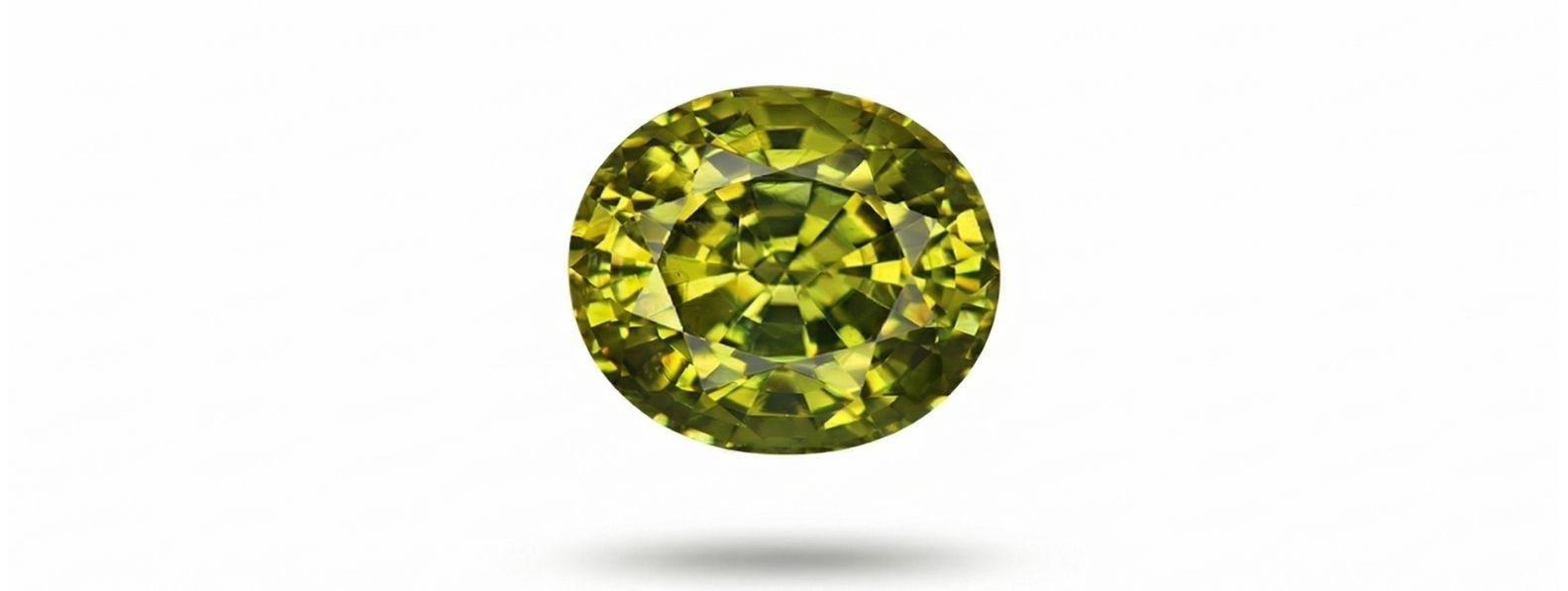
Understanding Grossular Garnet Gemstone
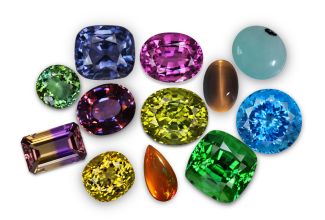
Grossular garnet is one of gemology's most instructive examples of how a single mineral species can produce radical visual diversity through chemistry alone. The same crystal lattice framework that holds calcium and aluminum in a colorless configuration accepts chromium and vanadium to produce tsavorite's intense emerald-quality green, accepts iron and manganese to produce hessonite's warm cinnamon-orange, and produces pale mint greens, golden yellows, and rare pinks from other trace element combinations — all within one species identity. Understanding grossular means understanding how this chemical flexibility translates into the commercial varieties buyers encounter by their trade names.
Explore our grossular garnet collection, tsavorite collection, and hessonite collection. For individual variety guides see Tsavorite Garnet Guide, Hessonite Garnet Guide, and the complete Garnet Gemstone Guide.
What Is Grossular Garnet
Grossular is a calcium aluminum silicate mineral with the ideal end-member formula Ca₃Al₂(SiO₄)₃. It belongs to the ugrandite series of the garnet group — the calcium-dominant series that also includes andradite and uvarovite. The calcium ion in the X-site of the grossular crystal lattice is substantially larger than the magnesium and iron ions that occupy the X-site in the pyralspite garnets (pyrope, almandine, spessartite), which means that grossular and the pyralspite garnets have limited solid-solution mixing between them. Grossular does, however, mix freely with andradite (sharing calcium in the X-site), which is the basis for the grossular-andradite hybrid known as mali garnet.
The name grossular derives from the Latin botanical name "grossularia," meaning gooseberry (Ribes grossularia), after the pale yellowish-green color of the first specimens described from Siberia in the early 19th century. The mineral was formally recognized by German mineralogist Abraham Gottlob Werner in 1808. Hessonite varieties have been used in jewelry since antiquity — ancient Greek and Roman carved gems (intaglios) frequently used hessonite, sometimes incorrectly identified as zircon or jacinth in historical literature.
Chemical Composition and Structural Flexibility
The ideal grossular formula Ca₃Al₂(SiO₄)₃ is rarely encountered in pure form in natural specimens. Natural grossular almost always contains partial substitutions in both the X-site and Y-site that modify its color and optical properties. In the X-site, calcium can be partially replaced by ferrous iron, manganese, or magnesium, though calcium dominates. In the Y-site, aluminum can be partially replaced by ferric iron, chromium, or vanadium, and these substitutions are the primary source of grossular's color diversity.
Chromium (Cr3+) and vanadium (V3+) substituting for aluminum produce the intense green of tsavorite. Both chromophores create similar green absorption profiles — absorbing strongly in the red and violet regions while transmitting green — but in slightly different spectral positions, which is why tsavorite from different origins shows slightly different green tones depending on the Cr:V ratio. Higher chromium content tends toward deeper, cooler emerald-like green; higher vanadium produces brighter, slightly more yellowish green.
Ferric iron (Fe3+) in the Y-site absorbs blue and produces orange, yellow, and brown tones. As the iron content increases, hessonite's color deepens from honey-orange through cinnamon- orange to reddish-brown. Manganese (Mn2+) in the X-site contributes to deeper orange saturation. The characteristic absorption spectrum of hessonite shows bands at 407nm and 430nm associated with manganese — a spectroscopic fingerprint distinct from tsavorite's chromium-vanadium spectrum.
Crystal Structure and Physical Properties
Grossular crystallizes in the isometric (cubic) system, forming characteristic dodecahedral (12-faced) and trapezohedral (24-faced) crystals. Like all garnets, it is singly refractive — it does not split light into two rays, distinguishing it from doubly refractive stones. Some grossular specimens show anomalous double refraction under the polariscope, caused by internal crystal strain rather than true birefringence.
Hardness: 6.5 to 7.5 Mohs. The hardness varies slightly with composition; tsavorite tends toward 7 to 7.5 Mohs, hessonite toward 6.5 to 7 Mohs. Both are adequate for all jewelry types including daily-wear rings.
Refractive Index: 1.690 to 1.760. This is the lowest RI range of any commercial garnet species, reflecting grossular's calcium-aluminum composition which has a lower light-bending effect than the iron and manganese-rich pyralspite garnets. The RI increases as iron content increases — hessonite typically shows RI toward 1.734 to 1.759, while pure or near-pure grossular sits closer to 1.690 to 1.720.
Specific Gravity: 3.49 to 3.61. This is lighter than most other garnet species. Tsavorite sits at approximately 3.57 to 3.61. This lower specific gravity relative to, for example, demantoid (3.84) or spessartite (4.12 to 4.20) is a useful identification property.
Dispersion: 0.028. This is lower than demantoid (0.057) and similar to most other grossular-type garnets. Despite lower dispersion than andradite varieties, well-cut tsavorite produces strong brilliance because its typically high clarity allows light to travel freely through the stone without significant scattering.
Cleavage: None. Like all garnets.
Fracture: Conchoidal to uneven.
Luster: Vitreous to greasy. Tsavorite displays strong vitreous luster; hessonite's characteristic heat-wave texture gives it a slightly diffused, greasy-to-vitreous luster.
Formation Geology
Grossular garnet forms characteristically in metamorphosed impure calcareous rocks and in metasomatic skarn environments. The fundamental requirement is the coincidence of calcium-rich and aluminum-rich chemistry, which occurs most commonly when originally calcium-carbonate rocks (limestones and dolomites) are metamorphosed in the presence of aluminum-bearing silicate fluids.
In regional metamorphic settings, argillaceous (clay-bearing) limestones subjected to increasing pressure and temperature produce calc-silicate marble assemblages containing grossular alongside diopside, vesuvianite, wollastonite, and calcite. These are the environments that produce much of the world's hessonite and yellow grossular.
In contact metamorphic and metasomatic skarn settings, magmatic intrusions drive intense chemical reactions with surrounding carbonate rocks. Hot, chemically active fluids metasomatize the country rock, introducing silicon, aluminum, iron, and in specific geological environments, chromium and vanadium. Where chromium or vanadium are introduced in sufficient concentrations into a calcium-aluminum silicate environment, tsavorite grows. The Mozambique Belt of East Africa, where tsavorite is found, represents one of the most favorable geological terrains on earth for this specific combination of conditions.
The Mozambique Belt is an ancient orogenic (mountain-building) terrain stretching through Tanzania and Kenya, formed approximately 550 to 700 million years ago during the Pan-African tectonic event. The specific rock types that host tsavorite within this belt are graphitic gneisses and calc-silicate assemblages that formed from the metamorphism of originally marine sediments including organic carbon (the graphite) and calcium carbonate. The graphite (reduced carbon) created reducing conditions that kept chromium and vanadium in their trivalent states — the forms that substitute for aluminum in the garnet lattice and produce the green color. Without this specific combination of rock type, metamorphic grade, and trace element chemistry, tsavorite cannot form.
Grossular Garnet Varieties in Detail
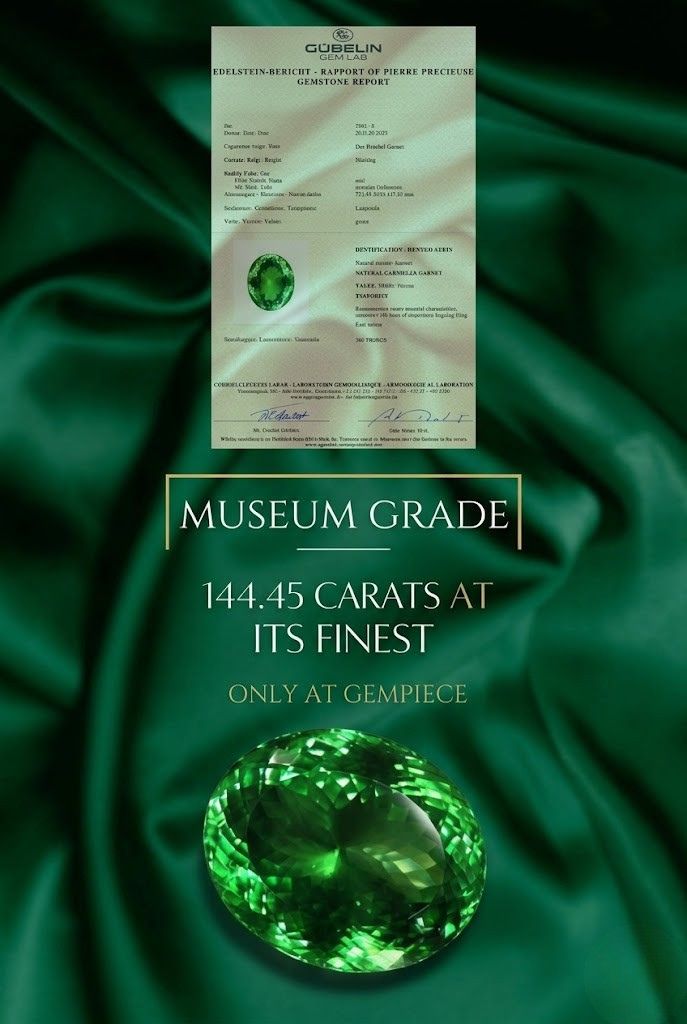
Tsavorite is the most commercially significant and most valuable grossular variety, introduced to the international gem market in the 1970s through the work of Campbell Bridges and Tiffany and Co. Its vivid green, entirely untreated, excellent clarity, and increasingly scarce supply position it as one of the most compelling colored gemstones in the world today. Read the complete scientific and commercial analysis in our Tsavorite Garnet Guide.
Hessonite is the orange to cinnamon-brown variety that has been used in jewelry since ancient Greece and Rome. Its characteristic heat-wave internal texture and warm glowing color distinguish it from all other orange gemstones. Sri Lanka is the benchmark source. It holds special significance in Vedic astrology as the Gomed stone associated with the planet Rahu. Read the full guide at our Hessonite Garnet Guide.
Mint grossular (merelani mint) is a pale green variety from Tanzania's Merelani Hills that has gained significant commercial attention in the 2010s and 2020s as jewelry designers sought alternatives to the more intensely saturated tsavorite green. The color is produced by lower concentrations of the same vanadium-chromium chromophores that color tsavorite, resulting in a softer, more pastel green. The Merelani Hills deposit is particularly notable because it produces both tanzanite and mint grossular from the same geological horizon — an extraordinary concentration of rare gem materials in one location.
Leuco garnet is an extremely rare colorless grossular variety. When a grossular crystal forms with minimal trace element contamination, the result is a transparent, colorless stone. Facetable gem-quality leuco garnet is very uncommon. Cut stones display good brilliance but lack the color appeal that drives most gemstone purchasing, making leuco garnet primarily a collector's curiosity. Notable leuco garnet specimens come from Quebec, Canada and a few other localities.
Hydrogrossular is a grossular variety where hydroxyl groups (OH) partially replace the silicate (SiO4) groups in the crystal structure, producing a mineral that is typically opaque to translucent rather than transparent. Hydrogrossular commonly forms massive aggregates in various colors including white, green (sometimes called "transvaal jade"), pink, and gray. It is used as a decorative stone but is not faceted as a gem in the conventional sense.
Rosolite is a translucent to opaque pink or purple variety of grossular found primarily in Guerrero and Oaxaca states in Mexico. Its pink to lavender color results from manganese substitution. While not commercially important as a faceted gem, rosolite crystal specimens are collected by mineral collectors for their distinctive coloration.
Global Sources and Their Characteristics
Kenya (Tsavo region and surrounding areas): The most historically important source of tsavorite, discovered by Campbell Bridges in the early 1970s. Kenyan tsavorite from deposits in Taita Taveta County and surrounding areas is known for producing some of the finest, most intensely colored material known. The geological environment is a classic graphitic calc-silicate sequence within the Mozambique Belt. Access to Kenyan tsavorite rough has become increasingly difficult as production from the most productive deposits has declined.
Tanzania (Multiple deposits): Tanzania produces tsavorite from multiple locations within the Mozambique Belt, most notably the Merelani Hills area (also the tanzanite source) and the Lemshuko deposit. Tanzanian tsavorite ranges from excellent quality material comparable to Kenyan stones to lighter, more mint-toned material that overlaps with the merelani mint designation. Tanzania is the primary source of mint grossular.
Sri Lanka: Sri Lanka's ancient alluvial gem gravels in the Ratnapura district and surrounding areas have produced hessonite for centuries. Sri Lankan hessonite is recognized globally as the benchmark for the variety, producing rich cinnamon-orange material in sizes from under one carat to over 100 carats in the gem gravels. The quality of Sri Lankan hessonite in terms of color richness and luster has not been consistently matched by other sources.
Canada (Quebec province): Quebec's metamorphic terrains have produced excellent hessonite material including large, well-cut stones. The Smithsonian Institution holds a Sri Lankan grossular of 64.2 carats and examples from Quebec above 20 carats exist in private collections.
Madagascar: Produces multiple grossular varieties including tsavorite quality material and hessonite. Madagascar has become an increasingly significant source in the global market.
Pakistan: Produces green grossular material from calc-silicate environments in the Himalayan metamorphic belt.
Grossular vs Emerald
The most commercially significant comparison in grossular gemology is between tsavorite and emerald. Both display vivid green, both are colored by chromium and vanadium, and both are presented as premier green gemstones in the fine jewelry market. The differences are substantial and favor tsavorite in several practical dimensions.
Emerald is a beryl variety (Be₃Al₂SiO₁₈) with hardness of 7.5 to 8 Mohs but with pervasive fracturing that makes it more fragile in practice than its hardness suggests. Most commercial emerald — from Colombia, Zambia, Brazil, or elsewhere — contains significant fractures (called jardin in trade terminology) that require filling with cedar oil, synthetic resins, or epoxy to improve apparent clarity and transparency. This treatment is industry standard for emerald and is accepted by the market, but it means the buyer is purchasing a treated stone with ongoing maintenance requirements.
Tsavorite is grossular garnet with hardness 7 to 7.5 Mohs. It forms without the pervasive fracturing that characterizes emerald. Most tsavorite achieves eye-clean to VVS clarity without any treatment. No filling, no oiling. The brilliance of a clean tsavorite typically exceeds that of a filled emerald of similar color because the tsavorite's uninterrupted crystal allows light to travel and reflect freely. For buyers who require a vivid green gemstone with complete natural integrity, tsavorite is the most compelling choice available.
Grossular Garnet in Jewelry
Grossular garnet works across all jewelry types and all metal colors. Tsavorite in white gold or platinum settings achieves the cool, vivid green presentation most comparable to emerald jewelry — a look that is now actively sought by designers who want natural, untreated greens. Tsavorite in yellow gold produces a warmer aesthetic that highlights the slightly warm undertone present in many Kenyan stones.
Hessonite's warm cinnamon-orange pairs naturally with yellow gold, creating a warm, rich combination that works beautifully in vintage-inspired and contemporary designs alike. Mint grossular in white gold or platinum produces a fresh, contemporary aesthetic for buyers seeking a pale green that reads as sophisticated rather than intense.
All grossular varieties are well-suited for rings due to adequate hardness and complete absence of cleavage. Their no-treatment status means no maintenance requirements beyond standard cleaning.
Value and Market Pricing
Grossular garnet value spans one of the widest ranges within any single garnet species, reflecting the dramatic difference between its most valuable variety (tsavorite) and its most affordable (yellow and brown grossular).
Fine tsavorite with vivid green and excellent clarity: $400 to $4,200 per carat for stones under two carats; prices rise steeply above two carats due to scarcity, with exceptional large stones commanding several thousand dollars per carat. Mint grossular with good saturation: $140 to $1,020 per carat. Yellow and orange grossular: $8 to $120 per carat. Hessonite in fine Sri Lankan quality: $15 to $200 per carat with larger exceptional stones reaching above this range.
Care and Maintenance
All grossular varieties are stable and require no special care beyond what is sensible for any quality gemstone. Clean with warm water, mild soap, and a soft brush. Rinse thoroughly and dry with a soft cloth. Avoid ultrasonic cleaners for hessonite (whose polycrystalline internal structure makes it more vulnerable to vibration damage than single-crystal stones). Steam cleaning is not recommended. Store separately from harder stones to prevent surface scratching. No oil treatment, re-treatment, or special maintenance is required for any grossular variety.
Buying Grossular Garnet
The buying criteria differ meaningfully between varieties. For tsavorite, evaluate color saturation and tone first — vivid, open green without excessive dark tone is the target. Clarity and cut quality drive the visual brilliance that distinguishes great tsavorite from adequate tsavorite. For hessonite, assess color richness and luster — the stone should glow with warm cinnamon character and display strong surface brilliance. The heat-wave internal texture is expected and not a flaw. For mint grossular, the color should be a clean, fresh pale green without brownish undertones.
All grossular varieties are untreated, so no treatment disclosure complexity applies. Browse our grossular garnet collection, tsavorite collection, and hessonite collection, or explore related guides: Tsavorite Garnet Guide, Hessonite Garnet Guide, Mali Garnet Guide, and the complete Garnet Gemstone Guide.