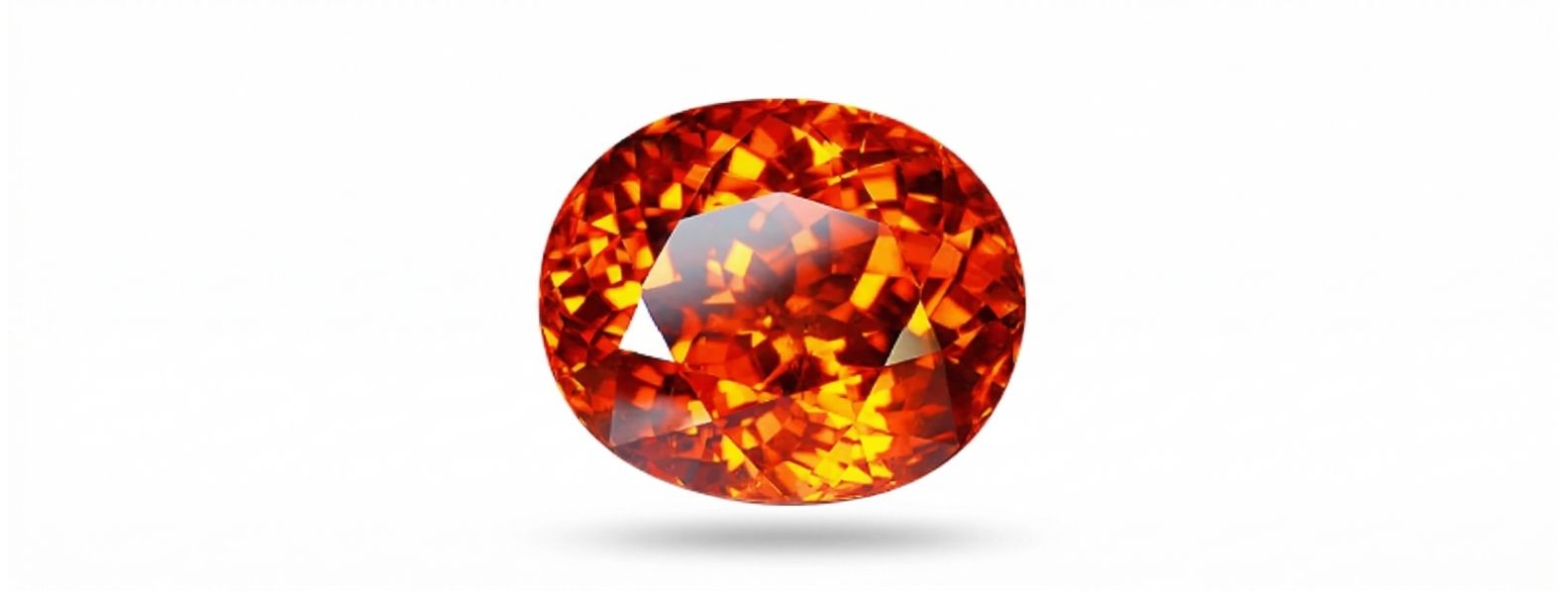
Understanding Spessartite Garnet
Spessartite garnet occupies a unique position in the natural gemstone world. It is the only widely available gemstone that produces a truly vivid, saturated orange as its primary color range — without enhancement, without treatment, without apology. When the mandarin garnets emerged from Namibia in the early 1990s, they changed the market's understanding of what a natural orange gemstone could look like. Before mandarin garnet, orange gems meant hessonite at modest saturation, Mexican fire opal, or heat-treated sapphire. After mandarin garnet, collectors had a new standard: pure, incandescent, natural orange that required nothing from a gemologist other than proper cutting.
Explore our spessartite garnet collection and related varieties including our malaya garnet collection and color change garnet collection. For related guides see Malaya Garnet Guide, Color Change Garnet Guide, and the complete Garnet Gemstone Guide.
What Is Spessartite Garnet
Spessartite (also correctly spelled spessartine — both spellings are accepted in gemological literature, with "spessartite" more common in the gem trade and "spessartine" the IMA-approved mineral name) is a manganese aluminum silicate garnet with the end-member formula Mn₃Al₂(SiO₄)₃. It belongs to the pyralspite series of the garnet group, alongside pyrope (magnesium-dominant) and almandine (iron-dominant). The mineral was first formally described from specimens in the Spessart Mountains of Bavaria, Germany, by German chemist Martin Klaproth in 1797, giving the variety its name.
What distinguishes spessartite chemically from its pyralspite relatives is its ideochromatic nature. In pyrope and almandine, the dominant cations (magnesium and iron respectively) are not themselves strongly chromophoric — color in those species comes from trace chromium, iron in specific oxidation states, and minor admixtures of other garnet species. In spessartite, the dominant cation, manganese (Mn2+), is itself the primary chromophore. Manganese in the Mn2+ oxidation state absorbs strongly in the blue and violet spectral regions, transmitting orange and red wavelengths, which is why spessartite's fundamental color is orange rather than red or colorless.
The Color Chemistry of Spessartite
Spessartite's color chemistry is elegant in its simplicity. Mn2+ ions in the Y-site of the garnet crystal lattice absorb light most strongly at approximately 412nm and 432nm (violet and deep blue), producing absorption bands that define the stone's spectral profile. The transmission window in the orange and red region (approximately 560 to 700nm) allows these wavelengths to pass through, creating the characteristic orange color that buyers see.
The purity and intensity of the orange depends on the concentration of manganese and the degree to which iron is absent. Pure spessartite with high Mn2+ content and minimal Fe2+ produces the most vivid, saturated, unmodified orange — the mandarin quality. As almandine content (Fe2+ in the X-site) increases, the iron's absorption characteristics add red and eventually brownish contributions to the transmitted color, shifting the stone from pure orange toward reddish-orange and eventually reddish-brown tones. The relationship between spessartite content and color purity is direct: higher spessartite percentage means more vivid, cleaner orange.
Absorption spectroscopy of spessartite shows the strong band below 445nm that masks two manganese lines at 432nm and 412nm, with the transmission window beginning abruptly at approximately 450nm and remaining open through the orange and red regions. This sharp spectral cutoff in the blue-violet is what gives fine spessartite its characteristic appearance under tungsten incandescent light: the warm wavelengths of incandescent illumination align perfectly with the spessartite transmission window, making these stones appear even more vivid and glowing under warm artificial light than in cooler natural light.
Physical and Optical Properties
Hardness: 7 to 7.5 Mohs. Excellent durability for all jewelry applications including daily-wear rings. No cleavage planes means spessartite resists chipping under impact.
Refractive Index: 1.790 to 1.820. This is the highest RI of the three pyralspite garnets, reflecting the higher atomic mass of manganese versus magnesium (pyrope) and the specific optical properties of the Mn-Al silicate framework. The elevated RI contributes to good brilliance in well-cut stones.
Specific Gravity: 4.12 to 4.20. Significantly higher than pyrope (3.65 to 3.80) and substantially heavier than grossular varieties (3.49 to 3.61). Manganese is a substantially heavier element than magnesium and slightly heavier than iron, explaining spessartite's position as the densest of the common pyralspite garnets. The high SG is a useful identification property distinguishing spessartite from orange hessonite (SG 3.57 to 3.73) and other orange stones.
Clarity: Most spessartite, particularly the orange varieties, contains eye-visible inclusions. Common inclusion types include needle-like minerals, fluid inclusions, healed fractures, crystal inclusions, and growth planes. Eye-clean spessartite exists but is uncommon and commands significant premiums. The Namibian mandarin garnet typically shows a characteristic "sleepy" appearance under magnification from numerous small crystal and needle inclusions — visible under loupe but not severely disrupting face-up beauty in the finest specimens. This sleepy character is somewhat analogous to hessonite's heat-wave effect: accepted as characteristic rather than condemned as a flaw.
Optical Character: Singly refractive (isotropic). No pleochroism.
Dispersion: 0.027 — similar to other pyralspite garnets. Produces adequate sparkle and brilliance in well-cut stones.
Cleavage: None, like all garnets.
Luster: Vitreous.
Formation Geology
Spessartite forms in manganese-rich geological environments — a requirement that significantly limits the number of deposits capable of producing gem-quality material. The specific environments where spessartite occurs include granitic pegmatites, metamorphosed manganiferous sediments, rhyolites, gneisses, and quartzites.
Granitic pegmatites are the most significant geological setting for large, clear spessartite crystals. Pegmatites are extremely coarse-grained igneous rocks that crystallize from the final, volatile-rich fractions of granitic magmas. The very slow crystallization in volatile-rich pegmatite environments allows crystal growth to large sizes with good transparency. The tourmaline pegmatites of San Diego County, California produced spessartite crystals up to 7 centimeters in diameter, and the Rutherford Mine in Amelia County, Virginia yielded a specimen weighing over 2,800 carats — the Rutherford Lady — demonstrating the scale of crystal growth possible in pegmatite environments.
The Namibian mandarin garnet deposit in the Marienfluss area of the Kunene Region occurs in a different geological context from typical pegmatite spessartite — it is associated with metamorphic rocks and alluvial secondary concentrations rather than primary pegmatite. The high purity of Namibian spessartite composition (minimal almandine contamination) reflects unusually favorable manganese-dominant chemistry in the regional metamorphic environment. The Nigerian spessartite deposits are associated with various metamorphic and metasomatic environments. The Tanzania Loliondo material occurs within the Mozambique Belt metamorphic terrain.
The Mandarin Garnet: Discovery and Market History
The history of mandarin garnet as a commercially significant gem variety began in the early 1990s when material from the Marienfluss area of Namibia's Kunene Region reached the international market. The initial stones were of extraordinary quality — vivid, pure orange with good clarity and available in sizes significantly larger than previously seen in fine spessartite. They generated immediate excitement among gemologists and dealers attending the major Tucson Gem and Mineral Show, where significant stones including a 29.77-carat cushion and a 14.77-carat triangular mix-cut were displayed in 1995, attracting international attention.
Early trade names for the new Namibian material included "hollandines" and "Kunene spessartines," but the name "mandarin garnet" — which evoked the stone's color directly and memorably — became the accepted designation. The International Colored Gemstone Association recognized the variety, and within the decade the mandarin garnet had transformed from an exotic novelty to a recognized premium gem category with its own collector base and established price structure.
The arrival of Nigerian spessartite in 1998 democratized the orange garnet market significantly. Nigerian material achieved near-pure spessartite composition (up to 95 mol%) with vivid color accessible at substantially lower prices than Namibian material. This influx, described by one prominent dealer as taking spessartite "from essentially a collector's stone into the realm of jewelry staple," allowed orange garnet to become a mainstream jewelry commodity while the finest Namibian mandarin material retained its premium position.
Global Sources in Detail
Namibia (Kunene Region, Marienfluss area): The original and most prestigious source of mandarin garnet. Average composition approximately 85 mol% spessartite, 12.5 mol% pyrope, 2.5 mol% grossular. Characteristic sleepy internal appearance from fine inclusions. Production peaked in the 1990s and has declined significantly. Current supply of fine Namibian mandarin above 2 carats is genuinely scarce.
Nigeria: The dominant commercial-volume source of affordable quality spessartite since 1998. Nigerian material achieves up to 95 mol% spessartite purity and displays vivid orange to reddish-orange colors. Some Nigerian stones show slightly deeper reddish tones reflecting small almandine admixture. Nigerian retail pricing for quality 1 to 4 carat stones is typically $100 to $250 per carat. Stones of 15 to 20 carats in exceptional quality can reach $900 per carat.
Tanzania (Loliondo and other areas): Produced significant spessartite from 2007 with composition close to Namibian material (approximately 77.5 mol% spessartite, 17.9 mol% pyrope, 4.6 mol% grossular). Tanzanian material provides an additional source of vivid orange at competitive prices within the Mozambique Belt gemstone production region.
Madagascar: Produces spessartite including some mandarin-quality material. Madagascar is a significant multi-gem source for the East African and Indian Ocean region.
United States (California, Virginia): San Diego County, California (Little Three Mine, Ramona area) has produced historically important spessartite in both gem and specimen quality. Amelia County, Virginia produced the famous Rutherford Lady, a 2,800+ carat specimen. American material is primarily of historical gemological significance.
Brazil, Sri Lanka, Myanmar, Mozambique: All produce spessartite in various quantities and qualities for the commercial market.
Spessartite, Malaya, and Color Change: Understanding the Family
Spessartite garnet is the parent species from which two important commercial varieties derive through hybridization with other garnet species. Understanding these relationships prevents confusion between related materials.
Malaya garnet is a pyrope-spessartite-almandine mixture in which no single species dominates as strongly as spessartite does in standard spessartite. Where spessartite averages 85 mol% or more spessartite component, malaya has compositions where pyrope may approach equality with spessartite or even dominate. The visual result is a shift from pure orange toward the peach, pinkish-orange, and salmon tones that define malaya's commercial identity. See the Malaya Garnet Guide for full detail.
Color change garnet is typically a pyrope-spessartite mixture where trace chromium and/or vanadium creates the selective absorption responsible for the color change effect. These stones share compositional overlap with both spessartite and malaya but are specifically selected for their color-change quality rather than for any fixed color in one lighting condition. See the Color Change Garnet Guide for full detail.
Spessartite in Jewelry
Spessartite garnet is well suited to all jewelry applications. Its hardness of 7 to 7.5 Mohs and complete absence of cleavage make it durable for rings, earrings, pendants, and bracelets including daily-wear pieces. The vivid orange color actually improves under incandescent light — the warm wavelength dominance of tungsten illumination aligns perfectly with spessartite's transmission window, making it even more vivid and glowing in warm restaurant lighting than in cool daylight. This is an important characteristic to demonstrate to prospective buyers.
Spessartite's orange color creates striking contrast with yellow gold settings, where the complementary warmth of both stone and metal creates a rich, opulent combination. In white gold or platinum, the cool metal makes the orange more vivid by contrast. Rose gold offers an intermediate combination that reads as modern and sophisticated.
Given that most spessartite contains some visible inclusions, setting styles that offer slight protection to the stone without obscuring it are preferable for daily-wear rings. Bezels and half-bezels provide good protection while maintaining visual access to the stone's color from all directions.
Value and Market Pricing
Fine Namibian mandarin garnet: $200 to $800 per carat for 1 to 2 carat stones; $800 to $2,400 per carat above 2 carats; premium collector pricing for fine stones above 5 carats reflecting genuine scarcity. Nigerian spessartite in fine vivid orange: $100 to $250 per carat for 1 to 4 carat range; $400 to $900 per carat for 15 to 20 carat exceptional stones. Eye-clean material across all sources commands premiums of 50% to 200% over included material of equivalent color, reflecting the rarity of clarity in this species. All spessartite is entirely untreated.
Care and Maintenance
Spessartite requires standard garnet care. Clean with warm water, mild soap, and a soft brush. Avoid ultrasonic cleaners for stones with visible inclusions — the rapid vibration can propagate from existing inclusions into the surrounding crystal. Steam cleaning is not recommended. Store separately from harder stones to protect the polished surface. Color and properties are entirely stable.
Buying Spessartite Garnet
Color purity is the primary criterion for spessartite evaluation. The ideal mandarin garnet displays a vivid, clean orange with no visible brownish undertone in natural or incandescent light. Any brownish cast indicates higher almandine (iron) content and reduces the stone's appeal relative to purer orange material. Clarity is the secondary factor: eye-clean spessartite is rare and commands significant premiums, but lightly included stones with strong color can represent excellent value. Cut quality affects how effectively the stone's brilliance and color are displayed — a well-proportioned cut maximizes both.
Browse our spessartite garnet collection or explore related guides: Malaya Garnet Guide, Color Change Garnet Guide, Hessonite Garnet Guide, and the complete Garnet Gemstone Guide.