
Understanding Montebrasite Gemstone
Montebrasite is the hydroxyl-dominant endmember of the amblygonite-montebrasite solid-solution series, a rare lithium aluminum phosphate mineral of formula LiAlPO₄OH that forms transparent, gem-quality crystals in pale yellow-green, near-colorless, and pale pink from lithium- and phosphate-rich granite pegmatites across Brazil, France, the United States, Pakistan, Namibia, Rwanda, and other global localities. Pronounced mon-tee-BRAH-site, the mineral was first formally described in 1871 and named after the Montebras Mine in the Creuse department of France, the type locality that provided the reference specimens defining the hydroxyl-dominant endmember composition. Montebrasite is, according to current mineralogical understanding documented at Mindat.org and in peer-reviewed geochemical literature, the most abundant member of the amblygonite-montebrasite group in most pegmatitic crystal-pocket environments, meaning that it is, paradoxically, simultaneously more common as a mineral endmember and more systematically underrepresented in the gem trade than its companion amblygonite.
This comprehensive montebrasite gemstone guide covers the complete mineralogy and crystal chemistry of the amblygonite-montebrasite series, how montebrasite is correctly distinguished from amblygonite, its color origin and variety including the landmark GIA 2023 Rwanda blue discovery, geological formation in LCT pegmatites, world sources with full geological context, complete gemological property data, collector value factors, and care, providing the most detailed and accurate montebrasite reference available in the English-language gemstone market.
Explore our montebrasite collection and amblygonite collection. For the companion mineral, see our amblygonite gemstone guide. Explore other rare gemstones at GemPiece.
Mineralogy and the Amblygonite-Montebrasite Series
Montebrasite belongs to the phosphate mineral class, amblygonite group, and forms a complete solid-solution series with amblygonite through continuous substitution of OH⁻ (hydroxyl) and F⁻ (fluorine) in the same structural site within the crystal lattice. The two defined endmembers are:
Amblygonite — LiAlPO₄F (fluorine dominant). First described by Breithaupt in 1817 from Ehrenfriedersdorf, Saxony, Germany.
Montebrasite — LiAlPO₄OH (hydroxyl dominant). First described in 1871 from Montebras, Creuse, France.
A crystal is classified as montebrasite when OH > F in the structural site and as amblygonite when F > OH. All intermediate compositions exist in nature. The crystal structure is identical for both endmembers, triclinic, space group P1̄, and all physical, optical, and gemological properties change only gradually across the series in proportion to the F/OH ratio. The result is that montebrasite and amblygonite are, for all practical gemological purposes, indistinguishable by standard laboratory methods available in the gem trade. Only Raman spectroscopy, analyzing the shift of the peak near 1060 cm⁻¹, which moves proportionally to fluorine content per Rondeau et al. 2006 in The Canadian Mineralogist, or wet chemical analysis for fluorine can definitively assign a composition to either side of the series.
The practical significance of this indistinguishability is substantial. GIA researchers, Mindat.org mineralogists, and geochemical literature, notably London, Morgan & Wolf (2001) in American Mineralogist, have established that most crystal-pocket material from granite pegmatites is in fact compositionally montebrasite, because the late-stage aqueous fluids responsible for crystal pocket formation are typically hydroxyl-dominant rather than fluorine-dominant. The gem trade's universal practice of calling all series material "amblygonite" is therefore an oversimplification that significantly underrepresents montebrasite's actual abundance and gemological identity. GemPiece is one of the very few commercial sources that identifies and lists montebrasite as a distinct category, reflecting a commitment to gemological accuracy that distinguishes our collection from the broader market.
Chemical Composition and Crystal Structure
Montebrasite: LiAlPO₄OH. The crystal structure is triclinic (space group P1̄), with Li⁺ in distorted octahedral coordination by oxygen atoms, Al³⁺ in AlO₄(OH) octahedra, with OH rather than F in the apical position, the key structural distinction from amblygonite's AlO₄F, and PO₄³⁻ tetrahedra linking the structure in three dimensions. The triclinic symmetry produces the complex cleavage geometry characteristic of the entire series: perfect cleavage on {100}, good cleavage on {110} and {011}, with all cleavage intersections at obtuse non-right angles, the "blunt angles" that give amblygonite its name and that both minerals share equally.
The OH vs. F substitution has measurable effects on physical properties: the specific gravity of montebrasite (~2.98) is slightly lower than amblygonite (~3.11) because the OH group has a greater effective ionic radius than F⁻, and the orientation of the optical indicatrix shifts with the F/OH ratio, providing the basis for the 2V optic axial angle measurement as a field estimate of composition, as established by Greiner & Bloss (1987) in American Mineralogist. Crystals of montebrasite can develop to impressive sizes in undisturbed pegmatite pockets, exceeding 1 meter in rare cases, though gem-quality transparent material suitable for faceting represents a small fraction of overall production.
Color Origin and Varieties
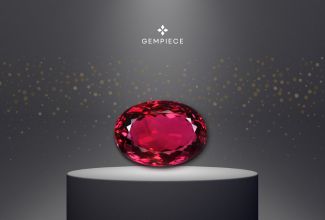
The color of gem-quality montebrasite is controlled by trace element impurities within the crystal lattice. Near-colorless to white montebrasite, the color most often associated with the montebrasite endmember in trade literature, reflects essentially pure LiAlPO₄OH composition with negligible trace element content. Pale yellowish-green and light green material, most characteristic of montebrasite as distinct from amblygonite's warmer pale yellow, is attributed to trace Fe²⁺ in a structural coordination that produces cool green rather than warm yellow absorption. Pale pink montebrasite results from trace Mn²⁺ substitution, the same mechanism responsible for pink coloration in lepidolite, certain tourmalines, and other lithium-bearing minerals from LCT pegmatite environments.
The most remarkable recent development in montebrasite color documentation is the blue material from the Buranga pegmatite near Gatumba, Rwanda, formally documented by GIA researchers Wim Vertriest and Gil Yuda in Gems & Gemology Winter 2023. Raman spectroscopy at GIA's Bangkok laboratory confirmed the host mineral as a near-pure montebrasite, with peak positions at 1052 cm⁻¹ or lower, indicating very low fluorine concentration. The blue color was attributed not to intrinsic lattice coloration but to small inclusions of scorzalite [(Fe²⁺,Mg)Al₂(OH,PO₄)₂], a deep blue secondary phosphate mineral, distributed through the creamy white montebrasite matrix. This inclusion-based blue mechanism is entirely distinct from the trace-element lattice color centers responsible for other gem variety colors and represents one of the most scientifically unusual color mechanisms documented in the phosphate gem family. The discovery significantly expanded the known color range of the entire amblygonite-montebrasite series and confirmed Rwanda's Buranga pegmatite as a source of exceptional collector-grade material.
Geological Formation and Occurrence
Montebrasite forms as a primary mineral in lithium-cesium-tantalum (LCT) enriched granite pegmatites, the most geochemically evolved and mineralogically complex type of pegmatite, characterized by extreme enrichment in Li, Cs, Ta, Nb, B, P, F, and other rare and incompatible elements excluded from earlier-crystallizing minerals. These pegmatites form during the final stages of granitic magma crystallization, when the residual melt reaches the saturation point for phosphate, fluoride, and lithium-bearing mineral phases. The LCT pegmatite environment is uniquely productive of gem minerals across all species: it is the geological source of Paraíba, rubellite, and indicolite tourmaline; aquamarine and morganite beryl; kunzite and hiddenite spodumene; and numerous collector minerals including montebrasite, amblygonite, lepidolite, columbite-tantalite, and complex secondary phosphates.
Within the pegmatite body, montebrasite occurs primarily in the core and core-margin zones where late-stage aqueous fluids have access to deposit large, well-developed crystals in open cavities. The geochemical reason for montebrasite's dominance over amblygonite in crystal pockets is straightforward: the late-stage pegmatitic fluids responsible for crystal pocket formation are typically water-rich and thus hydroxyl-dominant, favoring the OH-substituted montebrasite rather than the F-bearing amblygonite endmember. The relative fluorine activity of the pegmatitic fluid during formation is therefore the primary geological control determining whether any given crystal in the series is closer to amblygonite or montebrasite, and in the crystal-pocket environments that produce transparent gem-quality material, low fluorine activity and high water activity produce montebrasite.
World Sources: Geology and Gem Significance
France — Montebras, Creuse (type locality) — The historic Montebras Mine in the Creuse department of central France is the type locality for montebrasite, providing the reference specimens on which the 1871 formal description was based. The Montebras pegmatites are part of the Hercynian granitic belt of the French Massif Central and are associated with phosphate-rich LCT-type pegmatites. The locality carries both scientific significance and collector provenance premium. France is also historically connected to the related amblygonite species through early 19th-century European pegmatite mineralogy.
Brazil — Minas Gerais (primary commercial gem source) — The Minas Gerais pegmatite province is the world's most important commercial source for faceted amblygonite-montebrasite, with GemPiece's direct hands-on experience in both rough and faceted forms from Brazilian production confirming the full range of color and quality available. Documented localities include the Telírio claim near Linópolis, Divino das Laranjeiras, and numerous other pegmatite operations across the Jequitinhonha Valley and Araçuaí Orogen, the primary LCT pegmatite belt of Minas Gerais that also produces world-class tourmaline, aquamarine, and topaz.
USA — Newry, Oxford County, Maine — The Nevel Quarry and Bell Pit localities near Newry are among the most historically important North American sources for montebrasite documented in mineralogical literature, with multiple Mindat.org specimen records from this locality. Oxford County, Maine is also a world-class locality for tourmaline and beryl from the same LCT pegmatite province. Additional American montebrasite localities are known in South Dakota and California.
Pakistan — Gilgit-Baltistan, Braldu Valley — The Chhappu locality in the Braldu Valley of Shigar District, Gilgit-Baltistan is documented in Mindat.org locality data as a montebrasite source. Pakistan's Gilgit-Baltistan region hosts some of the world's finest LCT pegmatites and is globally recognized for exceptional aquamarine, tourmaline, and topaz production from the same geological environments.
Rwanda — Buranga Pegmatite, Gatumba (landmark blue material) — Confirmed by GIA Raman spectroscopy as near-pure montebrasite host, the Buranga pegmatite's extraordinary blue material reported in Gems & Gemology Winter 2023 places Rwanda firmly on the map for scientifically significant montebrasite. Rwanda's pegmatite belt, internationally known for columbite-tantalite (coltan) production, is an underexplored LCT province of growing importance to the collector gem market.
Additional documented sources include Namibia, Sweden, Finland, and Afghanistan, all within LCT pegmatite belts of their respective geological provinces.
Gemological Properties: Complete Data
Species: Montebrasite (amblygonite-montebrasite series). Chemical formula: LiAlPO₄OH. Crystal system: Triclinic (space group P1̄). Hardness (Mohs): 5.5–6. Specific gravity: ~2.98 (montebrasite endmember; amblygonite endmember ~3.11; intermediate compositions fall between these values). Refractive index: 1.578–1.611 (series range; individual stones fall within this range depending on F/OH composition). Birefringence: 0.020–0.027. Optic character: Biaxial; optic axial angle (2V) varies with F/OH ratio and provides a field estimate of series composition. Luster: Vitreous to resinous on crystal faces; pearly on cleavage surfaces. Transparency: Transparent to translucent. Cleavage: Perfect on {100}; good on {110} and {011}, multiple directions with obtuse intersections. Fracture: Subconchoidal to uneven. Streak: White. Color: Near-colorless, pale yellow-green, light green, white, pale pink; rarely blue (inclusion-based from scorzalite). Color mechanism: Fe²⁺/Fe³⁺ for yellow-green; Mn²⁺ for pink; scorzalite inclusions for blue. Treatment: None, fully natural and untreated. Fluorescence: Variable; weak green under long-wave UV; possible light blue phosphorescence under both UV wavelengths. Inclusions: Liquid inclusions, two-phase inclusions, parallel haze bands along cleavage planes, partially healed fractures, typically eye-clean in commercial material.
Collector Value Factors
Montebrasite's collector value is driven first by the accuracy of identification itself, a correctly identified and documented montebrasite, particularly from a known and historically significant locality, represents a level of gemological precision that generic trade "amblygonite" material does not. This identification premium is unique to montebrasite within the phosphate gem family and reflects the expertise of both the source and the collector.
Color is the primary aesthetic value driver. The pale yellowish-green to light green characteristic of montebrasite is most valued when distributed evenly without zoning or color banding inherited from the crystal growth structure. Near-colorless, eye-clean material carries collector value primarily on the basis of clarity and origin documentation. Pale pink montebrasite is rarer than green or colorless material and carries a premium accordingly. The extraordinary blue Rwanda material, confirmed montebrasite by GIA Raman spectroscopy and attributed to scorzalite inclusions, represents the absolute rarity extreme of the series and the most scientifically significant recent discovery in the phosphate gem family; faceted examples of this material, if they become available, would command exceptional collector premiums.
Clarity, cut quality, size, and provenance documentation follow in the value hierarchy. Eye-clean to near-loupe-clean material commands significant premiums over stones with visible parallel haze bands or liquid inclusions. Cut quality is particularly important for montebrasite, perfect cleavage makes faceting technically demanding, and expertly cut stones with crisp facets and no cleavage-related damage reflect premium lapidary skill. Large, well-colored, clean stones above 5 carats are genuinely rare; above 10 carats in fine quality, exceptional. Locality-documented material from Montebras, France; Newry, Maine; or Buranga, Rwanda carries provenance premiums over unprovenanced Brazilian commercial material.
Durability and Care
Mohs hardness 5.5–6 places montebrasite below quartz on the hardness scale, meaning that ordinary household dust, predominantly quartz particles, can abrade the surface of montebrasite over time. Perfect cleavage in multiple directions is the most significant durability concern: sharp impact in directions aligned with cleavage planes can produce clean cleavage breaks even in well-set stones. These properties require the same disciplined care approach as amblygonite, with which montebrasite shares all physical characteristics across the series.
Never use ultrasonic cleaners, transmitted vibration enters cleavage planes and can cause fracturing. Never use steam cleaners, thermal shock and pressure can exploit existing fractures and cleavage. Clean only with warm water, a small amount of mild soap, and a very soft brush applied with minimal pressure. Rinse gently with clean water and dry with a soft, lint-free cloth. Store in individual padded compartments, never in contact with harder gemstones including quartz, topaz, beryl, or corundum. In jewelry, always use protective bezel or flush settings and restrict use to low-impact applications: pendants, drop earrings, and brooches are strongly recommended; everyday open-prong rings are not.
Explore Companion and Related Gemstones
amblygonite (view collection), and explore other rare gemstones at GemPiece.