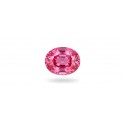

Ruby – Chromium Red Corundum, Pigeon Blood, Burma Origins and Value
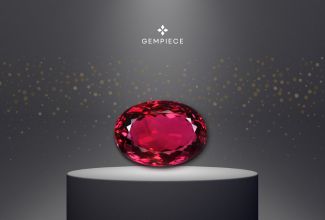
Ruby is the red variety of corundum — aluminum oxide (Al₂O₃) — and the only one of the four classical precious gemstones defined entirely by a single color. Every other color of gem-quality corundum is sapphire. The boundary between ruby and pink sapphire is drawn at a minimum saturation threshold: below it, a stone is pink sapphire; above it, ruby — and within the ruby range, the narrow band of vivid pure red that laboratories grade as pigeon blood red represents the apex of the entire colored gemstone value hierarchy.
Ruby's combination of chromium-driven red coloration, exceptional hardness (9 on the Mohs scale), and severe natural scarcity at fine quality makes it one of the most commercially significant gemstones in the world. Per-carat prices for fine unheated Mogok pigeon blood ruby have repeatedly set records at international auction — the Sunrise Ruby, 25.59 carats from Myanmar, sold at Sotheby's Geneva in May 2015 for USD 30.3 million, setting the world record price for any colored gemstone and any ruby ever sold at auction at the time.
This guide covers ruby's corundum mineralogy, the chromium color mechanism, the pigeon blood standard and its laboratory definition, the geology of the major producing origins and how it affects color and fluorescence, the complete treatment landscape, and the value factors professional gemologists and collectors use to evaluate ruby quality.
Explore our natural ruby collection with full treatment disclosure on every stone. Related varieties: star ruby, Burmese ruby, Mozambique ruby, pigeon blood ruby.
Mineral Composition and Physical Properties
- Mineral Species: Corundum — aluminum oxide (Al₂O₃)
- Variety: Ruby — the red variety; all other colors are sapphire
- Crystal System: Trigonal
- Hardness: 9 on the Mohs scale — second only to diamond
- Refractive Index: 1.762 to 1.770, uniaxial negative
- Specific Gravity: 3.99 to 4.01
- Birefringence: 0.008 to 0.010
- Cleavage: None — fractures conchoidally; no cleavage planes that could cause splitting
- Luster: Vitreous to adamantine
- Birthstone: July
- Anniversary Stone: 40th wedding anniversary
The Chromium Color Mechanism
Pure corundum is colorless. Ruby's red color is produced by chromium (Cr³⁺) substituting for aluminum (Al³⁺) in the crystal lattice — the two ions are similar in charge and ionic radius, allowing chromium to occupy aluminum sites within the corundum structure. Chromium absorbs strongly in both the blue-violet and yellow-green regions of the visible spectrum, leaving red as the dominant transmitted and reflected color.
Critically, chromium also causes strong red fluorescence under both long-wave and short-wave ultraviolet light — and in natural sunlight, which contains UV. This fluorescence adds additional red emission to the transmitted color, producing the characteristic glowing self-lit quality of fine Burmese ruby that distinguishes it from rubies colored by iron-chromium combinations. Iron, when present alongside chromium, partially quenches this fluorescence by absorbing the UV energy that would otherwise stimulate chromium emission. This is why low-iron marble-type rubies from Mogok fluoresce so intensely compared to high-iron basaltic rubies from Thailand — and why the Cr/Fe ratio is a core parameter in the GRS pigeon blood designation.
The boundary between ruby and pink sapphire is not chemical but colorimetric — both contain chromium, but the saturation must meet a minimum threshold to be classified ruby. GIA, GRS, and other major laboratories use standardized master stones and colorimetric measurement to make this determination.
The Pigeon Blood Standard — Laboratory Definition
Pigeon blood is the highest color quality designation in the ruby market. The term originated in the Mogok Valley of Myanmar, where miners described the finest rubies by their resemblance to the vivid red of the first drops of blood from a freshly killed pigeon — a color that is pure red without brown, orange, or strongly purple modification.
GRS (Gem Research Swisslab) introduced the first formal pigeon blood standard in 1996, with the first publicly noted pigeon blood certificate appearing at a Sotheby's London auction in June 1998. The GRS standard requires: vivid red color graded in daylight using master sets; high chromium content (approximately 0.3 to 0.5 wt% or higher); a Cr/Fe ratio greater than 1; and medium to strong UV fluorescence at 365nm. Gübelin Gem Lab and SSEF also issue pigeon blood quality designations using comparable criteria. GIA evaluates ruby color but does not use the pigeon blood terminology in standard GIA reports.
The pigeon blood designation is origin-independent — GRS applies it to qualifying rubies regardless of source. Roughly 20% of high-value vivid red Mozambique rubies tested at GRS receive the pigeon blood notation. However, a Burmese pigeon blood ruby commands a substantial additional origin premium over a Mozambique pigeon blood ruby of identical color grade because of Mogok's centuries of documented production, geological uniqueness, and severely constrained supply. A pigeon blood certificate is not a substitute for an origin certificate — both together represent the premium combination for collector-grade material.
Major Origins and Their Geology
Myanmar — Mogok Stone Tract
The Mogok Stone Tract in Mandalay Region, northern Myanmar, is the world's most historically significant ruby source. Ruby formed in marble-hosted metamorphic deposits — calcareous sediments recrystallized under high pressure and temperature — where the geological chemistry produced corundum with exceptionally low iron content. This low-iron environment allows chromium to dominate color expression and UV fluorescence without quenching, producing the characteristic Mogok glow. Mining is documented since at least the 6th century AD; the deposit was formally operated under British colonial administration from 1889 to 1931. Modern output is severely constrained. Fine unheated Mogok ruby above 3 carats represents the most valuable per-carat category of any natural colored gemstone.
Mozambique — Montepuez
Discovered in 2009 in Cabo Delgado Province in northern Mozambique, Montepuez has become the world's largest ruby-producing deposit by volume and the most commercially significant modern source. The geology is amphibolite-hosted — distinct from Mogok's marble — producing two chemically distinct ruby populations. Type A Montepuez ruby has low iron approaching Mogok chemistry, strong chromium content, and fluorescence capable of qualifying for pigeon blood designation. Type B has higher iron, stronger saturation in some color directions, but reduced fluorescence. Montepuez has fundamentally transformed global ruby supply, increasing the availability of large unheated stones and creating a new tier of collector material that did not exist before 2009.
Vietnam — Luc Yen and Quy Chau
Vietnam's marble-hosted ruby deposits produce material with chemical and optical characteristics resembling Mogok — low iron, high chromium, strong UV fluorescence. Fine Vietnamese pigeon blood ruby has received recognition at international auction. Supply is limited and origin documentation adds collector premiums.
Sri Lanka
Alluvial deposits in Sri Lanka's gem gravels produce ruby across a wide quality range. Top-grade Sri Lankan red in larger sizes can approach Mogok quality — the IGS notes that top-grade Sri Lankan reds are virtually indistinguishable from Mogok counterparts, though most commercial material trends toward pinkish-red. Strong fluorescence is common. Sri Lanka produces both faceted ruby and star ruby cabochon material.
Thailand and Cambodia
Basalt-related deposits with characteristically higher iron content produce darker, purplish-red material with very low UV fluorescence. Thailand has historically been the world's major ruby trading center rather than the primary quality source. Fine Thai material exists but does not command origin premiums comparable to Mogok or Mozambique.
Heat Treatment — The Most Important Commercial Variable
Over 95% of commercial ruby has been heat-treated. Heating dissolves the silk (rutile needle) inclusions that cause cloudiness, improves color saturation, and can convert brown-red material to vivid red through partial reduction of iron in the lattice. Heat treatment is permanent, universally disclosed on laboratory certificates, and accepted throughout the trade. A heated ruby with full laboratory documentation is a legitimate purchase priced accordingly.
Unheated ruby retains all original natural internal features — intact silk, fingerprints, unaltered growth zones — that heat treatment would modify or destroy. Laboratory gemologists detect unheated status by the presence of these features and the absence of heat signatures. For fine material above 2 carats, the unheated premium can be 3 to 10 times the price of an identical-appearing heated stone. For exceptional unheated Mogok pigeon blood material above 5 carats, the premium is effectively uncapped — there is no comparative market reference.
Lead glass filling is a lower-grade treatment that fills fractures in heavily included low-quality material with lead-rich glass. It dramatically reduces durability and is essentially incompatible with professional jewelry use. GemPiece does not carry glass-filled ruby.
Beryllium diffusion drives beryllium into the corundum lattice at extreme temperatures to lighten or alter color. All major laboratories test for this treatment and disclose it explicitly. Beryllium-diffused material is priced significantly below standard heated material.
Clarity in Ruby
Ruby is a GIA Type III gemstone — inclusions are expected in virtually all natural material. Completely eye-clean ruby is genuinely rare and commands premiums. Common inclusion types include rutile silk (the same needles that, in sufficient density and alignment, produce asterism in star ruby), fingerprints, crystals, growth zoning, and color banding. The presence of intact silk in an unheated ruby is simultaneously evidence of natural unheated status and a minor clarity deduction — the two factors must be weighed together. Major gemological laboratories document specific inclusion characteristics as part of their origin and treatment analysis.
Star Ruby
Star ruby displays asterism — a natural six-rayed star produced when rutile needle inclusions aligned in three sets at 60-degree angles reflect light simultaneously from the dome of a correctly cut cabochon. The rutile silk responsible for the star is the same material that heat treatment dissolves — which is why most fine star ruby is naturally unheated. The finest star rubies combine vivid body color with a sharp, well-centered six-rayed star and come primarily from Myanmar and Sri Lanka.
Ruby in Historical Context
Several of the most famous "rubies" in royal regalia were later identified as spinel — a separate mineral species historically indistinguishable from ruby without modern gemological testing. The Black Prince's Ruby in the British Imperial State Crown, the Timur Ruby, and the central stone of the Russian Imperial Crown are all spinel. This confusion is understandable given that fine spinel and ruby occupy the same color space and occur in the same geological environments. Modern gemological testing — refractive index measurement, spectroscopy, and specific gravity — definitively separates the two. Read about natural spinel as a collector alternative that is typically untreated and remains significantly undervalued relative to its optical quality.
Value Factors Summary
In order of commercial importance: color (pigeon blood vs vivid red vs lesser grades — the single largest value driver); treatment status (unheated with laboratory documentation commands the strongest premiums); origin (Mogok, then Mozambique and Vietnam for comparable quality); clarity (eye-clean to lightly included is standard; heavily included is discounted); cut quality; and carat weight (severe size premiums above 3 carats, exponential above 5 carats in fine quality).
Ruby Care
Hardness 9 with no cleavage makes ruby one of the most durable gems for all jewelry applications. Clean with warm water, mild soap, and a soft brush. Ultrasonic cleaning is generally safe for heat-treated ruby without fracture filling — avoid for glass-filled material. Remove before activities involving sharp impacts or strong chemicals. Store separately from other gemstones.
Explore Related Gemstones
Ruby variety guides: Burmese Ruby, Mozambique Ruby, Pigeon Blood Ruby, Star Ruby. Also explore natural sapphire — the same mineral species in every other color — and natural spinel — ruby's historic geological companion and finest untreated alternative.