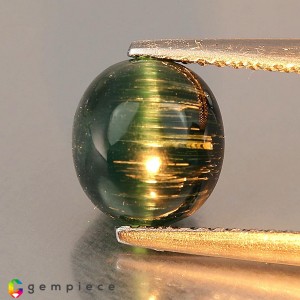
Buy best and quality tourmaline cats eye products
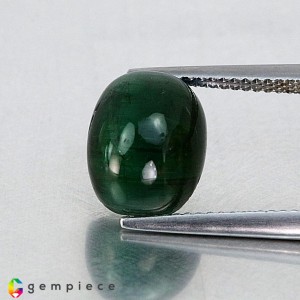
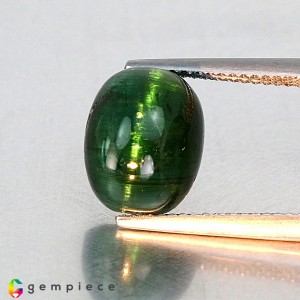
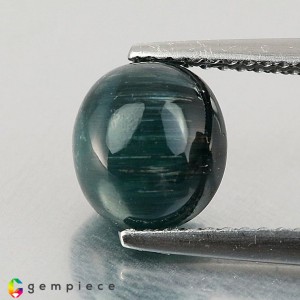
Tourmaline cats eye is a rare variety where tourmaline adds a second optical phenomenon to its already remarkable visual character. Tourmaline is already the mineral group with the widest color range in the gem world; in cats eye tourmaline, that color range exists within stones that also display chatoyancy, a bright luminous band of reflected light that moves across the surface of the cabochon as the stone or light source moves. The combination of tourmaline's vivid body color and the dynamic, living quality of a sharp cats eye effect produces a gemstone experience that neither phenomenon alone can equal.
The cats eye effect in tourmaline is produced by densely packed parallel hollow tubes or needle-like inclusions running parallel to the crystal's c-axis. When the stone is cut as a high-dome cabochon with the tubes perpendicular to the length axis of the finished stone, the tubes concentrate reflected light into a single bright line that appears to float just below the surface of the cabochon. Moving the light source or rotating the stone causes this band to slide smoothly across the dome in a continuous, fluid motion that closely resembles a cat's pupil responding to light.
Colors and Varieties
Cats eye tourmaline occurs in virtually every color that tourmaline produces, because the chatoyancy mechanism (parallel tube inclusions) is independent of the color mechanism (trace element chemistry). Any tourmaline color variety can in principle develop chatoyancy if the crystal contains sufficiently dense and aligned parallel tubes during growth.
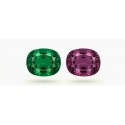
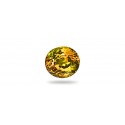
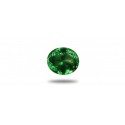
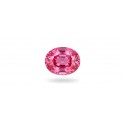
Green cats eye tourmaline is the most commonly available, reflecting the frequency of iron-colored green tourmaline as the dominant commercial variety. Pink and red cats eye tourmaline is rarer and more highly prized, as the combination of rubellite-quality pink-red with a strong cats eye commands significant collector premiums. Blue cats eye tourmaline (indicolite with chatoyancy) is among the rarest combinations. Brown cats eye tourmaline from dravite-type material is also found. Yellow, purple, golden, and even multi-color cats eye tourmaline with zoning and chatoyancy represent the most exceptional and collectible examples.
The GIA's Bangkok laboratory documented a vivid blue 0.51-carat cats eye tourmaline with Paraiba character, where LA-ICP-MS analysis confirmed copper content qualifying the stone as Paraiba tourmaline, making it an example of cats eye Paraiba tourmaline, one of the rarest gemological combinations documented. GIA noted that the sharp cats eye effect was caused by a layer of fine parallel growth tubes positioned just above the base of the cabochon.
For full gemological information, read our Tourmaline Cats Eye Gemopedia Guide. Browse related varieties including green tourmaline, pink tourmaline, and other tourmalines, with guides at Green Tourmaline Guide, Pink Tourmaline Guide, and Other Tourmalines Guide. See the complete Tourmaline Gemstone Guide and browse our full natural tourmaline collection.
What Makes a Good Cats Eye
The quality of the cats eye effect is the primary value driver for this variety, evaluated on three criteria: sharpness, centering, and brightness. A sharp eye has a narrow, well-defined band with clean edges, not a diffuse glow or broad indistinct band. The cats eye in tourmaline is generally more diffused than in chrysoberyl, which produces the sharpest cat's eye of any gem species. Excellent tourmaline cats eye has a clean, well-defined eye even if not quite as needle-sharp as fine chrysoberyl. Centering refers to whether the eye sits at the apex of the dome when the stone is viewed face-up with light directly above. A centered eye requires accurate orientation during cutting. An off-center eye significantly reduces the stone's visual impact and value. Brightness refers to how luminous and vivid the reflected band appears against the body color. A bright, high-contrast eye against a dark or vivid body color produces maximum visual impact.
Cutting Requirements
All cats eye tourmaline must be cut as cabochons. Faceting destroys the chatoyancy effect by breaking up the concentrated reflected band into multiple facet reflections. The dome of the cabochon acts as a focusing lens for the parallel tube reflections, converging them into the single bright band that defines the cats eye effect.
Orientation during cutting is critical. The parallel tubes must run parallel to the length axis of the finished cabochon (perpendicular to the direction the eye will travel when the stone is rotated). If the tubes run diagonally or perpendicular to this orientation, the eye will be weak, off-center, or absent entirely. Experienced cats eye tourmaline cutters examine the rough carefully under fiber-optic illumination to locate the tube orientation before determining the cutting axis.
Sources
Cats eye tourmaline is found in several gemstone-producing regions, with Sri Lanka (Ceylon), India, Brazil, Africa (particularly Tanzania, Kenya, and Mozambique), Madagascar, Myanmar, and the United States (California and Maine) all documented as sources. Sri Lanka's alluvial gem gravels have historically produced cats eye tourmaline alongside cats eye chrysoberyl, and Sri Lankan material is associated with the cats eye tourmaline collector tradition. Brazil is the primary source of larger cats eye tourmaline cabochons in green and brown tones. African sources contribute cats eye material in multiple color varieties. Exceptional material from Mozambique has been documented selling for over $5,000 per carat.
Properties
Species: Primarily elbaite; some dravite
Hardness: 7 to 7.5 Mohs
Cut Required: Cabochon only; dome height critical for eye quality
Refractive Index: 1.624 to 1.644
Specific Gravity: 3.02 to 3.20
Cleavage: None
Optical Phenomenon: Chatoyancy (cats eye effect)
Inclusion Type: Parallel hollow tubes along c-axis
Treatment: Natural; untreated
Value and Price
Standard green cats eye tourmaline cabochons: $30 to $200 per carat depending on eye quality, body color, and size. Pink and red cats eye tourmaline with sharp eye and vivid body color: $100 to $500 per carat. Exceptional fine material, particularly from Mozambique: $500 to $5,000 per carat for the finest documented examples. Cats eye Paraiba tourmaline with confirmed copper content, one of the rarest gemological combinations documented: individually priced well above standard cats eye tourmaline based on Paraiba-level market values. Browse our complete tourmaline cats eye collection or explore the full natural tourmaline range.
Frequently Asked Questions
What is tourmaline cats eye?
Tourmaline cats eye is a variety of tourmaline displaying chatoyancy, a bright band of light that moves across the cabochon surface when the light source or viewing angle changes, resembling a cat's pupil. The effect is produced by densely packed parallel hollow tubes or needle-like inclusions running parallel to the crystal's c-axis. The stone must be cut as a cabochon to display the effect.
What causes the cats eye effect in tourmaline?
Parallel hollow tubes and needle-like inclusions running parallel to the c-axis of the crystal reflect incident light in a concentrated band when properly cut and oriented as a cabochon. The tube density, alignment, and the dome height of the cabochon all determine the sharpness and brightness of the resulting eye. The GIA has documented the specific mechanism in multiple published lab notes.
Is tourmaline cats eye the same as chrysoberyl cats eye?
No. Chrysoberyl cats eye (cymophane) is a completely different mineral species and produces the sharpest and most brilliant cat's eye effect of any gem. Tourmaline cats eye has a more diffused eye quality compared to chrysoberyl but offers the unique advantage of tourmaline's full color range: vivid green, pink, red, blue, and multi-color cats eye tourmalines exist, while chrysoberyl cats eye is essentially limited to honey-yellow and greenish tones.
What colors does tourmaline cats eye come in?
Virtually any tourmaline color can develop chatoyancy. Green cats eye tourmaline is most common. Pink and red cats eye tourmaline is rarer and more valuable. Blue (indicolite) cats eye is among the rarest combinations. Brown, yellow, multi-color, and even copper-bearing Paraiba cats eye tourmaline have all been documented, with cats eye Paraiba being one of the rarest gemological combinations in the world.
Why must cats eye tourmaline be cut as a cabochon?
Faceting would break the concentrated tube reflection into multiple separate reflections from different facets, destroying the focused band effect. The smooth dome surface of a cabochon acts as a focusing lens that converges the parallel tube reflections into the single bright band defining the cats eye. There is no other cut that displays chatoyancy effectively.
Is cats eye tourmaline treated?
No. Cats eye tourmaline is entirely natural and untreated. The chatoyancy is a structural property of the inclusion arrangement and requires no treatment. All GemPiece cats eye tourmaline stones are natural with full treatment disclosure.