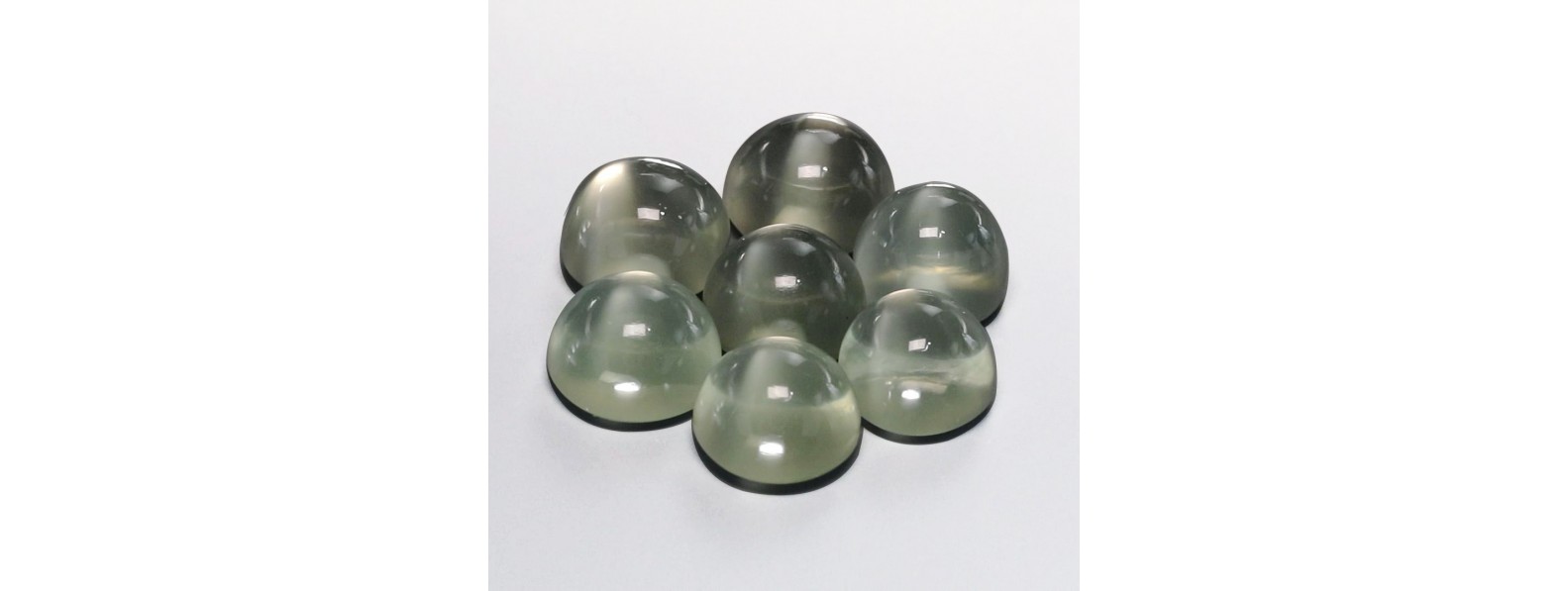
Moonstone – Adularescence, Star Moonstone and Feldspar Origins
Moonstone is among the oldest and most universally admired gemstones in human history — a feldspar mineral whose adularescence has been interpreted as captured moonlight in cultures from ancient Rome to modern India, and whose optical behavior remains one of the most scientifically interesting and visually arresting phenomena in gemology. The name itself is among the most evocative in the gem world, and no description of adularescence fully prepares a first-time viewer for the experience of watching fine blue-flash Sri Lankan moonstone respond to movement. This guide covers moonstone's feldspar mineralogy, the physics of adularescence, the star moonstone and cat's eye varieties, global sources, treatment landscape, and value factors for this enduring gemstone.
Explore our natural moonstone collection, star moonstone (view collection), and moonstone cat's eye (view collection).
Mineral Composition and the Feldspar Family
Moonstone is primarily a variety of orthoclase feldspar (KAlSi₃O₈) — a potassium aluminum silicate belonging to the monoclinic crystal system. The defining characteristic of gem-quality moonstone is not the orthoclase itself but the internal microstructure that develops when the originally homogeneous high-temperature feldspar cools and unmixes into alternating layers of orthoclase and albite (NaAlSi₃O₈). This process — called exsolution — produces the lamellar intergrowth responsible for adularescence. The mineral composition of these intergrown layers falls in the alkali feldspar series, with the orthoclase-rich layers alternating with albite-rich layers on a microscopic scale.
Moonstone measures 6 to 6.5 on the Mohs hardness scale. Specific gravity is 2.56 to 2.59. Refractive index is 1.518 to 1.526, biaxial negative. Perfect cleavage in two directions at approximately 90 degrees — a shared characteristic of the feldspar group that requires care in cutting and setting. The chemical formula of the orthoclase component is KAlSi₃O₈.
The Physics of Adularescence
Adularescence is produced by the Tyndall scattering and thin-film interference of light between the alternating orthoclase and albite lamellar layers within the moonstone. The two feldspar phases have slightly different refractive indices — orthoclase approximately 1.518 and albite approximately 1.529 — creating an optical boundary at each layer interface. Light entering the stone is partially scattered and partially refracted at each interface, with the scattered light from thousands of microscopically thin parallel layers combining to produce the characteristic glowing effect visible at the surface of the stone.
The color and intensity of the adularescence depend critically on the thickness of the lamellar layers. Very thin layers — approximately 100 to 300 nanometers — produce blue adularescence through preferential scattering of short wavelengths (the same mechanism that makes the sky appear blue). Thicker layers scatter longer wavelengths more efficiently, producing white, silver, or orange adularescence. The finest blue-flash moonstone from Sri Lanka owes its vivid blue glow to the exceptionally thin, regular lamellar structure developed in the specific metamorphic conditions of the Sri Lankan gem gravels.
Star Moonstone — Asterism in Feldspar
Star moonstone is a rare variety displaying asterism — a star pattern of reflected light — superimposed on or in place of the normal adularescence. Asterism in moonstone is produced by intersecting sets of parallel fibrous or needle-like inclusions, or by aligned structural features within the crystal, that reflect light as intersecting lines. Four-rayed stars are the most common form in moonstone, produced by two intersecting sets of aligned features at 90 degrees. Six-rayed stars are rarer and more valuable. The finest star moonstones display a sharp, well-centered, well-defined star simultaneously with strong adularescence in the background — a combination of two optical phenomena that makes such stones among the most optically complex in the collector gemstone world. Star moonstones from India and Sri Lanka are the primary commercial sources.
Moonstone Cat's Eye
Moonstone cat's eye displays chatoyancy — a single bright reflected light band across the cabochon surface — produced by a single set of parallel aligned inclusions or lamellar features within the crystal. The cat's eye effect in moonstone combines the species' characteristic adularescent glow with the precision of a sharp reflected band, creating a distinctive optical combination. Fine moonstone cat's eye with a sharp, well-defined eye and strong adularescence background is a specialized collector variety of meaningful rarity.
Sources and Origin Characteristics
Sri Lanka — particularly the Meetiyagoda area of the Southern Province — is the world's premier source of fine white moonstone with blue adularescence, and has been for centuries. Sri Lankan moonstone with fine blue flash is increasingly scarce as quality deposits are depleted, and truly exceptional material commands premiums that reflect this supply constraint. Myanmar produces fine white moonstone of comparable quality to Sri Lankan material. India — particularly Rajasthan and Tamil Nadu — is the major source of peach, orange, grey, and black moonstone varieties, as well as a significant producer of star moonstone. Madagascar, Tanzania, Brazil, Australia, and the United States (Oregon, New Mexico) provide additional supply in various qualities and colors.
Treatment Status
High-quality moonstone is generally not treated. The adularescence is an entirely natural structural phenomenon that cannot be created or enhanced by treatment. Some lower-quality moonstone may undergo surface coating or clarity enhancement, but these are not standard practices for quality material. GemPiece provides full treatment disclosure on all moonstone specimens.
Value Factors
Adularescence strength and color are the primary value determinants. Vivid blue adularescence in a colorless or near-colorless body from Sri Lanka represents the highest value tier. Star quality — sharpness, centering, and number of rays — is the primary driver for star moonstone value. Cat's eye sharpness and definition drive cat's eye moonstone value. Transparency of the body, size, and origin complete the value picture. Fine Sri Lankan blue-flash moonstone above 10 carats in collector grade is increasingly scarce and represents a meaningful investment-grade gemstone.
Durability and Care
Clean moonstone with warm water, mild soap, and a soft cloth. Avoid ultrasonic cleaners and steam — both can worsen cleavage-related fractures. Store separately from harder gemstones. Protect from sharp impacts that can exploit the perfect cleavage. For ring use, bezel settings provide the most practical protection.
Explore Related Feldspar and Optical Phenomenon Gemstones
Andesine (view collection), scapolite cat's eye (view collection), and danburite cat's eye (view collection).