
Star Ruby – Rutile Exsolution Asterism, Cabochon Orientation and Value
Star ruby is the asterism-displaying variety of corundum ruby — a gemstone where microscopic rutile needle inclusions, aligned in three crystallographic directions within the hexagonal crystal structure, simultaneously reflect light from the domed surface of a cabochon to produce a natural six-rayed star that glides across the stone under a single concentrated light source. Among optical-phenomenon gemstones, star ruby represents a rare intersection of two independent quality requirements — vivid body color and strong, sharp asterism — that are physically competing rather than complementary, because the heat treatment that improves color in most faceted ruby destroys the rutile silk that creates the star.
This guide covers the rutile exsolution mechanism, the cabochon orientation requirement, star quality grading, the full source landscape, the treatment relationship unique to star ruby, and value.
Explore our star ruby collection or related varieties: ruby, star sapphire, Burmese ruby, pigeon blood ruby.
Physical Properties
- Mineral: Corundum (Al₂O₃)
- Variety: Ruby — red corundum
- Crystal System: Trigonal (hexagonal)
- Hardness: 9 on the Mohs scale
- Optical Phenomenon: Asterism — natural six-rayed star
- Typical Cut: Cabochon — smooth dome, flat base
- Refractive Index: 1.762 to 1.770
- Specific Gravity: 3.99 to 4.01
- Major Sources: Myanmar (Burma), Sri Lanka, India, Madagascar, Tanzania
The Rutile Exsolution Mechanism
The six-rayed star in star ruby is produced by rutile (TiO₂) needle inclusions that exsolved from the corundum crystal during natural geological cooling. During initial crystal growth, titanium is incorporated into the corundum lattice in solid solution. As the crystal cools over geological time scales, titanium is expelled from the lattice and crystallizes as separate rutile needles — a process called exsolution. These rutile needles orient themselves parallel to the three {10-10} planes of the hexagonal corundum crystal, growing in three distinct sets at 60 degrees to each other.
When a single light source illuminates the curved dome of a correctly oriented cabochon, each set of parallel rutile needles reflects light as a bright line perpendicular to the needle direction. Three sets produce three crossing lines — six star rays at their intersection. The star appears to move across the dome as the stone and light source shift relative to each other because the reflective geometry changes continuously with viewing angle.
This is identical to the mechanism that produces asterism in star sapphire — the same mineral, the same rutile exsolution process, the same three-set geometry. The only difference is the chromium content that makes one red (ruby) and the other blue, grey, or another color (sapphire).
Cabochon Orientation — Why It Matters
A star ruby cabochon must be oriented with extreme precision for the star to appear centered and complete. The c-axis of the hexagonal corundum crystal must point precisely through the apex of the cabochon dome. When this alignment is achieved, all three rutile needle sets are positioned symmetrically relative to the dome surface, and their three reflected lines cross at the dome's center — producing a well-centered six-rayed star. Any deviation from this orientation displaces the star toward one side or causes one or more rays to weaken, shortened, or disappear entirely. An off-center star in a well-proportioned cabochon is the signature of incorrect crystal orientation during cutting — a lapidary error that significantly reduces value.
Why Star Ruby is Typically Unheated
Heat treatment of ruby at standard enhancement temperatures (1,200 to 1,800°C) recrystallizes and partially dissolves the rutile silk inclusions — the same needles that produce the star. The dissolution improves transparency and can enhance color, but it destroys or severely weakens the asterism in the process. A star ruby with a clearly defined, bright six-rayed star cannot have been heated at temperatures that would affect the rutile inclusions, which means fine star ruby is inherently unheated material. This is a structural consequence of the treatment, not a marketing claim. Laboratory confirmation of untreated status is still recommended for significant purchases, as partial heating at lower temperatures can affect some but not all inclusions.
Color Range and Body Appearance
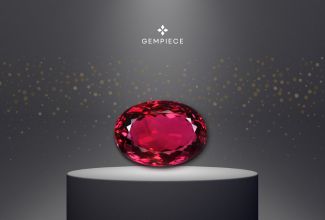
Star rubies range from vivid red through medium red, pinkish-red to purplish-red. The most commercially desirable body color is vivid to strong red — the same chromium-driven red that defines fine faceted ruby. The rutile inclusions that produce the star also make star ruby translucent to semi-transparent rather than fully transparent: a degree of translucency is necessary for the light to interact with the rutile silk throughout the dome and produce a well-illuminated star, but excessive opacity reduces the visual depth and richness of the body color. The balance between translucency and body color intensity is a key quality consideration.
Sources
Myanmar produces the finest star ruby by both color and star quality — high chromium content produces vivid red body, and well-developed rutile silk from Mogok's marble-hosted geology produces sharp, bright stars. Myanmar star ruby commands the strongest origin premiums. Sri Lanka is the most important source by volume for fine and large-size material; Sri Lankan star ruby often shows excellent star definition and good transparency against lighter body colors. India — primarily from Orissa and Tamil Nadu — is the dominant commercial source of large-size star ruby cabochons in the global market. Madagascar, Tanzania, and Vietnam produce star ruby in smaller commercial quantities.
Quality Grading
Star sharpness and brightness — the clarity, definition, and reflective intensity of the six rays — is the primary quality factor. A star that is sharp, complete, and clearly visible against the body under single light is the premium. Star centering — the star positioned at the crown of the dome — is the second factor. Body color intensity is the third — a deeper, more vivid red against which the star plays adds substantial value. Translucency and surface quality of the cabochon are the fourth consideration. Carat weight amplifies all other factors — large star ruby above 10 carats with strong combined quality is a genuine collector acquisition; above 20 carats at high standard, it is exceptional.
Explore Related Gemstones
Ruby (view collection), star sapphire (view collection), Burmese ruby, pigeon blood ruby.