
Understanding Garnet Gemstone
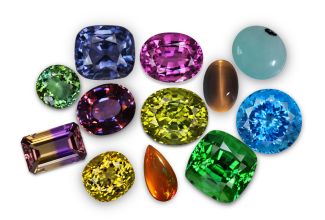
Garnet is one of the most structurally complex and visually diverse gem families on earth. To most buyers it means a deep red stone — and that impression is not wrong, only incomplete. The garnet group encompasses six distinct mineral species that collectively produce almost every color in the visible spectrum: blood red, vivid green, electric orange, raspberry pink, warm honey amber, and a rare shifting variety that changes color entirely depending on the light source. No other major gem group delivers this range from a single mineral family, which is precisely why garnet continues to fascinate gemologists, collectors, and jewelry designers worldwide.
This guide draws on two decades of hands-on experience working with garnet rough and finished stones across multiple origins, combined with current gemological science, to give you the most thorough and practical understanding of garnet available. Whether you are a first-time buyer selecting a January birthstone, a designer sourcing stones for custom work, or a collector evaluating rare varieties, everything you need is here.
Explore our natural garnet gemstone collection or browse individual variety collections including tsavorite garnet, demantoid garnet, rhodolite garnet, and spessartite garnet. For detailed variety guides, see our Gemopedia pages for tsavorite, demantoid, rhodolite, and spessartite.
What Is Garnet
Garnet is not a single mineral. It is a supergroup of silicate minerals that share an identical crystal framework but accommodate radically different chemical compositions within that framework. This structural openness is the key to everything: the same basic lattice that holds iron-rich almandine in a deep red configuration also holds calcium and chromium in grossular garnet to produce emerald-quality green, or iron and calcium in andradite to generate the highest dispersion of any natural silicate mineral on earth.
In traditional gemology and mineralogy, six species form the garnet group that matters for gem purposes. They divide into two solid-solution series based on the chemistry of their crystal lattice sites. The pyralspite series — pyrope (Mg₃Al₂Si₃O₁₂), almandine (Fe₃Al₂Si₃O₁₂), and spessartite (Mn₃Al₂Si₃O₁₂) — accommodates magnesium, iron, and manganese respectively in the X-site of the crystal structure. The ugrandite series — uvarovite (Ca₃Cr₂Si₃O₁₂), grossular (Ca₃Al₂Si₃O₁₂), and andradite (Ca₃Fe₂Si₃O₁₂) — requires calcium in the X-site. The size difference between calcium and the smaller ions of the pyralspite series means that mixing between the two series is structurally limited, which is why hybrid varieties tend to stay within each series rather than crossing freely between them.
In practice, most gem garnets are solid-solution mixtures. The stones you encounter in commerce — rhodolite (pyrope-almandine), malaya (pyrope-spessartite), mali garnet (grossular-andradite), color change garnet (pyrope-spessartite with specific trace element chemistry) — are natural blends whose precise composition determines color, optical character, and value.
Crystal Structure and Formation
All garnets crystallize in the isometric (cubic) system, forming well-developed symmetrical shapes — most commonly the rhombic dodecahedron (twelve diamond-shaped faces) or the trapezohedron (twenty-four kite-shaped faces). This cubic symmetry also means garnet is singly refractive, a useful identification characteristic that distinguishes it from doubly refractive stones such as tourmaline or sapphire.
Garnet forms under high temperature and pressure conditions, most commonly within metamorphic rocks — schists, gneisses, and eclogites — where burial and heat drive the chemical reactions that produce garnet crystals. Red garnets (almandine, pyrope) are among the most widespread minerals in high-grade metamorphic terranes worldwide. Green garnets require more specific geochemical environments: tsavorite needs rocks with unusual calcium-aluminum chemistry and the presence of vanadium or chromium, conditions found in the ancient Mozambique Belt of East Africa. Demantoid forms in serpentinized ultramafic rocks, a geologically rare setting, which explains its limited global distribution and high market value.
Some garnets also occur in igneous settings. Pyrope is frequently associated with kimberlite pipes — the same geological structures that bring diamonds to the surface — and spessartite appears in granitic pegmatites and rhyolites. This range of geological environments, from deep crustal metamorphism to volcanic intrusions, reflects garnet's remarkable structural tolerance for diverse chemical conditions.
Physical and Optical Properties
Despite differences in chemical composition, all garnets share a core set of physical properties that define them as a group. Understanding these properties is essential for identification, valuation, and proper care.
Hardness: 6.5 to 7.5 on the Mohs scale. The calcium-bearing ugrandite garnets (grossular, andradite) tend toward the lower end; pyralspite garnets generally sit at 7 to 7.5. This is adequate for all jewelry uses, though demantoid's rating of 6.5 means it benefits from protective settings such as bezels or halo constructions in daily-wear rings.
Cleavage: None. This is a significant practical advantage. Gemstones with strong cleavage — topaz, moonstone, kunzite — can fracture along predictable planes under impact. Garnet's absence of cleavage means it resists this type of damage, making it more forgiving in jewelry and considerably easier to cut without sudden breakage.
Refractive Index: Approximately 1.72 (grossular) to 1.94 (andradite). The high end, occupied by demantoid and other andradite varieties, exceeds diamond's refractive index in dispersion terms — meaning andradite splits white light into spectral colors more effectively than diamond, producing the intense "fire" that makes demantoid so extraordinary among colored gemstones.
Specific Gravity: 3.5 to 4.3, varying by species. Spessartite and almandine sit toward the heavier end; grossular is comparatively lighter. This variation is one of the diagnostic tools gemologists use when identifying garnet species.
Optical Character: Singly refractive (isotropic), though some mixed-species garnets show anomalous double refraction under the polariscope — a result of internal crystal strain rather than true birefringence.
Luster: Vitreous to resinous. Well-polished garnets carry a bright, glassy surface. Andradite varieties, especially demantoid, can display an almost adamantine (diamond-like) luster at their finest.
Color Range and the Chemistry Behind It
The color diversity within garnet is one of the most instructive examples in all of gemology of how trace-element chemistry translates directly into visual experience.
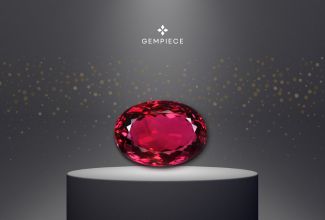
Red garnets — pyrope and almandine — owe their color primarily to iron and sometimes chromium. Pure pyrope produces a deep, clean blood red; almandine shifts toward red-brown as its higher iron content absorbs more blue and green wavelengths. Where the two mix, as in rhodolite, the result is a lighter, more purple-red that many buyers find more visually appealing than either parent species on its own.
Green garnets come from two entirely different chemical pathways. Tsavorite, a grossular variety, gets its color from vanadium and chromium substituting for aluminum in the crystal lattice — the same chromophores that color emerald. Demantoid, an andradite variety, also owes its green to trace ferric iron within the calcium-iron framework of andradite. Both greens compete at the very top of the colored gemstone market despite arriving through different chemistry.
Orange garnets — spessartite — are colored by manganese. Pure, high-manganese spessartite produces the vivid mandarin orange of the finest Namibian stones; as iron content increases, the color shifts toward reddish-orange and eventually brownish-red tones.
Color change garnets owe their alexandrite-like behavior to a specific trace element mix — usually vanadium or chromium — that creates an absorption window in the green region of the visible spectrum. In daylight the stone appears green or blue-green; under incandescent light the same absorption profile shifts it to red or purple. This precise chemical balance is geologically rare, which is why color change garnets are among the most collectible in the entire gem world.
The Six Garnet Species
Pyrope is a magnesium-aluminum silicate producing deep red to blood-red colors. Found in kimberlite pipes and peridotite — sometimes alongside diamonds — most commercial pyrope contains some almandine component. As almandine content increases and color lightens toward pink-purple, the mixture becomes rhodolite, one of the most commercially popular garnets in the world. Explore our pyrope garnet collection and the pyrope garnet guide.
Almandine is the most abundant garnet species and the source of most deep red garnet seen in commercial jewelry. Its higher iron content produces colors from vivid red through red-brown. India, Brazil, Sri Lanka, and Madagascar are major sources of faceting material.
Spessartite is a manganese-aluminum silicate responsible for the orange garnets that have generated enormous collector interest since major Namibian deposits were discovered in the 1990s. Mandarin garnets from Namibia represent the purest, brightest orange spessartites known. Browse our spessartite garnet collection and read the spessartite garnet guide.
Grossular is a calcium-aluminum silicate with perhaps the widest internal color range of any single garnet species — from colorless through yellow, orange, brown, and vivid green. Its gem varieties include tsavorite (green), hessonite (orange-brown), and leuco garnet (colorless). The green tsavorite variety, found primarily in Kenya and Tanzania, stands as one of the most commercially important garnets in the world. Explore our grossular garnet collection, tsavorite garnet collection, and hessonite garnet collection. For detailed guides see grossular, tsavorite, and hessonite.
Andradite is a calcium-iron silicate and the optically most spectacular garnet species. Its dispersion value of 0.057 exceeds diamond (0.044), giving andradite garnets fire that surpasses any other natural silicate. Demantoid is the gem-quality green andradite found in Russia and Namibia; topazolite shows yellow-green tones; melanite is an opaque black variety. Browse our andradite garnet collection and demantoid garnet collection. Detailed guides: andradite and demantoid.
Uvarovite is a chromium-bearing calcium garnet producing the most vivid, saturated green in the entire garnet group — but its crystals are almost always too small to facet individually. It is typically set as drusy clusters or kept as crystal specimens.
Named Trade Varieties
Beyond the six species, the commercial garnet market recognizes several established trade varieties worth knowing by name. Rhodolite (pyrope-almandine) is beloved for its pink-purple tones and strong brilliance — explore our rhodolite garnet collection and rhodolite guide. Malaya garnet (pyrope-spessartite) produces rare peach and pink-orange tones found primarily in East Africa — see our malaya garnet collection and malaya guide. Mali garnet (grossular-andradite) is a yellow-green hybrid with outstanding dispersion mined only in Mali, West Africa — browse our mali garnet collection and mali guide. Color change garnet, typically a pyrope-spessartite blend, ranks among the most collectible optical phenomena in the gem world — see our color change garnet collection and color change guide.
Garnet as January Birthstone
Garnet has been the birthstone for January since at least the 15th century, though its use as a personal talisman stretches far further back. Ancient Egyptians considered red garnet a symbol of life and eternity, carving it into amulets and setting it into royal jewelry. Roman nobles used carved garnet intaglios as personal seals on official documents. Medieval European clergy and aristocracy favored garnet for ecclesiastical jewelry and royal adornment, associating it with faith, loyalty, and protection during travel.
The modern meaning of garnet as a January birthstone draws on this long history: protection, strength, vitality, and the energy to begin something new — qualities fitting for the opening month of the year. In Indian Vedic astrology, garnet is associated with the planet Mars and is recommended for increasing confidence, clearing negative energy, and supporting health and focus.
Treatment Status
Natural garnet stands apart from almost all other major colored gemstone families in one important way: the vast majority of commercially available garnets are entirely untreated. No heat treatment, no fracture filling, no surface coating. The color you see in a garnet is the color nature produced. This is a meaningful distinction in a market where ruby, sapphire, and emerald are routinely heated, oiled, or beryllium-diffused to improve appearance. For buyers who place a premium on natural, unmanipulated gemstones, garnet represents one of the most reliable choices available in today's colored stone market.
Global Sources and Mining Origins
Garnet is found on every continent and in a remarkable variety of geological environments. The most commercially significant sources for quality gems today are concentrated in sub-Saharan Africa and Sri Lanka, with important historical and ongoing production in Russia, India, and Brazil.
Kenya and Tanzania's ancient Mozambique Belt is the source of the world's finest tsavorite, as well as important rhodolite and malaya garnet production. Namibia produces both the finest demantoid outside Russia and the most vivid mandarin spessartite. Sri Lanka's gem gravels have yielded hessonite, rhodolite, and pyrope for centuries. Russia's Ural Mountains — particularly the Bobrovka River region near Ekaterinburg — produced the most celebrated demantoids in history, stones that still set the benchmark against which all others are measured. Madagascar has emerged as a significant multi-variety source for demantoid, color change garnet, and rhodolite. Mali in West Africa remains the sole significant source of the grossular-andradite hybrid that bears the country's name.
Value Factors Across Garnet Varieties
Evaluating garnet requires understanding that value drivers differ significantly between varieties. What makes a rhodolite valuable is not identical to what makes a tsavorite or demantoid valuable, so a single universal framework oversimplifies the reality.
Across all varieties, color remains the dominant factor. Saturation, hue, and tone must all be considered together — a garnet with vivid, even color that is neither too dark nor too pale consistently commands a premium regardless of species. Clarity matters more for some varieties (tsavorite, color change garnet) than others (hessonite, where internal texture is a recognized feature of the stone's character). Cut quality is often undervalued by buyers but is critical to optical performance: a well-proportioned garnet will look substantially better than the same stone cut for maximum weight retention. Carat weight exponentially increases value in rare varieties — tsavorites above two carats and demantoids above one carat are genuinely scarce, and price per carat rises steeply at these thresholds. Origin adds a premium for specific varieties, though the stone's visual quality should always carry more weight than the origin label alone.
Garnet in Jewelry
Garnet's combination of good hardness, no cleavage, and a full spectrum of natural colors makes it one of the most versatile gem families for jewelry design. Red and pink garnets work beautifully with rose gold and yellow gold. Green tsavorite and demantoid are exceptional in white gold and platinum, where the metal amplifies cool green brilliance. Orange spessartite creates striking contrast against yellow gold. The range of available colors also makes garnet ideal for multi-stone designs — gradient pieces moving from the orange of spessartite through the pink-peach of malaya to the purple-red of rhodolite are among the most striking contemporary interpretations of what this family can achieve.
Ring settings that protect lower-hardness varieties like demantoid (6.5 Mohs) with bezel or halo construction are advisable for daily-wear pieces. Harder pyralspite garnets at 7 to 7.5 Mohs perform well in all standard ring constructions including prong and channel settings.
Garnet Care and Cleaning
Garnet requires no unusual care beyond what is sensible for any quality gemstone. Clean with warm water, mild soap, and a soft-bristle brush, rinse thoroughly, and dry with a soft cloth. Avoid ultrasonic cleaners for stones with visible inclusions — rapid vibration can propagate fractures from existing features, particularly in almandine and spessartite which tend toward higher inclusion content. Steam cleaning is not recommended. Store garnet separately from harder stones (diamond, sapphire, spinel) to prevent surface scratching. Garnet's absence of cleavage means it is far more resistant to mechanical damage than many other gems, but basic storage care preserves its surface polish over the long term.
Buying Natural Garnet Gemstones
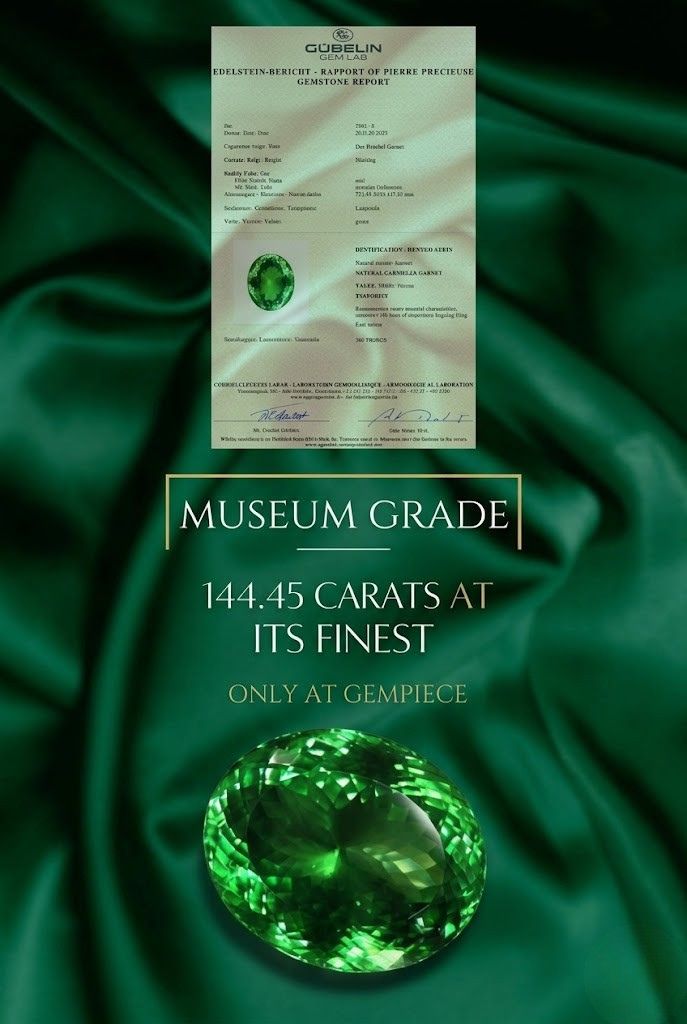
When purchasing garnet, evaluating the actual stone matters far more than relying on species labels or origin certificates alone. Color is everything — look for even saturation, a tone that is not so dark it appears black-red in dim light, and a hue that excites you personally. For collector-grade varieties like demantoid and tsavorite, a reputable laboratory report (GIA, Gübelin, AGL) confirming species and, where relevant, origin adds meaningful assurance. For the broader garnet market including rhodolite, spessartite, hessonite, and malaya, careful visual evaluation of a well-photographed or personally viewed stone is often entirely sufficient.
At GemPiece, every garnet in our collection is individually photographed with macro detail and presented with video so the stone's actual color, clarity, and cutting quality can be assessed before purchase. We source directly from established suppliers across Kenya, Tanzania, Sri Lanka, Russia, Namibia, and Madagascar with accurate origin representation on all significant pieces. Browse our natural garnet gemstone collection to find your stone, or explore individual variety guides in our Gemopedia: Tsavorite Garnet Guide, Demantoid Garnet Guide, Rhodolite Garnet Guide, Spessartite Garnet Guide, Hessonite Garnet Guide, Malaya Garnet Guide, Mali Garnet Guide, Color Change Garnet Guide, Andradite Garnet Guide, and Pyrope Garnet Guide.