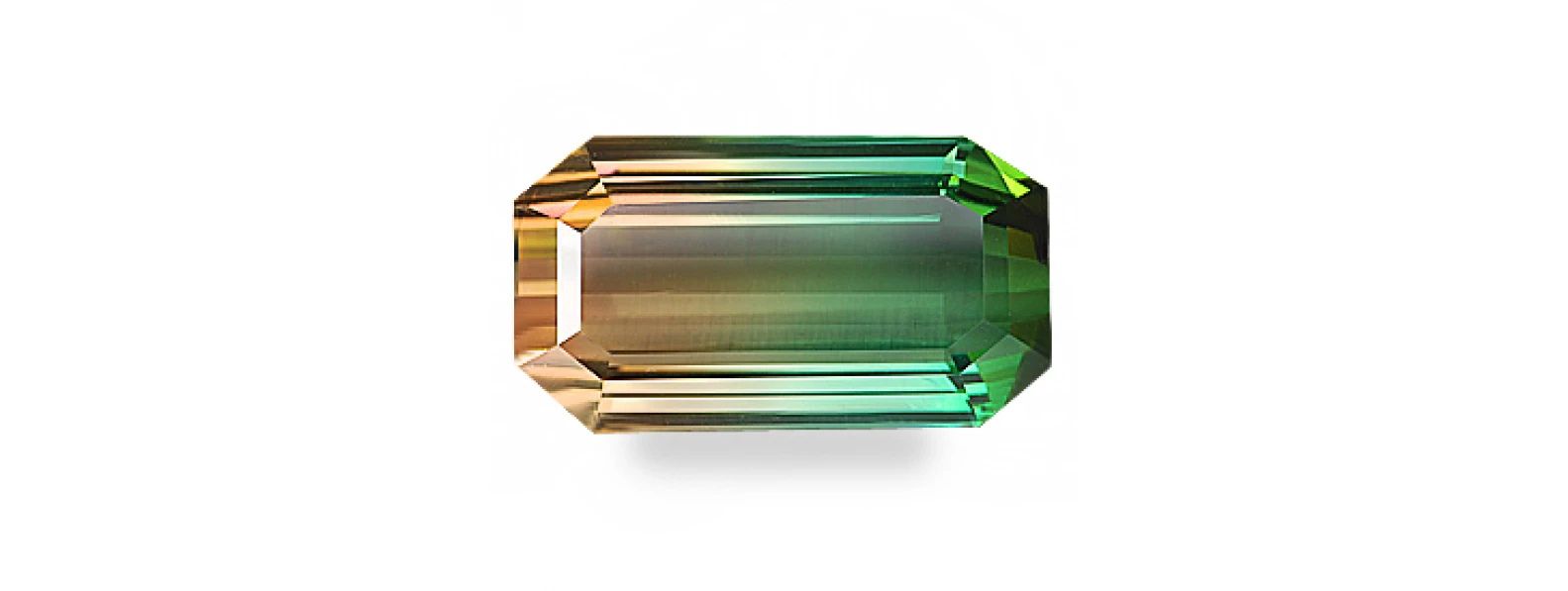
Understanding Bi-Color Tourmaline Formation, Watermelon Variety, Color Zoning and Value
Bi-color tourmaline is one of the clearest demonstrations in the natural world of how gemstones record geological history. A tourmaline crystal does not form instantaneously. It grows, ion by ion, over millions of years in a pegmatite pocket whose fluid chemistry is constantly evolving. Every shift in that chemistry leaves its mark in the crystal as a change in color. The resulting stone is not just a beautiful object; it is a physical record of geological time, chemistry, and change, frozen in silica and boron and suspended in the ancient rock of its formation.
Explore our bi-color tourmaline collection and related varieties including pink tourmaline, green tourmaline, and other tourmalines. For related guides see Pink Tourmaline Guide, Green Tourmaline Guide, Paraiba Tourmaline Guide, and the complete Tourmaline Gemstone Guide.
What Is Bi-color Tourmaline
Bi-color tourmaline is a variety designation applied to any tourmaline gemstone displaying two or more visually distinct color zones within a single crystal or finished gem. The color zoning occurs as a natural consequence of crystal growth in pegmatite environments where the chemical composition of the surrounding fluid changes during the growth period. No human intervention creates the color division. It is purely geological, purely natural, and entirely unique to each individual crystal.
Technically, bi-color refers to two distinct colors; tri-color to three; and multi-color or parti-colored to four or more. In commercial usage, bi-color is broadly applied to all tourmalines displaying more than one color zone, regardless of the exact count. The GIA's quality factors documentation for tourmaline notes that parti-colored stones are highly valued. Their documented 11.21-carat bicolor example, described as having intense colors, a clean junction between zones, and the highest clarity, is cited as a supreme example of both the gem material and the cutter's art.
Most bi-color tourmaline belongs to the elbaite species. Some bi-color material involves liddicoatite, particularly Madagascar specimens with complex triangular zoning, and occasionally dravite-elbaite transitions at the margins of zoned crystals from metamorphic terranes.
The Geology of Color Zoning
Pegmatites are exceptionally coarse-grained igneous rocks that form from the final, highly volatile-rich fractions of crystallizing granite magmas. As a granite magma cools and major minerals crystallize out, the remaining melt becomes progressively enriched in elements that do not fit into those mineral structures, including boron, lithium, fluorine, water, and the trace elements that color tourmalines.
This residual, volatile-rich melt eventually crystallizes as pegmatite, typically in pockets and veins within or adjacent to the parent granite. Crystal growth in pegmatite pockets is unusually slow. The high volatile content lowers the viscosity and melting point of the residual melt, allowing crystals to grow at geologically low temperatures over very long periods. This slow growth is what produces the large, well-formed, gemologically interesting crystals characteristic of pegmatite deposits.
The critical aspect for bi-color tourmaline is that the chemistry of the pegmatite fluid is not static during this long crystallization period. Several processes can change the fluid composition in real time: the progressive depletion of specific elements as they are incorporated into growing crystals, the migration of external fluids into the pegmatite pocket through fractures, and temperature and pressure changes that alter the solubility of different elements. Each of these processes can change which trace elements are available to the growing tourmaline crystal at any moment, producing color changes that are permanently recorded in the crystal's growth history.
Watermelon Tourmaline: The Geology in Detail
The classic watermelon pattern, pink or red center, white or pale zone, green rim, requires a specific sequence of events during crystal growth. The early growth phase must occur in a manganese-rich fluid environment. Manganese (Mn²⁺) substitutes into the Y-crystallographic site of the elbaite structure, producing pink coloration. This phase produces the crystal nucleus and inner growth zones that become the flesh of the watermelon.
A transition phase must then occur where neither manganese nor iron dominates the fluid. A period of relatively clean, element-poor fluid produces little chromophore substitution in the growing crystal, creating the white or pale zone that represents the boundary between the pink interior and the green exterior. In the finest watermelon specimens, this transition zone is thin and sharp; in others, it is broad and gradual.
The outer growth phase must occur in an iron-rich fluid environment. Iron (Fe²⁺ primarily) substitutes into the Y-site of the growing crystal, producing the green coloration of the outer rim. This three-phase sequence requires a very specific geological coincidence: a pegmatite pocket that starts with high manganese availability and transitions to high iron availability over the lifetime of the crystal. This is not a common condition, which is why true concentric watermelon zoning occurs in fewer than 5% of all bi-color tourmaline rough. The Cruzeiro Mine in Minas Gerais, Brazil is particularly famous for producing this specific zoning type with vivid colors and sharp transitions.
Types of Color Zoning
Longitudinal zoning, also called axial zoning along the crystal length, produces parallel color bands running along the long axis of the crystal. A crystal that grew pink for most of its length and then green for the final stages shows longitudinal zoning. When cut with the table perpendicular to the crystal length, the finished gem shows two distinct color halves side by side. This is the most common type of bi-color zoning.
Transverse zoning (radial or concentric zoning) produces the watermelon pattern, with color arranged in concentric layers around the crystal's growth axis. When the crystal is cut as a cross-section perpendicular to the c-axis, the concentric layers appear as rings. This is the rarer and more commercially prized zoning type.
Sector zoning occurs in some liddicoatite specimens where different crystallographic sectors of the crystal have different chemistries, producing a pinwheel or triangular pattern in cross-section that is unique to the liddicoatite calcium-tourmaline and not seen in elbaite.
Physical and Optical Properties
Hardness: 7 to 7.5 Mohs, consistent across the full crystal regardless of color zone.
Refractive Index: 1.624 to 1.644 for elbaite. Different color zones within the same crystal may show very slightly different RI readings due to different trace element content.
Specific Gravity: 3.02 to 3.20 for elbaite bi-color material. Iron-richer zones (typically the green zone) have slightly higher SG than manganese-richer zones (typically the pink zone).
Pleochroism: Each color zone shows its own pleochroism because pleochroism in tourmaline depends on the specific chromophores present. The pink zone shows different pleochroic colors than the green zone, creating visual complexity in bi-color faceted gems.
Cleavage: None, consistent across all tourmaline species.
Inclusions: Bi-color tourmaline typically contains more inclusions than standard monochromatic tourmaline. The color transition zones often contain tension fractures from the differential growth stress between chemically distinct zones. Eye-clean bi-color material is less common and more valuable.
Cutting Bi-color Tourmaline
Cutting bi-color tourmaline is one of the most creative and technically demanding challenges in lapidary work. The cutter must understand the geological structure of the specific piece being cut: where the color zones are, how they are oriented relative to the crystal axes, how thick each zone is, and how the pleochroism of each zone will interact with the chosen table orientation.
The first decision is whether to cut the piece as a slice or as a three-dimensional faceted gem. For watermelon tourmaline with concentric zoning, polished slices perpendicular to the crystal length are frequently the preferred presentation. They display the full geological story of the crystal without the compromise of transforming a circular color pattern into a faceted gem with limited color visibility from a single viewing direction.
For longitudinally zoned bi-color material intended for faceted gems, the critical decision is table orientation. If the table is positioned so the color junction runs across the table face, the finished gem shows two colors simultaneously from the face-up viewing position. A very sharp junction, where the color changes from vivid pink to vivid green over less than a millimeter, can be positioned to provide a dramatic visual split in the finished gem. Each piece of bi-color rough is genuinely unique, and the cutter's interpretive decisions significantly affect the value and beauty of the finished stone.
Famous Sources and Their Characteristics
Brazil (Minas Gerais, particularly the Cruzeiro Mine) is the most historically celebrated source of watermelon tourmaline and bi-color elbaite generally. The Cruzeiro Mine in São José da Safira has produced some of the world's finest watermelon tourmaline specimens with vivid pink-to-green zoning and exceptionally sharp transition zones. Brazilian bi-color material typically shows the richest manganese pinks and iron greens, with color in both zones being more saturated than comparable material from other sources. The Jonas Mine has produced bi-color material in addition to its famous rubellite. Brazilian bi-color commands the highest market premiums.
Nigeria (Oyo State and other pegmatite zones) is an increasingly important source of bi-color tourmaline with vivid pink-to-green and pink-to-yellow combinations. Nigerian bi-color material can show exceptional color vividness in both zones, particularly in the pink zone. Madagascar is the primary source of liddicoatite with its distinctive triangular sector zoning. Cross-sections of Madagascar liddicoatite crystals show a complex pinwheel of colors in triangular sectors that is unique in the mineral world. Afghanistan (Nuristan and Kunar provinces) produces bi-color material particularly in green-to-pink and colorless-to-color combinations. United States (Maine) produces bi-color tourmaline historically from Oxford County pegmatites, including watermelon material.
Treatments and Market Practices
Bi-color tourmaline, particularly watermelon tourmaline, is one of the least treated tourmaline varieties in the commercial market. The natural color zoning is the defining characteristic and primary value driver. Any treatment altering the color of one zone would destroy the very feature that makes the stone valuable.
Standard heating as applied to monochromatic tourmaline is generally not applied to watermelon or bi-color material. Heating would change the color of manganese-bearing zones (the pink component is temperature-sensitive) and could blur or alter the transition between zones. This means bi-color tourmaline, particularly fine watermelon material, is predominantly natural and untreated, a meaningful advantage in a market that increasingly values natural integrity.
Value and Market Pricing
Bi-color tourmaline value assessment requires evaluating two distinct color zones independently, plus the quality of the transition between them. Color quality in each zone is assessed separately. Each zone should display vivid, well-saturated color appropriate for its hue. A bi-color stone where one zone is vivid and the other is pale is worth considerably less than a stone where both zones are equally vivid.
Transition quality is a specific bi-color value factor. A sharp, clean junction where the color changes definitively from one hue to the other over a minimal distance is more valued than a gradual, diffuse transition. For watermelon material, the completeness of the concentric ring pattern significantly affects value.
Current market pricing: fine bi-color faceted gems with vivid colors in both zones and sharp transitions range from $100 to $500 per carat in standard commercial sizes. Exceptional large watermelon slices with vivid concentric zoning and minimal inclusions command $200 to $1,000 per carat or higher for the finest pieces.
Bi-color Tourmaline in Jewelry
Bi-color tourmaline's color division creates unique design opportunities that no monochromatic gemstone can replicate. A well-cut bi-color gem in a ring or pendant provides a natural color contrast that moves as the stone is viewed from different angles. The pleochroic behavior of each zone interacts with lighting and viewing direction to produce a constantly shifting visual character. Settings that allow maximum light entry from multiple directions display bi-color gems most effectively by allowing the viewer to see the color character from different angles.
Watermelon tourmaline slices present unique setting challenges due to their flat form and typically freeform shape. Bezel settings that encase the perimeter of the slice while leaving the face visible are the standard approach, protecting the stone's edges while displaying the full concentric zoning pattern across the face.
Buying Bi-color Tourmaline
When evaluating bi-color tourmaline, the sequence of assessment should begin with the overall visual impact of the color combination. Both zones should contribute meaningfully to the visual impression. For watermelon tourmalines specifically: in cross-section slices, assess whether all three elements of the watermelon pattern are clearly visible (pink center, white transition, green rim), whether the colors in both the pink and green zones are vivid, and whether the transitions are sharp enough to be read as distinct zones rather than a diffuse gradient. For faceted watermelon gems, the cutting orientation determines whether the watermelon pattern is visible face-up. Verify this before purchase.
Browse our bi-color tourmaline collection or explore related guides: Pink Tourmaline Guide, Green Tourmaline Guide, Other Tourmalines Guide, and the complete Tourmaline Gemstone Guide.