
Andesine – Plagioclase Feldspar, Treatment Controversy and Oregon Sunstone
Andesine is a plagioclase feldspar mineral that became one of the most debated gemstones in early twenty-first century gemology — a species where the boundary between natural color and artificial treatment became the central question of an industry-wide controversy that reshaped how laboratories, dealers, and collectors approach treatment disclosure for feldspar gemstones. Understanding andesine requires understanding both its mineralogy and its market history, because the two are inseparable in evaluating any specimen offered for sale today. This guide covers andesine's position in the plagioclase feldspar series, its color varieties, the copper diffusion treatment controversy, natural sources, Oregon sunstone, and the value factors that define genuine collector-grade andesine in the professional market.
Explore our natural andesine gemstone collection with full treatment disclosure on every stone.
Mineral Composition and the Plagioclase Series
Andesine is a member of the plagioclase feldspar solid solution series — a continuous chemical gradation between albite (NaAlSi₃O₈, sodium-rich) and anorthite (CaAl₂Si₂O₈, calcium-rich). Andesine falls in the intermediate range, containing approximately 70 to 50% albite (Ab) and 30 to 50% anorthite (An). Adjacent members of the series include oligoclase (Ab90–70) on the sodium-rich side and labradorite (Ab50–30) on the calcium-rich side. Material with a composition falling between andesine and labradorite — roughly Ab50 — is sold in the gem trade as andesine-labradorite, a hyphenated name reflecting its intermediate position rather than a mixture of two minerals.
Andesine belongs to the triclinic crystal system and is a common rock-forming mineral found in intermediate igneous rocks — the mineral is named after the Andes Mountains of South America, where it was first geologically identified as a significant component of andesite lava. The chemical formula reflects its intermediate composition: (Na,Ca)(Al,Si)AlSi₂O₈. Hardness is 6 to 6.5 on the Mohs scale. Specific gravity ranges from 2.65 to 2.69. Refractive index is 1.543 to 1.564 — consistent across the species. Cleavage is perfect in two directions at approximately 86 degrees — a characteristic shared across the plagioclase series.
Color and Optical Properties
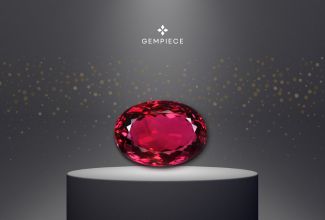
Natural, untreated andesine in its most common form occurs in pale yellow, white, gray, and occasionally pale green — colors that have limited commercial appeal as gemstones. The gemologically significant color range — vivid red, orange-red, champagne, and color-changing green-to-red — requires either natural copper content (as in Oregon sunstone) or copper diffusion treatment to produce commercially. Some andesine displays a subtle schiller effect — a metallic, reflective sheen caused by light reflecting off internal planar structures — which adds optical interest to cabochon-cut material.
Color-change andesine is the most rare and desirable natural variety, displaying a shift from green or teal under daylight to red or purple under incandescent light — a phenomenon produced by the specific absorption properties of the copper-bearing crystal under different spectral illumination. Natural color-change andesine from documented untreated sources is a genuine collector gemstone of significant rarity.
The Copper Diffusion Treatment Controversy
Between approximately 2002 and 2008, large quantities of vivid red, orange-red, and green andesine and andesine-labradorite flooded international gem markets, primarily presented as originating from the Democratic Republic of Congo, Tibet, and China. The material attracted significant commercial interest for its color intensity and accessible pricing. Experienced gemologists noted discrepancies — the volumes available were inconsistent with the reported sources, no prior documentation of natural red feldspar from these localities existed, and the color distribution in some stones appeared surface-concentrated rather than uniformly distributed throughout the crystal.
Investigation by multiple independent gemological researchers established that the majority of this material was pale andesine or labradorite that had undergone copper diffusion treatment — a process in which copper-bearing compounds are applied to the stone surface and heated to high temperatures, driving copper ions into the crystal lattice to produce an artificial red or orange-red color. The treatment produces a color zone concentrated near the stone's surface, detectable when recut or chipped surfaces are examined for color distribution, and confirmable through advanced spectroscopic analysis.
The controversy established copper diffusion treatment as a significant gemological concern for plagioclase feldspars and led to increased laboratory scrutiny of all red feldspar material. Some natural red andesine from Congo and Tibet was confirmed, but separating it from treated material requires laboratory analysis beyond the capability of standard visual gemological testing.
Oregon Sunstone — The Natural Benchmark
Oregon sunstone — mined from the Sunstone Butte deposit and related localities in Lake County, Oregon — is the most reliably documented source of natural, untreated red and orange feldspar of andesine-labradorite composition. Oregon sunstone contains natural copper inclusions and copper ions within the crystal lattice that produce red, orange, and green colors without any external treatment. The natural copper content in Oregon material is geologically explained by the volcanic environment of the deposit — a labradorite-andesine feldspar hosted in basaltic lava flows where copper-bearing fluids interacted with the crystallizing feldspar. Oregon sunstone with natural red color and laboratory-confirmed untreated status is the gold standard for natural copper-colored feldspar and commands the highest premiums in the market for this species.
Sources
Natural gem-quality andesine sources with documented provenance include Oregon, USA (the primary benchmark for natural untreated red feldspar), and the Democratic Republic of Congo near the Nyiragongo volcano (a small 2002 find of confirmed natural material). The Andes Mountains of South America represent the geological type locality but have not produced significant gem-quality material. China, Tibet, and Mongolia have produced andesine used as base material for copper diffusion treatment. Japan and parts of Europe also host andesine mineralogically but without commercial gem-quality production.
Treatment Status and Disclosure
Treatment disclosure is the most critical aspect of any andesine transaction. Copper diffusion treated andesine is a commercially legitimate product when properly disclosed — it is a real gemstone with a real treatment that produces a real, stable color, and it has market value at appropriate pricing. What is not acceptable is misrepresenting treated material as natural untreated andesine. GemPiece provides explicit treatment disclosure on every andesine stone — natural untreated status is confirmed by laboratory documentation where available, and treated material is clearly labeled as such.
Value Factors
Natural, untreated andesine with confirmed red or color-change character from verified origins — particularly Oregon sunstone with laboratory certification — commands the highest values. Color-change andesine in natural untreated form is the most coveted collector variety. Treated andesine has commercial value at appropriate prices with full disclosure. For all andesine, color saturation, transparency, size, and cut quality influence per-stone pricing. Laboratory certification from a reputable gemological laboratory is strongly recommended for any significant purchase.
Durability and Jewelry Use
Andesine's hardness of 6 to 6.5 and perfect cleavage in two directions make protective settings essential for ring use. Bezel and half-bezel settings provide the most appropriate protection. Earrings and pendants are the most practical everyday applications. Avoid exposure to extreme heat for copper-diffusion treated material, as high temperatures could theoretically affect the treatment. Handle with care and avoid sharp impacts along cleavage directions.
Care and Maintenance
Clean andesine with warm water, mild soap, and a soft cloth. Avoid ultrasonic cleaning for treated material. Steam cleaning is not recommended. Avoid prolonged sun exposure and contact with harsh chemicals. Store separately from harder gemstones to prevent contact scratching.
Explore Related Feldspar and Color-Change Gemstones
Collectors of feldspar gemstones and color-change varieties may also appreciate moonstone (view collection), diaspore (view collection), and color change sapphire (view collection).