
Kornerupine – Vivid Green Borosilicate, Pleochroism and Value
Kornerupine is a gemstone that specialist dealers and gemologists return to repeatedly as an example of a species whose optical quality and collector merit have never been reflected in its market price — a consistently undervalued green gemstone that produces naturally vivid colors, strong pleochroism, and occasional cat's eye effects in a durable, naturally untreated package. Named for Andreas Nikolaus Kornerup — the Danish scientist and explorer who contributed significantly to the understanding of Greenlandic geology — kornerupine was first described from Fiskenaesset, Greenland in 1884 and has since been found in gem quality in Sri Lanka, Myanmar, Madagascar, and Kenya. This guide covers kornerupine's mineralogy, chromium-vanadium green color, strong pleochroism, cat's eye variety, and value.
Explore our natural kornerupine collection.
Mineral Composition and Physical Properties
Kornerupine is a complex borosilicate mineral with the approximate chemical formula Mg₃Al₆(Si,Al,B)₅O₂₁(OH) — a magnesium aluminum borosilicate with variable boron and aluminum content. It belongs to the orthorhombic crystal system and forms prismatic crystals, typically elongated along the c-axis. The boron content is a distinctive compositional feature shared with tourmaline and danburite within the gem mineral world, reflecting a geological association with boron-rich metamorphic and metasomatic environments.
Kornerupine measures 6.5 to 7 on the Mohs hardness scale. Specific gravity is 3.28 to 3.35. The refractive index is 1.665 to 1.699, biaxial negative, with birefringence 0.013 to 0.017. Cleavage is imperfect in one direction — less of a practical concern than the perfect cleavage of topaz or feldspar. The combination of reasonable hardness, imperfect cleavage, and natural color makes kornerupine a practical collector gemstone for all standard jewelry applications.
Color and Pleochroism
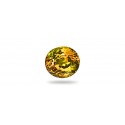
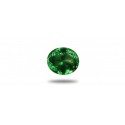
Kornerupine's most commercially significant colors are green and brown-green, produced by trace chromium and vanadium substituting within the crystal lattice — the same elements responsible for the green of emerald, tsavorite, and chrome tourmaline. The vivid green of fine kornerupine can approach the saturation of these premium green gemstones while remaining available at significantly lower prices due to lower market awareness.
Kornerupine is strongly pleochroic across its optical axes, displaying typically colorless to pale yellow (along one axis), green (along the second axis), and brown to yellow-brown (along the third axis). A well-oriented cut maximizes the green trichroic direction face-up while the brown-yellow tones are visible in the pavilion at oblique angles, adding the characteristic optical depth of a strongly pleochroic gemstone. Rare colorless kornerupine is known, as are blue-green and brown varieties.
Cat's Eye Kornerupine
Chatoyant kornerupine is the most collectible form of the species. Parallel fibrous inclusions or growth channels within kornerupine crystals occasionally develop in sufficient density and alignment to produce a sharp cat's eye effect in cabochon form. Fine cat's eye kornerupine from Sri Lanka in vivid green body color with a well-defined, sharp eye is a specialist collector gemstone of genuine rarity — rare within the kornerupine species itself, which is already uncommon in fine facetable quality.
Sources
Sri Lanka's gem-bearing gravels are the most important and prestigious commercial source of faceted kornerupine, producing fine green to brown-green material of excellent transparency and collector quality. Myanmar produces green kornerupine comparable in quality to fine Sri Lankan material. Madagascar is a significant secondary source. Kenya's Umba Valley produces kornerupine in various colors. The type locality in Greenland and occurrences in Canada and Australia are mineralogically documented but not commercially significant for gem production.
Treatment Status
Kornerupine is not treated. The natural color — produced by chromium and vanadium — requires no enhancement. This untreated natural status is consistent across all commercial kornerupine and is a significant value attribute for collectors.
Value Factors
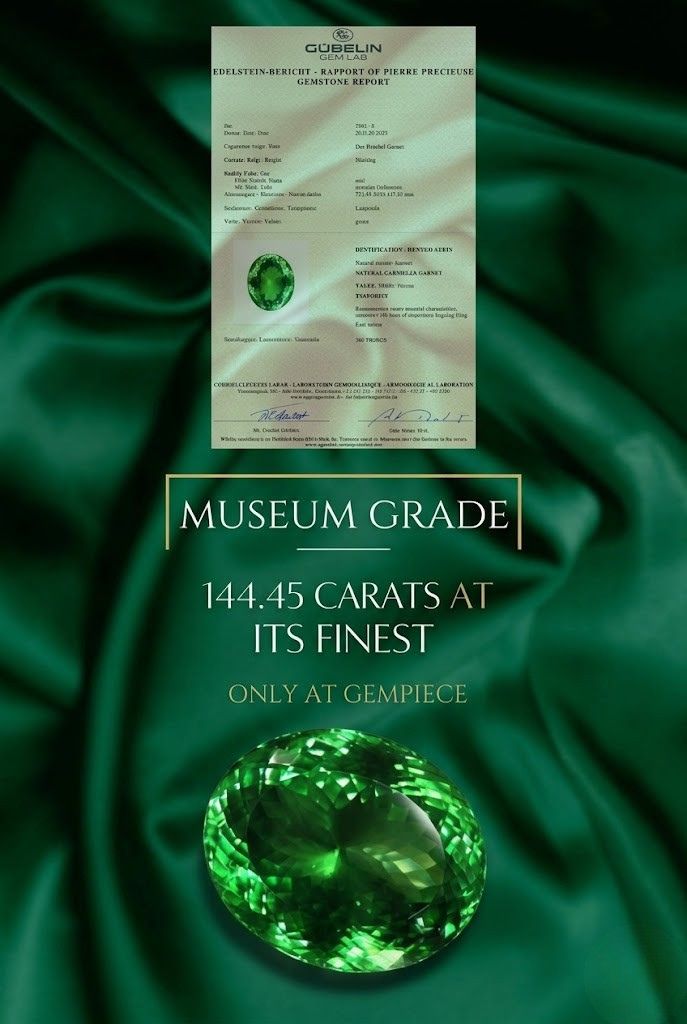
Vivid green color with good saturation and transparency from Sri Lanka or Myanmar is the primary value driver. Cat's eye quality — sharpness, centering, and definition of the eye — drives cat's eye kornerupine value. Eye-clean clarity and well-oriented cutting maximizing green face-up add significant value. Kornerupine is consistently underpriced in the current market relative to its optical quality — vivid green kornerupine of comparable color to tsavorite garnet sells at a fraction of tsavorite's per-carat price, representing a genuine collector opportunity.
Durability and Care
Clean with warm water, mild soap, and soft brush. Avoid ultrasonic cleaning for stones with fractures. Steam cleaning is generally safe for clean specimens. Store separately from harder gemstones.
Explore Related Green and Collector Gemstones
Chrome diopside (view collection), chrome sphene (view collection), and andalusite (view collection).