









Sillimanite Cat's Eye – Fibrolite Chatoyancy, Myanmar and India
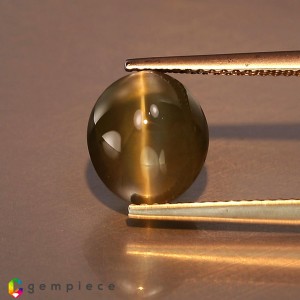
Sillimanite cat's eye is the chatoyant gem form of sillimanite — the aluminum silicate polymorph (Al₂SiO₅) that forms at the highest temperature conditions of the three kyanite-andalusite-sillimanite trio — and represents by far the most commercially and collector-significant gem expression of this mineral species. The fibrous aggregate crystal habit of sillimanite (also known as fibrolite in this form) is uniquely suited to produce strong, sharp chatoyancy in cabochon form: the parallel fibrous crystals that make up fibrolite act as a dense array of aligned scattering surfaces that reflect light as a concentrated, mobile band when the correctly oriented cabochon is viewed under a single directional light source. This guide covers the fibrolite habit and its optical mechanics, quality grading, the distinction between Indian and Myanmar material, and collector value.
Explore our sillimanite cat's eye collection or the full sillimanite family.
Mineral Composition and the Fibrolite Habit
Sillimanite cat's eye is composed of fibrolite — the fibrous aggregate form of the aluminum silicate Al₂SiO₅ in the orthorhombic crystal system. Rather than forming as large single crystals suitable for faceting, fibrolite consists of tightly packed masses of long, parallel fibrous crystals oriented along the c-axis of the orthorhombic structure. This microstructure is the direct cause of both the chatoyancy and the characteristic silky visual appearance of polished sillimanite cat's eye cabochons.
Physical properties: hardness 6 to 7.5 (variable along vs. across fiber direction); specific gravity 3.23 to 3.27; refractive index 1.659 to 1.683, biaxial positive; perfect cleavage in one direction parallel to fiber length. The variability of hardness with direction — hardest across the fibers, softer along them — is structurally analogous to the anisotropic hardness of kyanite and reflects the same fundamental relationship between bond geometry and scratch resistance in these Al₂SiO₅ polymorphs.
The Chatoyancy Mechanism in Fibrolite
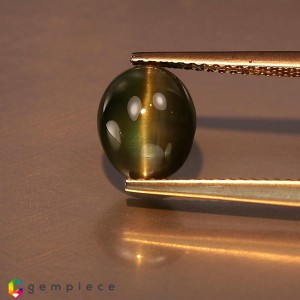
The parallel fibrous crystals in fibrolite are the structural analog of the inclusion sets that produce chatoyancy in other cat's eye gemstones — they function as a natural, densely packed array of aligned scattering surfaces. When a single light source illuminates the curved dome of a fibrolite cabochon cut with the fiber direction perpendicular to the dome's length, the fibers collectively reflect light as a narrow, bright band that travels smoothly across the dome as the stone is rotated — the classic cat's eye. The sharpness of this band depends on the uniformity and density of fiber packing — very tightly packed, precisely parallel fibers produce the sharpest, most brilliant cat's eye.
Unlike cat's eye gemstones where chatoyancy is produced by inclusions within an otherwise transparent crystal (chrysoberyl, scapolite, moonstone), sillimanite cat's eye is produced by the crystal's own structural habit — the fibrous aggregate is the gemstone, not a feature within it. This means that sillimanite cat's eye is inherently opaque to translucent rather than transparent, and the aesthetic appeal comes from the combination of the silky fibrous body surface and the bright mobile eye rather than from depth of transparency.
Indian vs Myanmar Material
India — primarily Odisha (formerly Orissa) and Bihar states — is the dominant commercial source of sillimanite cat's eye, producing a wide range of quality from standard commercial grade to collector quality at accessible prices. Indian material is typically grey to white in body color with variable eye sharpness; the best Indian material shows a well-defined eye against a clean, even grey body. Myanmar is the source of the finest quality sillimanite cat's eye in the market — blue-grey material with a distinctive cool body color, exceptional fiber uniformity, and the sharpest and brightest cat's eye effects known in the species. Myanmar sillimanite cat's eye commands meaningful collector premiums for both origin and quality.
Treatment Status
Sillimanite cat's eye is not treated. The chatoyancy and body color are entirely natural properties of the fibrolite crystal aggregate. No enhancement is applied.
Value Factors
Eye sharpness, brightness, and mobility are the primary value drivers — a crisp, well-centered, strongly reflective eye against a clean, even body is the premium quality combination. Body color quality is the secondary factor — the cool blue-grey of fine Myanmar material commands premiums over common grey-white Indian material. Size matters significantly: large, clean sillimanite cat's eye above 15 carats with strong chatoyancy is genuinely uncommon collector material. Myanmar origin with documentation adds provenance value.
Explore Related Gemstones
Sillimanite (view collection), scapolite cat's eye, and moonstone cat's eye (view collection).