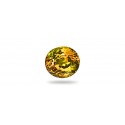

Clinohumite – Rare Orange Gem from the Pamir Mountains
Clinohumite is a gemstone that most professional gemologists will encounter perhaps once in a career — a genuinely rare magnesium silicate mineral whose gem-quality form is so limited in supply that it occupies a category of its own in the collector market. Discovered in 1876 within limestone blocks ejected from Mount Vesuvius, clinohumite remained for over a century a mineralogical curiosity rather than a commercial gemstone. The discovery of transparent gem-quality material in the Pamir Mountains of Tajikistan in the late twentieth century transformed it into one of the most coveted collector gemstones on the market today. This guide covers clinohumite's mineralogy, optical properties, Pamir Mountain origins, clarity characteristics, and market value.
Explore our natural clinohumite gemstone collection sourced directly from trusted Tajikistan suppliers.
Mineral Composition and Physical Properties
Clinohumite is a magnesium iron silicate mineral belonging to the humite group — a family of minerals named after the English gem collector Sir Abraham Hume. Its chemical formula is (Mg,Fe)₉(SiO₄)₄(F,OH)₂, with the monoclinic crystal structure reflected in its name — "clino" refers to the monoclinic (oblique) crystal system, distinguishing it from the related orthorhombic mineral humite. The humite group also includes norbergite, chondrodite, and humite itself, but clinohumite is the only member of the group found regularly in gem-quality form.
Clinohumite measures 6 to 6.5 on the Mohs hardness scale. Its refractive index ranges from 1.623 to 1.728 — notably high for its chemical class — contributing to its strong brilliance. The specific gravity is approximately 3.17 to 3.35, slightly variable depending on iron content. Birefringence is moderate at 0.028 to 0.041. Clinohumite is fluorescent, glowing tan to yellowish-orange under shortwave UV light — a useful identification characteristic.
Color and Optical Properties
Clinohumite's color in gem-quality specimens ranges from pale golden yellow through vivid orange to deep reddish-orange, with some brownish specimens also known. The most commercially prized color is a pure, saturated medium orange — a warm, glowing tone reminiscent of fine spessartite garnet but with the distinctive optical character of the humite group.
Clinohumite is distinctly pleochroic, showing subtle shifts between orange, yellow to brown, and near-colorless when viewed along different crystallographic axes. A characteristic feature of clinohumite's optical behavior is that its brilliance color — the lighter color seen in reflected light — is always lighter than the body color, creating a layered visual depth that enhances the stone's appeal when rotated under light.
Discovery and History
Clinohumite was first described in 1876 by the French crystallographer Alfred des Cloizeaux from specimens found in limestone blocks ejected during a volcanic eruption of Mount Vesuvius near Naples, Italy. The mineral was named for its monoclinic crystal structure and its relationship to the humite mineral group. For over a century, clinohumite was known only as an opaque or translucent mineral with no commercial gem application.
The emergence of transparent gem-quality clinohumite from the Pamir Mountains of Tajikistan — a deposit discovered and developed in the late twentieth century — fundamentally changed the mineral's status. Tajikistan clinohumite rapidly attracted collector attention for its vivid color, fluorescence, pleochroism, and extraordinary rarity. Today, Pamir clinohumite is recognized as one of the most desirable and collectible rare gemstones in the world.
Origins and Sources
The definitive source of gem-quality clinohumite is the Pamir Mountains of Tajikistan, where the mineral occurs in association with high-pressure metamorphic marble formations — the same geological environment that produces the fine Tajikistan spinel for which the region is renowned. The remote, high-altitude location of the Pamir deposits and the limited volume of gem-quality material extracted each season contribute directly to clinohumite's scarcity.
Secondary sources include the Taimyr Peninsula in northern Russia and the Magenhe deposit in Tanzania. Material from these localities is occasionally faceted but is generally less commercially significant than Tajikistan clinohumite in terms of both quality and market recognition.
Clarity Characteristics
Clinohumite is typically included. Even in gem-quality material, most specimens contain visible inclusions including fingerprints, euhedral crystal inclusions, color zoning, and microscopic distributed inclusions that create a translucent to near-transparent appearance. Eye-clean or near-eye-clean transparent clinohumite is rare and commands the highest premiums. Semi-transparent clinohumite with microscopic distributed inclusions is more commonly available and retains strong collector interest due to the species' rarity. Inclusions are accepted and expected for this species — clarity expectations differ fundamentally from those applied to emerald, aquamarine, or other Type I and Type II gemstones.
Treatment Status
Clinohumite is not treated. No known treatment exists for this species, and no synthesis has been commercially developed. Every clinohumite in the market is natural and untreated — a significant distinction for collectors who prioritize natural gemstones. GemPiece provides complete treatment disclosure on every stone offered.
Value Factors
Clinohumite value is driven primarily by transparency, color saturation, and origin. Transparent Pamir Tajikistan material with vivid orange color commands the highest prices. Size is a major value driver — most gem-quality clinohumite is under 1 carat, and stones above 2 carats in transparent quality represent significant collector acquisitions. Semi-transparent material is more accessible in price while retaining strong collector appeal due to rarity. The complete absence of treatment is a consistent value attribute of the species.
Durability and Jewelry Use
With a Mohs hardness of 6 to 6.5, clinohumite is suitable for jewelry in protected settings. Earrings, pendants, and bezel-set rings are the most appropriate applications. Given its rarity and collector value, many clinohumite owners choose to display the stone loose or in protective settings rather than in daily-wear jewelry. With appropriate care, clinohumite jewelry is practical and uniquely distinctive.
Care and Maintenance
Clean clinohumite with warm water, mild soap, and a soft brush. Avoid ultrasonic and steam cleaning. Store separately from harder gemstones to prevent contact scratching. Avoid exposure to harsh chemicals and prolonged direct sunlight. Handle with care and avoid sharp impacts.
Explore Related Rare Gemstones
Collectors of rare orange gems may also appreciate sphene (view collection), triplite (view collection), and diaspore (view collection).