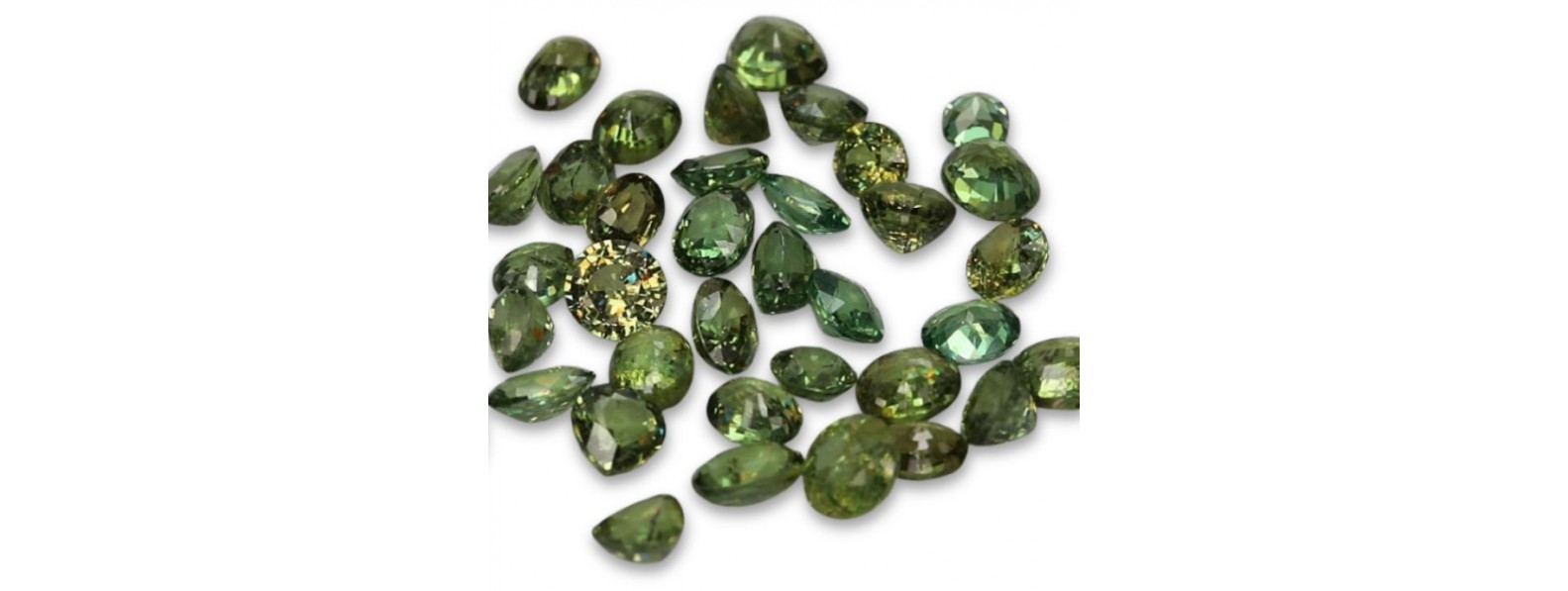
Understanding Demantoid Garnet
Demantoid garnet rewards those who take the time to understand it. On the surface, it is a vivid green garnet. Below the surface, it is a mineralogical and optical phenomenon — a stone with dispersion that measurably exceeds diamond, a formation story tied to the deepest processes of serpentinization in the earth's crust, an inclusion type that defies conventional gemological valuation logic, and a market history intertwined with Russian imperial luxury. This guide covers all of it in the depth the stone deserves.
Browse our demantoid garnet collection and andradite garnet collection. For related guides see Andradite Garnet Guide, Tsavorite Garnet Guide, and the complete Garnet Gemstone Guide.
What Is Demantoid Garnet
Demantoid is the gem-quality green variety of andradite garnet, a calcium iron silicate mineral with the formula Ca₃Fe₂(SiO₄)₃. It belongs to the ugrandite series of the garnet group, where calcium occupies the X-site of the crystal lattice and ferric iron occupies the Y-site. The vivid green color is produced by chromium (Cr3+) substituting for iron within this lattice framework, with the precise concentration and oxidation state of chromium versus ferric iron determining the exact shade and intensity of green displayed.
The name demantoid derives from the Dutch and German word "demant" meaning diamond, coined in recognition of the stone's exceptional brilliance and fire. This was not hyperbole when it was named, and it is not hyperbole now: demantoid's dispersion value of 0.057 is scientifically measured to exceed diamond's 0.044. This means that under equivalent lighting conditions, a well-cut demantoid produces more spectral color flashes — more fire — than a diamond of similar size and cut quality. The combination of this optical performance with vivid natural green color in a completely untreated gemstone is, within the entire mineral kingdom, unique to demantoid.
Discovery, History, and Cultural Significance
The story of demantoid is inseparable from the story of imperial Russia. The gemstone was first discovered in 1853 along the Bobrovka River, a tributary of the Chusovaya River in the Nizhny Tagil district of the Ural Mountains. Local platinum miners found small green crystals in the alluvial gravels and initially could not identify them. Finnish mineralogist Nils Gustaf Nordenskiöld examined the material in 1854, identified it as a new variety of andradite garnet, and recognized its extraordinary optical properties.
Within a decade, demantoid had attracted the attention of the Russian aristocracy and, most consequentially, the Fabergé workshops in St. Petersburg. Carl Fabergé and his craftsmen incorporated demantoid garnet into their celebrated Easter eggs, jewelry pieces, and decorative objects created for the Romanov family and European royalty. The warm, vivid green stones set in intricate gold settings became synonymous with imperial Russian luxury and remain some of the most recognized gemstone jewelry in art history.
Demantoid's association with Russian imperial culture elevated its prestige and established the standards against which all subsequent discoveries are compared. When Russian production declined through the 20th century and the stones became scarce, their absence from the contemporary market only deepened the mystique. Pieces containing demantoid from the Fabergé era have sold at auction for extraordinary prices, with the gemstones themselves commanding significant premiums independent of the jewelry setting.
The modern chapter of demantoid history began in 1996 with the discovery of the Green Dragon Mine in Namibia's Erongo region, followed by the 2009 Antetezambato discovery in Madagascar. These sources reintroduced demantoid to contemporary jewelry and the collector market, though they have not resolved the fundamental scarcity that makes fine demantoid so valuable.
Mineralogy and Crystal Chemistry
Demantoid belongs to the andradite species within the ugrandite series of the garnet group. Its chemical formula is Ca₃Fe₂(SiO₄)₃, with calcium and ferric iron as the dominant cations. The color-producing mechanism involves chromium (Cr3+) substituting for iron (Fe3+) in the Y-site of the crystal structure. The proportion of chromium versus total iron determines the color outcome: higher chromium content drives color toward a more saturated green; lower chromium content allows the ferric iron's absorption spectrum to influence the color toward yellowish-green or brownish tones.
Demantoid crystallizes in the isometric (cubic) system, forming characteristic dodecahedral and trapezohedral crystal shapes. As a singly refractive mineral, it does not exhibit birefringence, which is a useful identification property distinguishing it from doubly refractive green stones such as tourmaline and peridot.
The absence of cleavage in demantoid (shared by all garnets) means that crystals do not have preferential fracture planes, making them more durable to impact forces than cleaved gemstones and allowing cutters to orient stones for maximum optical performance without cleavage risk. This is practically significant for demantoid because its softness (6.5 Mohs) already presents cutting challenges; the absence of cleavage at least eliminates one major cutting hazard.
Physical and Optical Properties in Detail
Hardness: 6.5 on the Mohs scale. This is the defining practical limitation of demantoid and must be understood by any buyer. At 6.5 Mohs, demantoid is softer than quartz (7 Mohs), meaning that common dust particles — which often contain quartz — can scratch the polished surface of a demantoid ring over time. Protective settings for ring use are not optional; they are necessary for long-term preservation of surface quality. For earrings, pendants, and brooches, the hardness presents no practical concern.
Refractive Index: 1.880 to 1.889. This is the highest refractive index of any garnet species, substantially higher than tsavorite (1.734 to 1.759), rhodolite (1.740 to 1.770), or spessartite (1.790 to 1.820). The high RI is directly responsible for demantoid's exceptional surface luster, which approaches the adamantine quality of diamond and sphene. Light entering the stone is bent more sharply by a high-RI material, contributing to the intensity of internal reflections.
Dispersion: 0.057. This is the most defining optical property of demantoid and the physical basis for its legendary fire. Dispersion measures a mineral's ability to separate white light into its spectral components — the same property responsible for the rainbow patterns visible from a cut diamond or glass prism. Demantoid's dispersion of 0.057 exceeds diamond (0.044), sphene (0.051), and essentially all other commonly encountered natural gemstones. In practical terms, this means that a well-cut demantoid in good lighting displays more intense, more colorful fire than any other natural silicate crystal of equivalent size.
The interplay between body color and dispersion is important: in very dark green demantoids, the body color partially absorbs the dispersed spectral light, masking some of the fire. Lighter-toned stones often show more visible fire precisely because the green body color is less absorbing. This creates an interesting trade-off in evaluation: the darkest, most saturated greens are prized for color intensity but show less fire; the lighter stones show more spectacular dispersion but less saturated color. The most commercially desirable balance is a medium-to-medium-dark vivid green that retains strong dispersion — a combination found most consistently in fine Russian and Iranian material.
Specific Gravity: approximately 3.84. This is notably higher than tsavorite (approximately 3.61) and most other green gemstones, providing a gemological tool for identification when visual assessment is ambiguous.
Luster: Adamantine to resinous. The finest demantoids display a near-diamond-quality surface brilliance when freshly polished, a direct consequence of the high refractive index. This lustrous quality contributes significantly to the stone's visual impact.
Heat Sensitivity: Demantoid is heat-sensitive. Sudden temperature changes or exposure to direct heat sources can damage the stone. Steam cleaning is not appropriate. Jewelers working with demantoid-set pieces should avoid torch proximity to the stone.
Absorption Spectrum: Demantoid shows absorption of the blue end of the spectrum up to 460nm, partially masking the more typical 443nm andradite line. Fine lines in red at 620nm, 632nm, 693nm, and 700nm are present but difficult to detect due to the high chromium content that dominates the spectrum in green demantoid.
Formation Geology
Demantoid forms primarily in serpentinized ultramafic rocks — geological settings that are significantly rarer than the metamorphic environments producing most other garnets. The process begins with ultramafic rocks (peridotite, dunite, harzburgite) that are rich in magnesium, iron, and silica but poor in calcium. When these rocks are subjected to hydrothermal alteration in the presence of water, a process called serpentinization occurs: the olivine and pyroxene minerals within the rock break down and react with circulating water to form serpentine minerals.
Demantoid forms at this interface between the hydrothermal fluid and the serpentinizing rock. The fluids introduce calcium and additional silica from surrounding geological formations, which combine with the iron-rich serpentinized environment to crystallize calcium-iron silicate — andradite garnet. When the hydrothermal fluid also carries trace chromium (typically derived from chromite minerals within the ultramafic rock), this chromium enters the growing andradite crystal lattice and produces the green coloration of demantoid.
The horsetail inclusions characteristic of Russian demantoid are a direct product of this geological environment. The chrysotile fibers (a serpentine mineral variety) grew in the fractures and cavities of the serpentinized host rock simultaneously with the andradite crystals. When andradite crystallized around these pre-existing fibers and chromite nuclei, it trapped them as inclusions. This is why horsetail inclusions are geologically diagnostic of the serpentinite host environment — and why their presence in a demantoid is, in a very real sense, geological evidence of the stone's origin.
In Namibia and some other locations, demantoid also forms in skarn deposits — contact metamorphic zones where igneous intrusions interact with carbonate-bearing rocks. Skarn-type demantoids tend to be cleaner than serpentinite-type material because the formation environment is different, which explains why Namibian stones typically lack horsetail inclusions but often achieve better face-up clarity.
Horsetail Inclusions: Geology, Gemology, and Value
Horsetail inclusions in demantoid garnet represent one of the most famous and most discussed features in all of practical gemology. Their significance spans geology (as environmental indicators of formation conditions), gemology (as identification and origin markers), and commerce (as value-enhancing rather than value-diminishing inclusions).
Under magnification, horsetail inclusions appear as fine, curved, radiating fibers of golden to brownish-golden color emerging from a central nucleus, fanning outward in a pattern that genuinely resembles the flowing tail of a horse. The fibers are composed of chrysotile, a fibrous variety of serpentine mineral. The central nucleus from which they radiate is typically a chromite crystal, an iron-chromium oxide mineral that is a natural constituent of the ultramafic rock environment where Russian demantoid forms.
The inclusions form not because the garnet crystal trapped foreign material accidentally, but because the chrysotile fibers and their chromite nuclei were already present in the serpentinized rock matrix when the andradite began crystallizing. As the garnet grew around this pre-existing material, it incorporated the fibers and nuclei into its lattice. The result is a geological snapshot — preserved within the crystal — of the exact formation environment at the microscopic scale.
In standard gemological valuation, inclusions reduce a stone's value by diminishing clarity and potentially disrupting brilliance. Horsetail inclusions in demantoid represent a recognized exception. The reasons are both pragmatic and aesthetic. Pragmatically, well-developed horsetails provide strong circumstantial evidence of Russian origin, the most commercially prestigious source for demantoid. Aesthetically, a fine horsetail inclusion under magnification is genuinely beautiful — it adds a visual dimension to the stone that is visible with a loupe and distinct to this one gemstone variety.
It must be noted, based on a 2018 gemological study, that horsetail inclusions are no longer exclusively diagnostic for Russian origin or even for demantoid specifically — they have been found in non-demantoid brown andradite and in some Iranian and Italian demantoid material. However, the association remains strongest with Russian material, and laboratory-verified Russian origin with visible horsetails continues to command the market's highest premiums for this variety.
Gemological literature recommends that demantoids with horsetail inclusions be cut with the inclusion oriented toward the crown (top) of the finished stone so the fibrous pattern is visible from the face-up viewing position. This cutting orientation maximizes the visual display of the inclusion and is a sign of a knowledgeable lapidary working with premium Russian material.
Origin Comparison: Russia vs Namibia vs Madagascar
The three primary commercial origins for demantoid each produce distinctly different material, and understanding these differences is essential for intelligent purchasing.
Russia (Ural Mountains, primarily Nizhny Tagil district): Russian demantoid is the benchmark against which all other origins are judged. The warm yellowish-green color of the finest Russian stones — sometimes described as "grass green with golden undertones" — is distinct from the cooler greens of Namibian material. Nearly all Russian demantoid contains chrysotile inclusions of some form, and well-developed horsetail patterns are strongly associated with this origin. Russian stones above one carat are genuinely rare; above two carats, they approach museum quality. Laboratory verification of Russian origin (GIA, Gübelin, or AGL) adds a premium of 30% to 100% or more over equivalent non-Russian material depending on size and quality.
Namibia (Erongo Region, primarily Green Dragon Mine): Namibian demantoid introduced the contemporary market to demantoid on a commercial scale from 1996 onward. The material is characterized by excellent transparency, vivid cool green color (slightly less warm than Russian), and more consistent availability in sizes above one carat than Russian material. Stones over two carats are more regularly seen from Namibia than from Russia, though large clean pieces remain uncommon. Horsetail inclusions are generally absent, but the high face-up clarity of Namibian stones often makes them more visually impressive to buyers who prioritize clean appearance over inclusion character. For jewelry applications where maximum face-up beauty is the goal, fine Namibian demantoid frequently outperforms Russian material at a significantly lower price.
Madagascar (Antetezambato, Antsiranana Province): Madagascar has become a significant source since 2009 and has produced some of the largest demantoid crystals recorded. Madagascar material ranges from yellowish-green to deep vivid green and has produced exceptional stones in sizes that exceed what Russian and Namibian deposits typically yield. Some Madagascar demantoid displays inclusion patterns reminiscent of horsetails, making it particularly interesting for collectors. The deposit has also produced large faceted stones that have appeared at international gemstone shows and attracted serious collector attention.
Iran (Belqeys Mountain, West Azerbaijan): Iranian demantoid, from the Belqeys Mountain deposit near the town of Takab, has gained significant recognition since the mid-2000s. Iranian stones display vivid green color with good transparency and occasionally show horsetail inclusions. The geological environment is similar to the Russian serpentinite setting, which explains the presence of horsetails in some Iranian material. Iranian demantoid represents an emerging alternative for buyers seeking Russian-style characteristics without the full Russian premium.
Italy (Val Malenco in Sondrio, Ala in Piedmont): Italy has a long history of demantoid production from skarn deposits, particularly in the Alps. Italian stones tend toward apple-green to yellowish-green tones and have contributed to the historical gemological record. Commercial production is limited, and Italian demantoid is primarily encountered in older pieces and mineral specimen collections rather than the current gem market.
Demantoid vs Tsavorite: The Two Green Garnets
Demantoid and tsavorite are the two most commercially important green garnets and are frequently compared by buyers evaluating green gemstone options. Despite both being green garnets, they are fundamentally different mineral species with different optical properties, different formation environments, different hardness profiles, and different price structures.
Demantoid (andradite, Ca₃Fe₂Si₃O₁₂) has higher dispersion (0.057) and higher RI (1.880 to 1.889), producing more fire. Tsavorite (grossular variety, Ca₃Al₂Si₃O₁₂) has greater hardness (7 to 7.5 Mohs versus 6.5) and is more suitable for daily-wear ring applications. Tsavorite is typically cleaner in clarity and available in a wider range of sizes; demantoid is rarer but peaks at higher values for the finest Russian material. Both are completely untreated.
In the current market (2025 to 2026), fine Kenyan tsavorite above two carats in vivid color commands $3,000 to $8,000 per carat. Fine Russian demantoid with horsetail inclusions above one carat commands $2,000 to $15,000 per carat. At the very top of the market, exceptional Russian demantoid outprices exceptional tsavorite on a per-carat basis.
Demantoid and the Fabergé Legacy
Carl Fabergé's workshops used demantoid garnet extensively in the Imperial Easter Eggs and associated jewelry created for the Romanov family between approximately 1880 and 1917. The use of small, vivid green demantoids as foliate details, flower centers, and accent stones in intricate gold and enamel work established the aesthetic vocabulary of Russian imperial jewelry that influenced decorative arts across Europe.
The Fabergé legacy has materially affected the demantoid market in two ways. First, it established the cultural prestige of Russian-origin demantoid as distinct from all other origins — a prestige that persists in current pricing. Second, it created a market for antique Russian jewelry containing demantoid, where the provenance of the stones contributes to the overall piece's value beyond the simple gemological assessment of the individual stones. Antique Fabergé pieces containing demantoid garnet are among the most valuable decorative art objects in existence.
Value, Market Pricing, and Investment
Demantoid garnet pricing is driven by a hierarchy of factors: origin (Russian commands the highest premium), size (price per carat rises steeply with size across all origins), color saturation and tone (vivid medium-to-dark green is optimal), clarity (including the special case of horsetail inclusions for Russian stones), and cutting quality (which directly affects how effectively the exceptional dispersion is displayed).
Current market pricing by origin and size, as of 2025 to 2026:
Russian demantoid, with well-developed horsetail inclusions and good color, verified by GIA or Gübelin laboratory report: 0.5 to 1 carat at $500 to $2,000 per carat; 1 to 3 carats at $2,000 to $15,000 per carat; 3 to 5 carats at $8,000 to $30,000 per carat; exceptional stones above 5 carats reach extraordinary prices at specialized auction.
Namibian demantoid, without horsetail inclusions, good clarity and vivid green: 0.5 to 1 carat at $200 to $900 per carat; 1 to 3 carats at $300 to $2,000 per carat; above 3 carats at $800 to $5,000 per carat depending on quality. Iranian and Madagascar demantoid with good color and clarity typically prices between Namibian and Russian levels depending on specific quality factors.
From an investment perspective, fine demantoid garnet has demonstrated consistent long-term value appreciation. The combination of genuinely constrained global supply, growing collector demand, and the entirely natural untreated status that the most sophisticated segment of the gem market prioritizes creates favorable fundamentals. Significant pieces with laboratory documentation of origin and quality retain value through market cycles more consistently than lower-quality material.
Care and Maintenance
Demantoid garnet requires specific care practices that differ from those appropriate for harder gemstones. The 6.5 Mohs hardness means that common environmental abrasives including household dust (which contains quartz particles at 7 Mohs) can scratch the polished surface over time if the stone is unprotected. Daily-wear ring stones should be in protective settings and removed during activities involving potential impact or abrasion.
Clean demantoid with warm water, mild soap, and a soft-bristle brush. Rinse thoroughly. Avoid ultrasonic cleaners entirely for any demantoid with visible inclusions, particularly horsetail inclusions — the vibration can propagate fractures from existing chrysotile fibers into the host crystal. Do not use steam cleaning. Avoid thermal shock from sudden temperature changes. Store demantoid separately from harder stones (diamond, sapphire, tsavorite) to prevent surface contact and scratching.
Buying Demantoid Garnet
When evaluating demantoid, the primary criterion is color tone and brightness in face-up position. The stone should display a vivid, open green with strong light return. Avoid stones so dark they appear near-black or brownish in standard lighting — these show little of the dispersion that makes demantoid extraordinary. A medium-to-medium-dark vivid green with the fire clearly visible in normal lighting conditions is the ideal target.
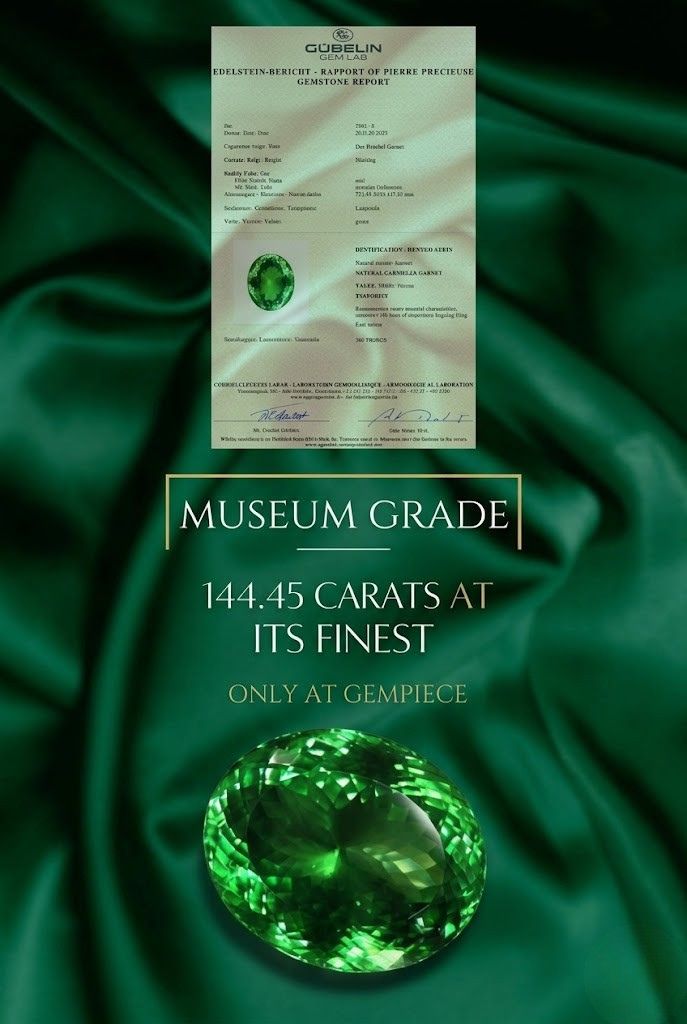
For horsetail inclusions, verify their presence clearly under 10x magnification. Do not accept verbal descriptions alone — the inclusions should be demonstrably visible and well-formed. For Russian origin claims at premium pricing, a laboratory report from GIA, Gübelin, or AGL confirming species, origin, and treatment status is not optional — it is a necessary purchase protection.
At GemPiece, all demantoid origin representations are verified and accurate. We work with established suppliers across Russia, Namibia, Madagascar, and Iran, and maintain strict transparency on treatment disclosure and origin claims for every stone we sell. Browse our demantoid garnet collection and explore related guides: Andradite Garnet Guide, Tsavorite Garnet Guide, Color Change Garnet Guide, and the complete Garnet Gemstone Guide.