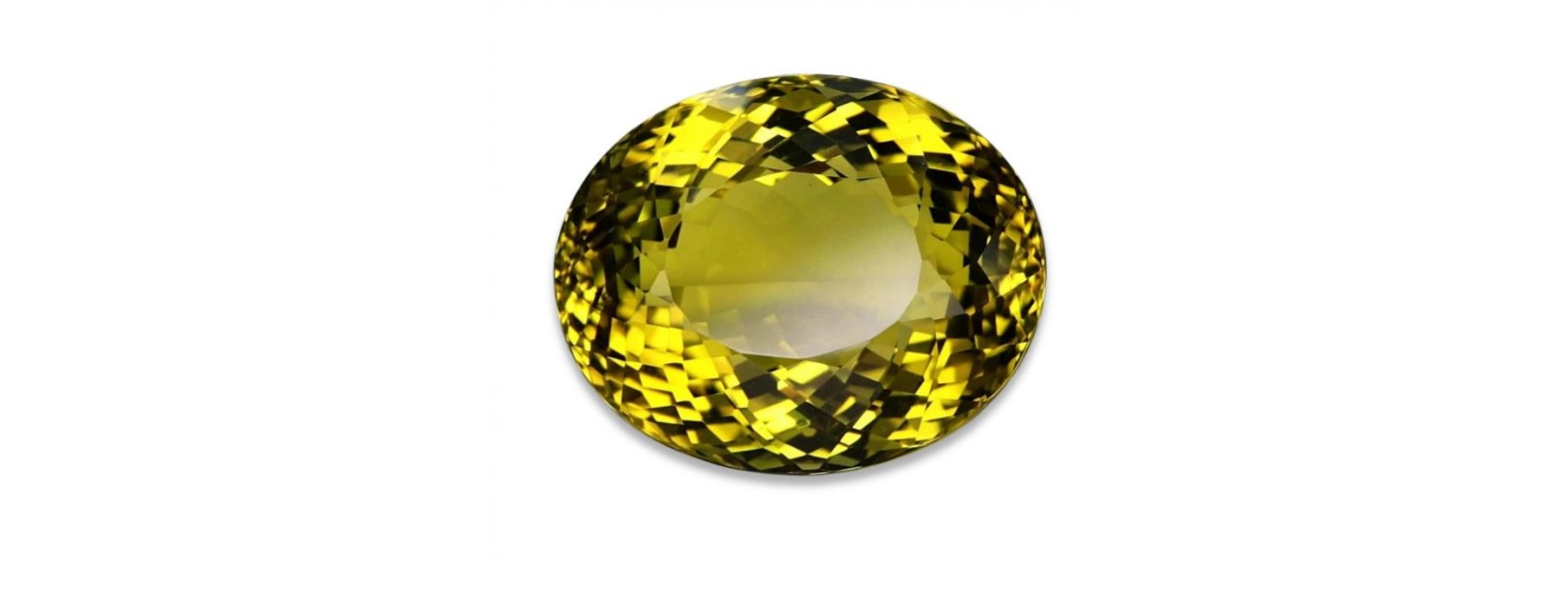
Prasiolite is the green variety of macrocrystalline quartz (SiO₂) — the only green member of the macrocrystalline quartz gem family, and one of the most commercially interesting treated gemstones in the affordable colored stone market. Named from the Greek prason (leek) and lithos (stone), prasiolite's characteristic pale to medium yellowish-green to leek-green color occupies a unique position among green gems: lighter and cooler than emerald, warmer and more distinctly yellow-green than blue-green tourmaline, and different in character from the warm olive-yellow of peridot. Prasiolite is commercially produced by heat-treating iron-bearing amethyst from specific geological deposits — primarily Montezuma, Minas Gerais, Brazil — at approximately 500 degrees Celsius, a stable and accepted treatment that converts amethyst's purple Fe³⁺ color centers to the green Fe²⁺ configuration of prasiolite. Natural prasiolite — formed by equivalent geological processes in situ — exists in rare quantities from Poland and a small Brazilian locality and represents a genuine gemological rarity. This comprehensive prasiolite gemstone guide covers mineralogy, color origin and treatment mechanism, the natural vs. treated distinction, geological sources, gemological properties, the naming controversy (prasiolite vs. green amethyst), value factors, comparison with peridot, emerald, tsavorite, and other green gems, jewelry applications, and care.
Explore our prasiolite collection — or return to the complete quartz gemstone guide (view all quartz). Related variety guides: amethyst (view collection), citrine (view collection), lavender quartz (view collection), lemon quartz (view collection), and rose quartz (view collection).
Mineralogy and Chemical Composition
Prasiolite is silicon dioxide (SiO₂) in its macrocrystalline trigonal form — the same mineral species, chemical formula, and crystal structure as amethyst, citrine, smoky quartz, rose quartz, lavender quartz, and all other macrocrystalline quartz gem varieties. The SiO₄ tetrahedral framework that constitutes the quartz crystal structure is one of the most stable mineral structures in nature, accounting for quartz's extraordinary chemical resistance, mechanical durability, geological ubiquity, and outstanding practical performance as a gemstone material. Prasiolite is distinguished from all other quartz varieties purely by the specific color mechanism and treatment history that produces its green color — not by any difference in chemistry, crystal structure, or physical properties. Mohs hardness 7. Specific gravity 2.65. Refractive index 1.544–1.553, uniaxial positive, birefringence 0.009. No cleavage — conchoidal fracture. Vitreous luster. Trigonal crystal system.
Color Origin: The Iron Mechanism and Heat Treatment Chemistry
The color of both natural and heat-treated prasiolite is produced by iron (Fe) ions within the silicon dioxide crystal lattice, in a specific oxidation state configuration that produces green light absorption and transmission. Understanding the iron chemistry is essential to understanding both amethyst and prasiolite — since prasiolite is, in the most fundamental sense, amethyst whose iron has been converted from one oxidation state to another.
In amethyst, the purple color is produced by Fe³⁺ ions (ferric iron) substituting for Si⁴⁺ in tetrahedral lattice positions, combined with charge-transfer interactions. These Fe³⁺ color centers absorb yellow and green wavelengths preferentially, transmitting violet and red wavelengths and producing the characteristic purple of amethyst. When amethyst is heated to approximately 300–500°C, the Fe³⁺ ions are reduced — gaining an electron — to become Fe²⁺ (ferrous iron). The Fe²⁺ configuration produces a fundamentally different absorption pattern: it absorbs in the red and yellow portions of the spectrum, transmitting green wavelengths, thereby converting the stone's color from purple to yellowish-green or green. This color conversion — from purple amethyst to green prasiolite — is the chemical basis of both natural prasiolite formation (geological heating) and commercial prasiolite production (artificial heat treatment).
Critically, not all amethyst can be converted to prasiolite by heating. Most amethyst heated to 500°C turns yellow to orange-yellow — producing citrine — rather than green. Only amethyst from specific geological deposits containing the right concentration and structural configuration of iron converts to green on heating. The Montezuma deposit in Minas Gerais, Brazil is the primary known commercial source where the iron chemistry is suitable for green conversion; the Four Peaks deposit in Arizona and select material from Poland and other localities also contain convertible amethyst in limited quantities. The geological variable responsible for green versus citrine conversion in different deposits is not fully understood and remains an active area of gemological inquiry.
Natural Prasiolite: Formation, History, and Rarity
Natural prasiolite forms when amethyst in specific geological settings is subjected to heat or irradiation by natural geological processes — typically by proximity to volcanic or geothermal heat sources, or by natural irradiation from radioactive minerals in the host rock environment. The resulting green color is chemically identical to that produced by artificial heat treatment; the distinction is entirely in whether the conversion occurred in nature or in a laboratory. Natural prasiolite was first described scientifically in the early 19th century from deposits in the Lower Silesia region of Poland — now part of the historical gemological record. The Montezuma locality in Minas Gerais, Brazil, where natural prasiolite has been found alongside amethyst in talus deposits influenced by volcanic basalt and andesite flows, is the best-documented natural prasiolite source in active geological literature.
Natural prasiolite is definitively rare — far rarer than treated prasiolite — and the global supply is commercially negligible compared to heat-treated production. Laboratory confirmation of natural color origin requires advanced spectroscopic analysis and is provided by major gem testing laboratories including GIA and AGL. A gemological certificate stating "color is natural" confirms natural prasiolite; "color is due to heat treatment" confirms treated material. GemPiece discloses treatment status on every prasiolite stone, and the pricing of natural versus treated material reflects this important distinction.
The Three Production Methods: Heat Treatment, Irradiation, and Natural Formation
Heat treatment (most common) — The dominant commercial production method. Natural amethyst from the Montezuma deposit, Minas Gerais, Brazil, is heated to approximately 500°C in laboratory ovens. The Fe³⁺ to Fe²⁺ reduction converts the color from purple to yellowish-green. The treatment is permanent and stable under normal conditions. Approximately 30% of the Montezuma amethyst treated by this method achieves the characteristic prasiolite green color; the remainder produces yellow, orange, or off-green results unsuitable for prasiolite marketing, and is typically marketed as citrine. Prasiolite can also be produced by heating smoky quartz from certain deposits, yielding a slightly darker, more olive-green result.
Irradiation — Gamma irradiation (typically from cobalt-60 sources) can convert the color of iron-bearing amethyst from certain Polish deposits to green, producing prasiolite without the thermal treatment. Irradiation-produced prasiolite may be less stable to light and heat than heat-treated material; advanced spectroscopic analysis can distinguish irradiation-produced from heat-treated prasiolite in laboratory conditions.
Natural formation — Geological heating or natural irradiation of amethyst in specific rare geological contexts produces natural prasiolite without human intervention. Rare, not commercially significant at volume, and confirmed by laboratory analysis. Commands market premiums over treated material when authenticated.
The Naming Controversy: Prasiolite vs. Green Amethyst
The trade name debate around prasiolite is one of the more commercially significant nomenclature issues in the colored gemstone market, with direct implications for consumer transparency and regulatory compliance. The term "green amethyst" has been widely used in retail jewelry and online gemstone markets to describe prasiolite because amethyst has broad consumer name recognition that prasiolite — as a less familiar term — lacks. Marketing as "green amethyst" leverages amethyst's popularity to make the product more accessible to general consumers.
However, "green amethyst" is scientifically and gemologically incorrect. Amethyst is defined as the purple variety of quartz — the purple color is the definitional characteristic of amethyst, not merely a descriptive attribute. A green stone is, by definition, not amethyst. The US Federal Trade Commission (FTC) has specifically stated in its Jewelry Guides that calling prasiolite "green amethyst" is a misleading trade practice. Other regulatory bodies in the international gem trade take similar positions. The correct terms are prasiolite (the gemological name), green quartz, or vermarine (a less common trade alternative). GemPiece uses the accurate term prasiolite throughout and does not use the misleading "green amethyst" designation. See our amethyst guide for full detail on amethyst variety terminology.
Sources: Global Production and Origin
Brazil — Montezuma, Minas Gerais (primary) — The world's dominant source for commercial prasiolite production. The Montezuma deposit contains iron-bearing amethyst with the specific Fe chemistry that converts to green on heating — a property that is geologically specific to this deposit and not universally shared by Brazilian amethyst as a whole. Commercial prasiolite production from Montezuma began in the mid-1950s following the discovery that local amethyst turned green when heat-treated. This deposit remains the global supply foundation for prasiolite, accounting for the majority of the world's commercially significant prasiolite production.
Poland — Lower Silesia (natural prasiolite; historical) — The first recorded locality for natural prasiolite. Lower Silesia amethyst from this historically significant mining region can be irradiated to produce prasiolite, and natural prasiolite has been documented from this area since the early 19th century. The deposit is not a significant current commercial source but is gemologically important as the type locality for natural prasiolite.
Arizona, USA — Four Peaks and related localities — The Four Peaks amethyst deposit in Maricopa County, Arizona contains amethyst that can be heat-treated to prasiolite. Additional small-scale prasiolite production has been documented from a locality near Susanville, California, where prasiolite, amethyst, and citrine occur together in talus at the base of metavolcanic basalt and andesite exposures — a natural geological analogue to the artificial heat treatment process.
Other sources — Minor quantities of natural prasiolite have been reported from Canada and Namibia. Tanzania, Uruguay, India, and Zimbabwe have also been cited as sources for amethyst that can yield prasiolite under treatment conditions, though these are minor contributors to commercial supply.
Gemological Properties: Complete Data
Species: Quartz. Variety: Prasiolite (green quartz). Chemical formula: SiO₂. Crystal system: Trigonal. Hardness (Mohs): 7. Specific gravity: 2.65. Refractive index: 1.544–1.553. Birefringence: 0.009. Optic character: Uniaxial positive. Luster: Vitreous. Transparency: Transparent to near-transparent (eye-clean to near-loupe-clean in commercial material). Cleavage: None. Fracture: Conchoidal. Color: Pale yellowish-green to medium leek-green; rarely deeper celery or olive green. Color mechanism: Fe²⁺ color centers in the SiO₂ lattice produced by heat treatment or (rarely) natural geological processes. Treatment: Heat treatment and/or irradiation (standard for commercial material; must be disclosed). Natural prasiolite: untreated, rare, confirmed by laboratory analysis. Fluorescence: Typically inert under UV. Inclusions: Type II clarity stone — may contain crystals, negative crystals, liquid inclusions, two-phase inclusions, partially healed fractures; commercial material selected for eye-clean quality.
Prasiolite vs. Other Green Gemstones: A Definitive Comparison
Prasiolite vs. Emerald — Emerald (green beryl, Be₃Al₂Si₆O₁₈, Mohs 7.5–8) is the world's most prestigious green gemstone, valued for its deep, vivid, blue-green color and its extraordinary rarity at fine quality. However, emerald is almost universally heavily included — "jardin" (internal garden of inclusions) is considered inherent to emerald character — and the vast majority of commercial emerald is fracture-filled with oils, resins, or polymers to improve apparent clarity. Prasiolite, by contrast, is a type II clarity stone that is commercially available in eye-clean to loupe-clean quality without fracture filling. For buyers who want a transparent, clean, unfilled green stone in large sizes at accessible prices, prasiolite offers a practical alternative with full treatment transparency. Emerald's deep, saturated blue-green color cannot be replicated by prasiolite's lighter leek-green; they are distinct aesthetic choices rather than direct substitutes.
Prasiolite vs. Peridot — Peridot (olivine, (Mg,Fe)₂SiO₄, Mohs 6.5–7) shares prasiolite's accessible price positioning and yellow-green color family, but the two gems are mineralogically distinct and aesthetically different. Peridot's color is a distinctly warm, rich olive-yellow-green produced by Fe²⁺ in an orthorhombic olivine structure; prasiolite's leek-green is cooler, lighter, and more clearly green without peridot's olive warmth. Peridot has slightly lower hardness (6.5–7 vs. quartz's consistent 7) and perfect cleavage in one direction that makes large peridot stones somewhat more vulnerable to impact damage. Prasiolite's greater transparency and availability in very large eye-clean sizes give it an advantage over peridot for bold, large-format jewelry designs.
Prasiolite vs. Tsavorite Garnet — Tsavorite (green grossular garnet, Ca₃Al₂Si₃O₁₂, Mohs 7–7.5) is one of the world's most prized colored gemstones, valued for its intense, vivid, pure green color — comparable to fine emerald without the inclusions and treatments — and its extreme rarity in fine quality above 2–3 carats. Tsavorite commands very high prices, particularly in larger stones. Prasiolite cannot replicate tsavorite's intense, saturated vivid green, but for buyers wanting a large, transparent green center stone in the 10–30 carat range, prasiolite provides a practical, beautiful, and dramatically more affordable option.
Prasiolite vs. Green Tourmaline — Green tourmaline (elbaite, Mohs 7–7.5) encompasses a wide range of green tones from pale mint through medium green, teal, and deep chrome green. Fine green tourmaline is more expensive than prasiolite, particularly in saturated, larger sizes. Pale green tourmaline at lighter tones may overlap visually with prasiolite, but tourmaline's higher birefringence and different optical character distinguish it under magnification.
Value Factors
Color is the dominant value driver for prasiolite. The most valued material displays a clean, medium-light leek-green to celery-green — sufficiently saturated to read clearly as a distinct, attractive green, not so pale as to appear near-colorless or washy, and without brown, grey, or muddy modifiers that degrade the color quality. Even color distribution is important; zoning (color banding or uneven distribution inherited from the amethyst precursor) can occur and reduces value. Darker, more saturated prasiolite — approaching medium-green — commands premiums over paler material provided the color remains clean.
Clarity is critically important in prasiolite. Because the commercial standard for prasiolite is eye-clean or better (the rough selection for heat treatment specifically prioritizes clean material), stones with visible inclusions are discounted significantly relative to clean material. Cut quality matters substantially — prasiolite's high transparency rewards precise proportioning, and well-cut prasiolite with excellent optical symmetry will outperform poorly cut material of comparable color in terms of visual impact and brilliance. Large sizes are commercially accessible in prasiolite, but stones of 20 carats and above with strong color and excellent clarity still command meaningful premiums. Natural vs. treated status is a premium factor when laboratory-confirmed: natural prasiolite with certified natural color commands premiums over equivalent treated material.
Cutting and Creative Applications
Prasiolite has developed a particular following among creative gem cutters and designer jewelers for its response to large-format and artistic cutting. The gem's excellent transparency, consistent availability of clean rough in large sizes, and distinctive color make it ideal for precision faceting, concave cutting, checkerboard-top cutting, and fantasy or freeform artistic cuts — styles that showcase transparency and light interaction to maximum advantage. Many of the most celebrated prasiolite pieces in designer fine jewelry feature unusually large stones in individual artistic cuts rather than standard commercial calibrations, capitalizing on prasiolite's size availability and optical quality to create center stones that would cost dramatically more in any other green species.
The absence of cleavage in quartz is an important practical advantage for ambitious cutting: lapidaries can work large prasiolite rough aggressively without the risk of cleavage-related splitting that constrains the cutting of topaz, spodumene (kunzite), or feldspar varieties. Only approximately 30% of the Montezuma amethyst treated for prasiolite production yields the target green color — the selectivity of the raw material, combined with the cutting skill required to produce high-quality faceted prasiolite, means that fine cut prasiolite represents more skilled work than the accessible price point might suggest.
Treatment Stability, Light Sensitivity, and Reversibility
Prasiolite's heat-treated color is stable under normal indoor wear and everyday lighting conditions. The key stability concern is prolonged UV exposure: the Fe²⁺ color centers responsible for prasiolite's green can be reversed by sustained intense UV radiation, causing the color to fade toward paler green or, in extreme cases, toward the original amethyst purple. This is not a risk under typical indoor wear but is relevant for pieces exposed to prolonged direct sunlight over extended periods. Notably, some prasiolite may temporarily show a shift toward purple at very low temperatures (around −20°C) due to reversible oxidation state changes, returning to green at room temperature — a scientific curiosity rather than a practical concern.
Irradiation-produced prasiolite may be less stable than heat-treated material and more susceptible to color fading under UV exposure. Natural prasiolite color stability is similar to heat-treated material since both derive from the same Fe²⁺ color center mechanism. The practical guidance for all prasiolite: avoid sustained direct sunlight and intense UV sources; store away from strong light; clean with warm soapy water and a soft brush; no steam cleaning.
Durability and Care
Clean prasiolite with warm water, mild soap, and a soft brush. Rinse thoroughly and dry with a soft lint-free cloth. Ultrasonic cleaning is generally safe for prasiolite without significant fractures. Avoid steam cleaning and avoid prolonged direct sunlight or UV exposure. Store separately from diamond, ruby, sapphire, and other stones of hardness 8 and above to prevent surface scratching. The absence of cleavage in quartz gives prasiolite better impact resistance than cleavage-prone gems of comparable hardness — a practical advantage for ring and pendant use.
Explore Related Gemstones
amethyst (view collection), citrine (view collection), lavender quartz (view collection), lemon quartz (view collection), rose quartz (view collection), ametrine (view collection), and all quartz varieties (view all quartz).