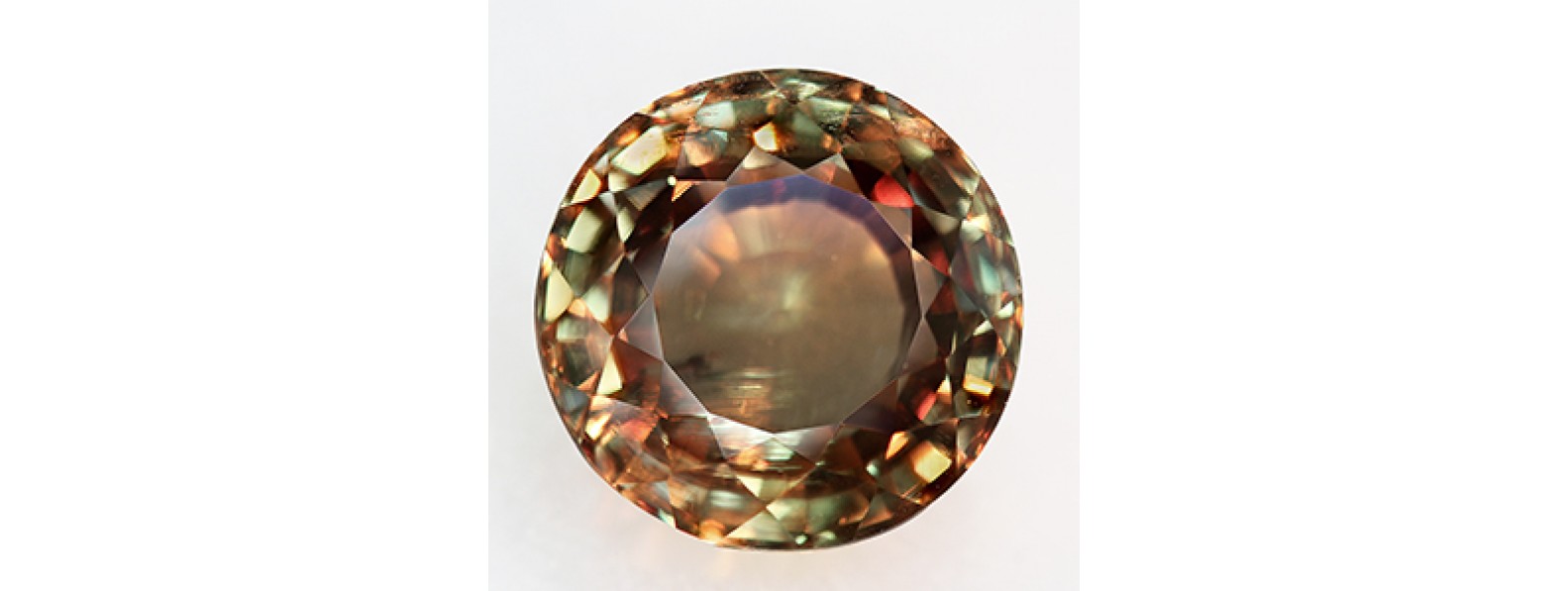
Diaspore – Color Change Turkish Gem, Zultanite and Csarite
Diaspore is the only gemstone that changes from green to pink and does so from a single geological address on earth. In the Ilbir Mountains of southwestern Turkey, a deposit formed approximately 30 million years ago under specific metamorphic conditions produces aluminum hydroxide crystals containing trace manganese that give them a property found nowhere else in the gem world at commercial scale: a vivid shift from kiwi green in cool daylight to raspberry pink or champagne under warm incandescent light. First formally described in 1801, renamed and trademarked twice in the 21st century, and now recognized as one of the most compelling collector gemstones in the modern market, diaspore's story is one of geological specificity, commercial reinvention, and genuine optical science.
Explore our natural diaspore collection and related color-change gemstones including color change sapphire, andalusite, and andesine. For related guides see Color Change Sapphire Guide, Andalusite Guide, and Andesine Guide. Browse our full rare gemstone collection.
What Is Diaspore
Diaspore is an aluminum oxide hydroxide mineral with the chemical formula AlO(OH). It belongs to the orthorhombic crystal system and is the dimorph of boehmite, meaning both minerals share the same chemical composition but crystallize in different structures. In industrial contexts, diaspore is a common constituent of bauxite ore deposits globally and is one of the aluminum-bearing minerals processed for aluminum metal production. In gem contexts, it is an entirely different proposition: transparent, color-changing, trichroic, and almost exclusively available in fine quality from one geological source in southwestern Turkey.
The mineral was first formally described in 1801 by the chemist Martin Heinrich Klaproth, who named it from the Greek "diaskorpizein" meaning to scatter, referencing its distinctive behavior of decrepitation (explosive scattering into pearly fragments) when heated with a blowpipe. This thermal behavior is a mineralogical curiosity but irrelevant to gem use under normal conditions. The Ural Mountains of Russia provided the original type locality, but those specimens were never gem-quality. It was the Ilbir Mountains of Turkey that would eventually transform diaspore from a mineralogical footnote into a serious gemstone.
The Turkish Deposit: Geology and Formation
The Ilbir Mountains of Muğla Province in the Aegean region of southwestern Turkey contain the only commercially significant source of gem-quality color-change diaspore on earth. The deposit formed approximately 30 million years ago during the Oligocene epoch, when hydrothermal fluids rich in aluminum, manganese, and other trace elements percolated through a specific metamorphic sequence within the Anatolian tectonic framework. The resulting mineral assemblage within bauxite-rich metasedimentary rocks created pockets of exceptional diaspore crystallization under conditions that have not been replicated at any other commercially known location.
Mining occurs at high altitude in the Ilbir range under challenging terrain conditions. The ore is extracted and processed to separate gem-quality diaspore from the surrounding bauxite matrix. Of all the diaspore rough recovered from this deposit, only approximately 2% meets the transparency, color, and crystal quality standards required for faceting into gems. This selectivity ratio is one of the most extreme in commercial gemstone production and directly explains the genuine scarcity of fine faceted diaspore in the market despite decades of mining.
In 2020, Afghanistan emerged as a secondary source of pleochroic diaspore, producing material in baby pink to lilac hues with distinct optical character from Turkish material. Afghan diaspore in pink-lilac tones ranges from $150 to $300 per carat at wholesale and represents a different market segment from the primary Turkish color-change material.
Zultanite and Csarite: The Commercial Names
The commercial history of Turkish gem-quality diaspore in the modern trade begins with Murat Akgun, who acquired the Turkish mining rights and began developing the gem market for this material in the early 2000s. Working with gem professional Stephen Kotlowski, Akgun sought a compelling trade name for the material. "Sultanite" was considered but rejected because a mineral with that name already existed. Kotlowski modified the spelling, and "Zultanite" was registered as a trademark in approximately 2005 to 2006, named in honor of the 36 sultans of the Ottoman Empire that ruled Turkey from 1299 to 1923. The name was intended to connect the stone to Turkey's imperial heritage and differentiate it in the market.
In 2011, Kotlowski faceted the world's largest Zultanite into a 96-carat gem named the Sultan's Shield. British jeweler Stephen Webster incorporated it into a luxury jewelry set that eventually sold for approximately $1.5 million, with the Sultan's Shield accounting for approximately two-thirds of that value. Legal disputes followed, resulting in Akgun creating a second trademark, Csarite, through Milenyum Mining. Both trademarks now coexist and refer to the same material from the same Turkish source. GemPiece uses the mineralogically accurate name diaspore with full origin documentation.
The Color Change Mechanism
The color change in diaspore operates through a well-documented optical mechanism involving the absorption behavior of manganese (Mn³⁺) within the crystal lattice. Manganese in the trivalent oxidation state creates a broad absorption band in the orange-yellow region of the visible spectrum, centered approximately between 580 and 620nm. This absorption band does not disappear or move under different lighting; it remains constant. What changes is the spectral composition of the illuminating light source.
Natural daylight and cool fluorescent light contain a relatively high proportion of blue and green wavelengths. Under these light sources, the Mn³⁺ absorption band falls in a region where the incident light already has relatively less energy, meaning the green and blue wavelengths dominate transmission, and the stone appears green. Under warm incandescent light, which is rich in orange and red wavelengths, the Mn³⁺ absorption band falls precisely in the region where the incident light is strongest. The absorption removes the orange-yellow component from the transmitted light, leaving pink and violet wavelengths to dominate, and the stone appears raspberry pink or champagne.
This is the same type of color-change mechanism operating in alexandrite, where chromium (Cr³⁺) rather than manganese (Mn³⁺) creates the absorption band. The difference in chromophore identity produces different final colors: alexandrite shifts from green to red; diaspore shifts from green to pink. Both mechanisms depend on the interaction between the chromophore's fixed absorption band and the changing spectral energy distribution of different light sources.
Trichroism: Three Colors in One Crystal
Beyond the primary daylight-to-incandescent color change, diaspore exhibits strong trichroism, meaning it shows three distinct colors when viewed along three different crystallographic axes. This property occurs because diaspore is biaxial, meaning it has two optical axes, producing three principal optical directions (X, Y, Z) each with different absorption characteristics.
The three pleochroic colors in Turkish diaspore are typically: yellowish green (X direction), greenish gray or colorless (Y direction), and violet or pinkish-violet (Z direction). This trichroic complexity means that in addition to the primary light-source-driven color change, the stone shows different color nuances depending on the viewing angle. An experienced cutter will orient the stone to maximize the most attractive color in the face-up position under the primary intended viewing light.
The refractive index range of 1.702 to 1.750 (biaxial positive) and birefringence of 0.048 are both relatively high for a colored gemstone. The high birefringence means that doubling of back facets can sometimes be observed under magnification, similar to what is seen in peridot and zircon.
Physical and Optical Properties
Chemical Formula: AlO(OH), aluminum oxide hydroxide
Crystal System: Orthorhombic; dimorph of boehmite
Hardness: 6.5 to 7 Mohs
Refractive Index: nα 1.682–1.702, nβ 1.705–1.725, nγ 1.730–1.752 (biaxial positive)
Birefringence: 0.048
Specific Gravity: 3.30 to 3.40
Cleavage: Perfect in one direction {010}; imperfect on {110} and {210}
Fracture: Conchoidal
Luster: Vitreous to pearly on cleavage surfaces
Transparency: Transparent to translucent
Pleochroism: Strong trichroic (yellowish green, greenish gray, violet)
Fluorescence: Inert to weak under UV
Treatment: None; entirely natural and untreated
Clarity and Inclusions
Turkish color-change diaspore is generally a relatively clean gemstone compared to many collector varieties. Most faceted specimens are eye-clean to very slightly included. The most common inclusions are fingerprints (healed fractures with fluid remnants) and liquid-filled inclusions. Unlike emerald or rubellite, which are almost always heavily included, diaspore typically achieves eye-clean status in a meaningful proportion of gem-quality rough.
Eye-clean material with strong color change and excellent cutting represents the optimal combination. Investment-grade diaspore is typically described as stones above 5 carats with exceptional color change, high clarity, and excellent cut quality. Such specimens are extremely rare and command premium pricing in the collector market.
Cutting Diaspore
Cutting diaspore presents specific challenges. The perfect cleavage in one direction means that pressure applied along the cleavage plane during grinding and polishing can initiate a cleavage fracture. Experienced lapidaries orient the rough to minimize the risk of cleavage propagation and manage lap pressure carefully. The high birefringence (0.048) means that the cutter must also consider how facet doubling will affect the stone's appearance under magnification, though this is rarely visible to the naked eye in well-cut stones.
The trichroism of diaspore requires that the cutter evaluate which crystallographic direction will produce the most attractive face-up color under the primary intended light source. For maximum daylight green, the table should be oriented to present the X-axis; for maximum incandescent pink, the Z-axis orientation is preferred. Most commercial diaspore is cut to optimize the daylight appearance, as green is the more immediately attractive color for most buyers.
Diaspore vs Alexandrite: A Detailed Comparison
Diaspore and alexandrite are frequently compared because both are natural color-change gemstones. The comparison is instructive but the differences are as significant as the similarities.
Alexandrite is a chromium-bearing variety of chrysoberyl (BeAl₂O₄) with a hardness of 8.5 Mohs, no cleavage, and a color change from green (daylight) to red or purplish-red (incandescent). Fine alexandrite commands $5,000 to $50,000 per carat or more at retail. Diaspore is an aluminum hydroxide with a hardness of 6.5 to 7, perfect cleavage in one direction, and a color change from green (daylight) to raspberry pink or champagne (incandescent). Fine diaspore in large sizes commands $500 to $10,000 per carat or more at retail.
The color change in alexandrite is generally considered more dramatic (green to red spans a greater distance in the color wheel than green to pink). Alexandrite's higher hardness and lack of cleavage make it more practical for daily-wear jewelry. Diaspore's color change includes a multi-color trichroic complexity that alexandrite does not possess, and its single-source Turkish origin creates a supply constraint directly comparable to Tanzanian tanzanite.
For buyers who want the color-change phenomenon at a more accessible price with the added story of single-source origin rarity, diaspore represents a compelling alternative to alexandrite.
Value and Market Pricing
Diaspore pricing varies significantly with color-change intensity, size, and clarity. Commercial-grade color-change diaspore (smaller stones with moderate color change) ranges from $70 to $200 per carat at wholesale. Fine quality with vivid color change in good clarity: $200 to $900 per carat wholesale. Zultanite-grade material above 3 carats in vivid color: $500 to $3,000 per carat at wholesale; $500 to $10,000 per carat at retail. Exceptional collector pieces above 5 carats with the strongest color change: $1,000 to $10,000+ per carat depending on quality. Afghan pink-lilac diaspore: $150 to $300 per carat wholesale.
The investment case for fine diaspore is supported by the single-source nature of supply, the 2% gem-quality yield from Turkish rough, and the documented price appreciation since Zultanite's 2006 commercial introduction. The Sultan's Shield transaction ($1.5 million for a 96-carat stone set in a jewelry piece) established a benchmark for the upper tier of the market.
Buying Diaspore
When evaluating diaspore, the first and most important test is viewing the stone under both daylight and incandescent light. A stone that shows only a weak or ambiguous shift between the two light sources does not qualify as fine color-change diaspore regardless of its other qualities. The shift should be clearly visible to the naked eye as a definitive change in color family from green to pink, not merely a change in tone within the same color family.
Request video footage of the stone under both light conditions if purchasing online. At GemPiece, every diaspore is individually filmed under natural light and incandescent light to show the full extent of the color change before purchase. Browse our diaspore collection or explore our full rare gemstone collection. For related guides see Color Change Sapphire Guide and Andalusite Guide.