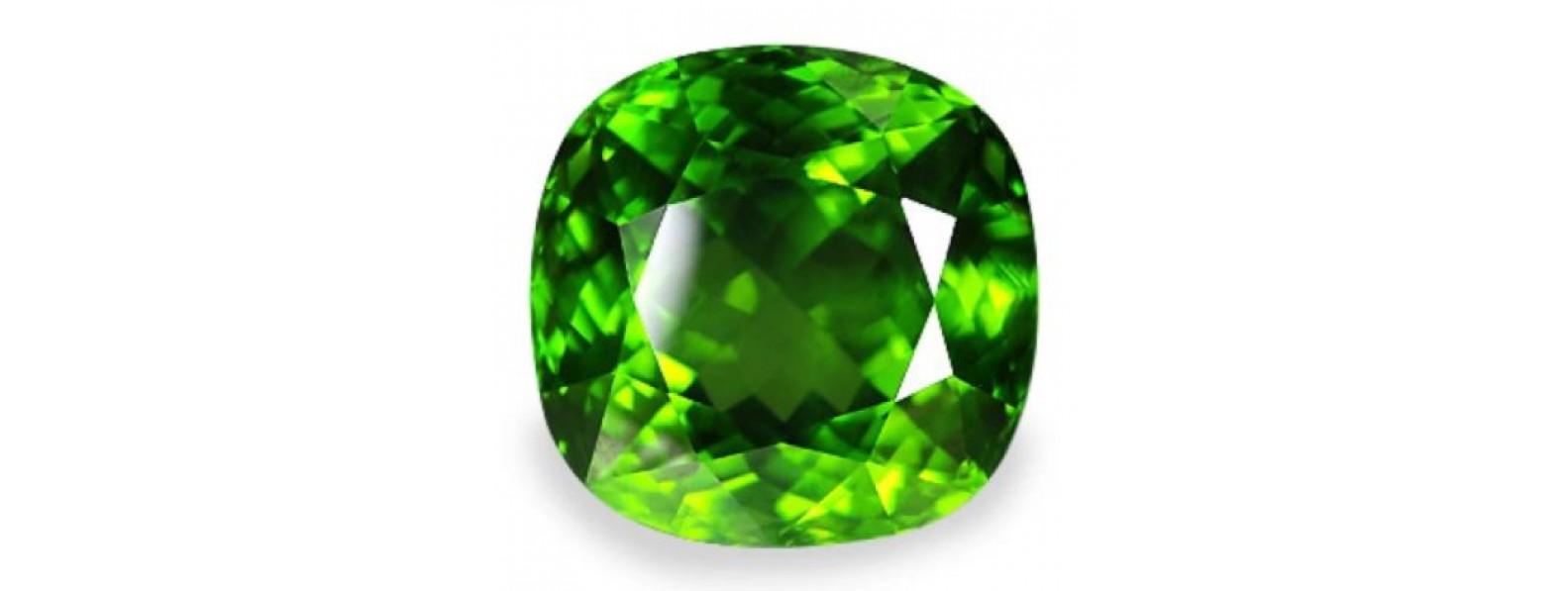
Peridot Guide – Origins, Colors, Properties and Value
Peridot is geologically, chemically, and historically unique among the world's major gemstones. No other widely traded gemstone forms this deep in the earth, arrives at the surface through volcanic convulsion, travels to gem cutters from inside ancient meteorites, was mined by pharaonic Egypt for 3,500 years, and still occurs exclusively in one color family because the element that creates that color is not a guest in the crystal but the host itself. Peridot's green is not caused by chromium, manganese, or copper visiting an otherwise colorless mineral framework. It is caused by iron that is chemically essential to the mineral's existence. Remove the iron and you no longer have peridot at all.
This guide covers the complete mineralogy, formation geology, historical record, origin-by-origin analysis, clarity characteristics, and value assessment of peridot in the depth that collectors and serious buyers need.
Explore our natural peridot collection and related green gemstones including emerald, green tourmaline, tsavorite garnet, and chrome tourmaline. For related guides see Emerald Guide, Green Tourmaline Guide, Tsavorite Guide, and Chrome Tourmaline Guide.
What Is Peridot: Mineralogy and Classification
Peridot is the gem-quality variety of olivine, a mineral series that forms one of the most abundant mineral groups in the earth's upper mantle. The olivine series spans from pure forsterite (Mg₂SiO₄, magnesium silicate) at one end to pure fayalite (Fe₂SiO₄, iron silicate) at the other end, with natural specimens occupying intermediate compositions along the forsterite-fayalite solid solution. Peridot specifically refers to the gem-quality green olivines of this series, which typically contain approximately 85 to 95% forsterite and 5 to 15% fayalite. The chemical formula (Mg,Fe)₂SiO₄ reflects this mixed composition.
Peridot crystallizes in the orthorhombic crystal system, forming tabular or prismatic crystals with imperfect cleavage. The specific gravity of 3.32 to 3.37 is consistent across most peridot sources. The refractive index of 1.650 to 1.690 and birefringence of 0.036 are both characteristic, with the high birefringence directly observable in faceted stones as doubling of back facets visible to the naked eye from oblique viewing angles, a diagnostic property that helps identify peridot from similar-colored gems.
Why Peridot Is Always Green: Idiochromatic Color
The concept of idiochromatic color is central to understanding peridot. Most gemstones are allochromatic, meaning they are colorless in their pure form and acquire color from trace element impurities that enter the crystal structure during growth. Ruby is colorless corundum with chromium. Emerald is colorless beryl with chromium. Aquamarine is colorless beryl with iron. Remove the chromophore and the base mineral remains.
Peridot is idiochromatic. Iron (Fe²⁺) is not a trace impurity in peridot; it is a compositionally essential element that occupies the same structural sites as magnesium in the forsterite framework. There is no "pure peridot" that is colorless. Pure forsterite (no iron) is a different mineral species. Peridot by definition contains iron, and that iron produces its green color through d-d electron transitions that absorb primarily in the blue-violet and red regions of the visible spectrum, transmitting green.
The shade of green depends on the Fe²⁺/Mg²⁺ ratio: lower iron produces pale yellowish-green or lime green; moderate iron produces vivid bright green; higher iron produces deeper olive green. Tannins and other trace elements can introduce slight brownish or yellowish modifiers in some material. But no amount of treatment or geological manipulation can produce a non-green peridot, which is why it is always described as a single-color gemstone.
Formation: The Mantle Origin
Peridot forms in the earth's upper mantle, 20 to 55 miles (32 to 88 km) below the surface, under conditions of extreme temperature (approximately 900 to 1,100°C) and high pressure. Olivine is one of the most abundant minerals in the upper mantle and constitutes the majority of the peridotite rock type that makes up much of the earth's interior below the crust.
Gem-quality peridot reaches the earth's surface through two primary mechanisms. The first is volcanic activity: basaltic magma from the mantle incorporates peridotite xenoliths (fragments of mantle rock) as it rises toward the surface. These xenoliths contain olivine crystals that may be gem-quality, and they are brought to the surface by the basaltic eruption. The San Carlos Apache Reservation in Arizona, the world's largest commercial producer of peridot by volume, produces material through exactly this mechanism: small peridot crystals contained in basalt xenoliths weathered out of volcanic material.
The second mechanism is tectonic uplift: large-scale plate tectonic processes can expose sections of ancient oceanic mantle (ophiolite sequences) at the earth's surface. The Zabargad Island deposit in Egypt's Red Sea, historically the most important peridot source for thousands of years, formed through this tectonic exposure mechanism. The Kohistan region of Pakistan, which produces some of today's finest commercial peridot, also involves a partially tectonic exposure of mantle-derived material.
Extraterrestrial Peridot: Pallasites and the Cosmic Connection
Peridot holds a distinction shared by no other transparent wearable gemstone: it genuinely comes from space. Pallasites are a class of stony-iron meteorites consisting of an iron-nickel metal matrix studded with olivine crystals. They are believed to have formed at the core-mantle boundary of ancient differentiated asteroids during the early solar system, when molten iron settled to the center of asteroids while magnesium-iron silicates (olivine) crystallized at the boundary between the iron core and the silicate mantle.
When these asteroids collided and broke apart, pallasite fragments were ejected into space and some eventually fell to earth as meteorites. When these meteorites are sliced and polished, the olivine crystals within them are frequently gem-quality peridot, transparent and green. These extraterrestrial olivine crystals are called pallasitic peridot, and when faceted into gems they are sometimes marketed as Palladot.
The intense heat of atmospheric entry and the shock of impact means that most pallasitic peridot crystals survive in small sizes. Most facetable pieces yield finished stones under half a carat. The most famous pallasite for gem-quality olivine is the Esquel meteorite, which fell in Argentina approximately 50,000 years ago and contains exceptionally large, clear olivine crystals, some of which have yielded faceted peridot of notable quality. Peter Simon Pallas documented the first known pallasite in Siberia in 1772, giving the class its name.
In 2006, NASA's Stardust mission returned samples from the comet Wild 2 and found that the dust contained olivine crystals, confirming that peridot is found not just in meteorites but in cometary material as well, extending its cosmic provenance from the asteroid belt to the outer solar system.
History: 3,500 Years of the Gem of the Sun
Peridot's documented history begins on Zabargad Island in the Red Sea, which ancient Egyptians called Topazios (the source of the later confusion with topaz in classical literature). The island, also known as St. John's Island, was mined for peridot as early as 1500 BCE and possibly earlier. The ancient Egyptians called peridot "the gem of the sun" for its bright green glow and believed it possessed extraordinary protective properties. A belief persisted that miners could not find the stones by day because their green blended into the island's rocky terrain, and so miners marked their positions during daylight and worked at night when the stones glowed visibly.
Egyptian priests ground peridot into powders mixed with wine, believing this preparation would bring them closer to the light of the divine. Peridot was set into gold in pharaonic jewelry found in tombs spanning multiple dynasties. The historical association between peridot and Cleopatra is well-documented as a strong tradition: historians including the gemologist Eduard Gübelin have argued that at least some of Cleopatra's famous emerald collection was actually peridot, as the two stones were routinely confused throughout antiquity and well into the medieval period.
The Shrine of the Three Kings in Cologne Cathedral, built in the 12th century to house relics of the Three Magi, was decorated with stones long believed to be large emeralds. Modern gemological analysis has confirmed that these stones are peridot, likely sourced from Zabargad Island through Byzantine trading networks. Napoleon, whose empress Josephine collected important gemstones, also had documented interest in peridot, and the stone was fashionable throughout the Napoleonic and subsequent periods.
In ancient Sanskrit texts, peridot is referred to as "zabarjad" (a transliteration of the island name). In medieval European tradition, it was called the Evening Emerald for its ability to maintain vivid color under candlelight and artificial light, a property that true emerald, which is typically darker and more subdued under artificial light, does not share equally.
Global Sources in Detail
Myanmar (Mogok Valley and Kyaukpon Mountain) produces some of the world's finest and most collectible peridot. Burmese peridot is associated with rich, deep green saturation with a characteristic soft silky internal appearance. The typical inclusions in Burmese material include feathery fluid inclusions that create a luxurious, almost liquid internal texture considered beautiful in its own right by experienced collectors. Large Burmese peridot above 5 carats in fine color and acceptable clarity are genuinely scarce and command strong premiums. Myanmar also produces the occasional very large stone; crystal sizes from the Mogok region can reach hundreds of carats in rough, with faceted stones documented above 50 carats in collector grade.
Pakistan (Kohistan, Khyber Pakhtunkhwa) is the most important current source for high-quality commercial peridot. Kohistan material is prized for its bright, vivid green, excellent transparency, and availability in attractive larger sizes relative to other fine sources. Stones from Pakistan often contain characteristic ludwigite inclusions described as thin black rod-like or hair-like structures, which are a diagnostic indicator of Pakistani origin. Pakistani peridot is the benchmark for commercial fine quality in today's market and continues to produce material that satisfies collectors and jewelry designers equally.
China was historically a significant source of yellowish-green to light green peridot with excellent transparency and clean crystal quality. Chinese production has declined significantly in recent years, and fine material from Chinese sources attracts increasing collector attention as scarcity grows.
Arizona (San Carlos Apache Reservation) is the world's largest commercial producer of peridot by volume but yields primarily small stones in commercial quality. San Carlos material is typically under 3 carats and is used heavily in commercial jewelry at accessible price points. The reservation controls the majority of Arizona production and the economic benefit flows to the Apache community. The stones occur as xenoliths in basalt and are recovered from weathered basalt and alluvial concentrations.
Norway (Sunnmore region) produces limited but historically significant peridot. Norwegian material appears in classic mineralogical collections and was documented as early as the 1700s. Egypt's Zabargad Island produced the world's primary peridot supply for over 3,500 years before exhaustion in the mid-20th century. Tanzania, Vietnam, and Ethiopia contribute additional commercial material.
Physical and Optical Properties
Chemical Formula: (Mg,Fe)₂SiO₄, magnesium iron silicate
Mineral Series: Forsterite-Fayalite (olivine group)
Crystal System: Orthorhombic
Hardness: 6.5 Mohs
Refractive Index: nα 1.650 to nγ 1.690 (biaxial positive)
Birefringence: 0.036, strong; back facet doubling often visible
Specific Gravity: 3.32 to 3.37
Cleavage: Imperfect in two directions; conchoidal fracture
Luster: Vitreous to oily
Color Cause: Fe²⁺ as a compositionally essential structural element (idiochromatic)
Absorption Spectrum: Three bands at approximately 493, 473, and 453nm
Fluorescence: None under UV
Treatment: None; naturally untreated
Clarity Type: Type II (GIA); inclusions are expected and normal
Inclusions: Lily Pads, Chromite, and Ludwigite
Peridot has several characteristic inclusions that experienced gemologists use both for identification and for origin determination.
Lily pad inclusions are the most famous and most diagnostic peridot inclusion. These appear as circular or oval flat reflective shapes with concentric fissures radiating outward from a central crystal, resembling a water lily pad viewed from above. They form around small included mineral crystals (typically chromite or other spinel-group minerals) where differential thermal expansion between the inclusion and the surrounding olivine creates concentric stress fractures. Lily pads are so characteristic of peridot that their presence is considered strongly supportive of identification even without optical property testing.
Black octahedral chromite crystals are the second most common inclusion type. These tiny black crystals with the characteristic octahedral habit of the spinel group are visually distinctive under magnification. Their presence reflects the chromium-rich geological environments in which mantle peridotite forms.
Ludwigite inclusions, which appear as dark brown to black rod-like or needle-like structures, are characteristic of Pakistani Kohistan material and represent a useful origin indicator. They were named after the Austrian mineralogist Ernst Ludwig and consist of magnesium iron borate.
Burmese material is distinctive for its soft silky feathering, which consists of fine clouds of minute fluid inclusions or partially healed fractures that create the characteristic internal texture considered beautiful rather than detrimental by experienced collectors.
Cutting and Orientation
Cutting peridot requires attention to its strong birefringence (0.036) and the way this affects the stone's visual character. When viewing a well-cut peridot from above at normal distance, the strong doubling of back facets is sometimes visible to the naked eye from oblique angles, particularly in larger stones. This is not a defect but a characteristic property. Experienced cutters minimize the visual impact of doubling by optimizing cutting proportions and facet arrangement.
Peridot shows distinct pleochroism: the stone appears stronger green when viewed along the b-crystallographic axis and more yellowish-green when viewed along the other axes. Cutters orient the table to present the strongest green face-up position, which in most well-cut commercial peridot is the standard orientation for maximum color appeal.
At GemPiece, all peridot is cut in-house in our Bangkok workshop. Each piece of rough is evaluated for clarity, color distribution, and crystal orientation before cutting begins, ensuring that the finished stone delivers its best possible color and brilliance.
Value and Buying Guidance
The primary criterion for peridot evaluation is color: the stone should display a clean, vivid, open green without brownish, grayish, or yellowish modifiers that reduce its visual appeal. The ideal peridot color is described as pure vivid green with no yellow or brown modifier, comparable to a fresh spring leaf at its most saturated.
Examine clarity face-up under natural light. Lily pad inclusions and chromite crystals are expected and accepted; what matters is whether inclusions significantly reduce transparency or visual impact in the face-up position. Eye-clean or near-eye-clean material commands meaningful premiums over heavily included equivalents.
Origin adds value in the collector market. Burmese material with provenance documentation commands premiums over Pakistani or Chinese material of equivalent visual quality, reflecting both the prestige of Burmese gem origin and the specific internal character that experienced collectors recognize.
Browse our peridot collection or explore related guides: Emerald Guide, Green Tourmaline Guide, Tsavorite Guide, and Chrome Tourmaline Guide.