
Understanding Rubellite Tourmaline
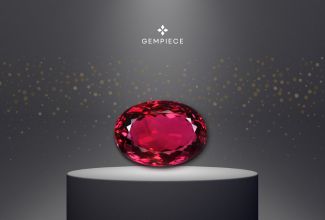
Rubellite is the rarest color in the tourmaline family and one of the rarest red gemstones in the collector world. Only approximately 3% of all tourmaline produced globally achieves the color saturation, tone, and critical lighting stability that the trade requires for the rubellite classification. The other 97% is pink tourmaline, verdelite, indicolite, or other varieties. This 3% threshold is not arbitrary; it reflects a specific geochemical requirement for sufficient Mn³⁺ (trivalent manganese) content that is genuinely uncommon in elbaite crystal growth environments. The result is a gemstone whose rarity is not marketing language but mineralogical reality, and whose price appreciation over 2024 to 2025 reflects both that rarity and growing collector recognition of it.
Explore our natural rubellite collection and related tourmaline varieties including pink tourmaline, Paraiba tourmaline, and all tourmaline varieties. For related guides see Pink Tourmaline Guide, Paraiba Tourmaline Guide, and the complete Tourmaline Gemstone Guide.
What Is Rubellite
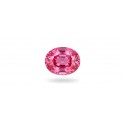
Rubellite is a variety of elbaite tourmaline displaying red to purplish-pink as the dominant body color, where the color is produced by manganese in the crystal structure and where the color meets a specific stability criterion under different lighting conditions. The name derives from the Latin "rubellus" meaning reddish, combined with the Greek "lithos" meaning stone, producing a name that has been used in gemological literature since at least the 18th century when fine red tourmalines from the Ural Mountains of Russia were first systematically described.
Rubellite belongs to the elbaite species (Na(Li,Al)Al₆Si₆O₁₈(BO₃)₃(OH)₄) within the broader tourmaline mineral group. Like all elbaite, it crystallizes in the trigonal crystal system, forming elongated prismatic crystals with characteristic triangular cross-sections. Unlike some gemstone species, tourmaline including rubellite has never been successfully synthesized in laboratory conditions, meaning every rubellite in the market is natural. There is no synthetic rubellite. This simplifies the natural vs synthetic evaluation significantly, though treatment assessment remains important.
The Manganese Color Chemistry of Rubellite
The red to purplish-pink color of rubellite is produced by manganese in two oxidation states operating within the elbaite crystal structure. Understanding the chemistry explains why rubellite is so rare and why the incandescent light test works.
Mn²⁺ (divalent manganese) in the Y-crystallographic site of elbaite absorbs in the blue-green spectral region, transmitting pink wavelengths. This produces lighter, more purely pink tones. The absorption from Mn²⁺ is positioned in a spectral region where incandescent light (rich in warm orange-yellow wavelengths) provides relatively little energy, meaning stones dominated by Mn²⁺ show their color instability under warm light as a shift toward brown or orange.
Mn³⁺ (trivalent manganese) absorbs in the yellow-green region of the spectrum, a deeper and more strategically positioned absorption band that transmits red and purplish-red wavelengths more strongly. Critically, Mn³⁺ absorption is positioned in a spectral region where incandescent light is rich in energy. The warm incandescent spectrum therefore does not overpower the Mn³⁺ absorption; instead, the absorption remains strong enough under warm light to transmit the characteristic red-pink quality that defines rubellite. This is why sufficient Mn³⁺ content is the mineralogical requirement for rubellite: it is the only manganese oxidation state that produces light-stable deep red-pink in tourmaline.
The question of how Mn³⁺ develops in tourmaline is geologically interesting. Research has established that tourmaline crystals often initially form containing Mn²⁺ (producing pale or colorless stones). Over millions of years, natural gamma radiation from surrounding rocks gradually oxidizes Mn²⁺ to Mn³⁺, building the deep red color that eventually defines rubellite quality. This slow geological color-building process is why rubellite from specific deposits where gamma radiation exposure has been sufficient shows the finest and most stable color.
The Incandescent Light Test: The Definitive Rubellite Standard
The practical trade test for rubellite is the incandescent light test: move the stone from cool daylight or fluorescent light into the warm orange-yellow light of an incandescent bulb and observe whether the color remains intensely red-pink or shifts toward brownish or orangey-pink. If the color remains vivid and red-toned under incandescent light, the stone is rubellite. If it shifts noticeably, it is pink tourmaline.
This test matters commercially because rubellite commands significantly higher prices than standard pink tourmaline of similar daylight appearance. A stone sold as rubellite that fails the incandescent test is either misrepresented or the result of a seller who has not properly evaluated it. Experienced buyers at GemPiece apply this test to every stone classified as rubellite before listing, and documentation of both daylight and incandescent appearance is provided with every rubellite in our collection.
The Jonas Mine: The Most Famous Rubellite in History
The Jonas Mine (Mina Jonas) in Conselheiro Pena, Doce Valley, Minas Gerais, Brazil holds an extraordinary place in colored gemstone history. Discovered in 1978 and actively mined through the 1980s and into the 1990s, the Jonas Mine produced rubellite crystals of a size, color quality, and clarity combination that had never been seen before and has not been matched since.
In approximately 1978, the mine yielded a single rubellite crystal weighing over 200 kilograms, an extraordinary find in a mineral family where crystals above 1 kilogram in gem quality are considered exceptional. The crystal displayed the characteristic Jonas Mine cranberry-red color with unusual clarity for rubellite and immediately became one of the most famous mineral discoveries of the 20th century. IGS documents two rubellites on lepidolite clusters from the Jonas Mine with the largest crystal at 2.5cm as representative examples of the mine's documented output.
The Jonas Mine color is distinctive: a pure, clean cranberry-red without brownish or orangey modifiers, attributed to an unusually favorable Mn³⁺/Mn²⁺ ratio combined with low iron content that avoids the iron-related brownish tones that affect many rubellites. Jonas Mine production is now largely depleted, and authentic Jonas Mine rubellite with provenance documentation commands significant premiums in the collector market above standard Brazilian rubellite pricing.
The Ouro Fino mine, also in Minas Gerais, is now fully exhausted but is documented as producing rubellite with the finest historical reputation in the trade, including material with emerald-like jardin inclusions described in the Gem Adventurer trade resource. The Cruzeiro Mine in São José da Safira continues active production, yielding approximately 8 tonnes of tourmaline per year of which approximately 20% is rubellite, making it one of the world's most productive current rubellite sources.
Global Sources in Detail
Brazil (Minas Gerais) sets the historical benchmark for rubellite color quality. The Jonas Mine's legacy defines what the finest rubellite should look like for most collectors and dealers. Current Brazilian production from the Cruzeiro Mine provides the commercial market with consistent supply, though the legendary quality of Jonas Mine and Ouro Fino material is no longer reproducible. Brazilian rubellite commands origin premiums reflecting historical prestige and the association with the finest material ever documented.
Mozambique (Manica and Zambezia Provinces) has transformed the fine rubellite market since its deposits opened commercially. Mozambique produces vivid purplish-pink rubellite in sizes that Brazilian material rarely achieves, making large fine rubellite above 5 carats genuinely accessible for the first time. The purplish-pink character of Mozambique rubellite aligns precisely with the color preference of the European and American collector market. Mozambique rubellite in good vivid purplish-pink with acceptable clarity represents the strongest current value proposition in the premium rubellite market.
Nigeria (Oyo State, particularly deposits near Obomosho) has become the largest African output source for rubellite in total production. Nigerian rubellite is notable for its high transparency, a characteristic that makes it particularly attractive for buyers who want color and clarity simultaneously. Nigerian material can rival Brazilian stones in saturation at competitive pricing, making it a key source for the commercial fine jewelry market.
Madagascar produces rubellite with relatively lower iron content than many other African sources, which translates to higher clarity and less brownish contamination in the body color. Madagascan rubellite is valued for this clarity-friendly composition. Afghanistan produces rubellite with exceptional transparency that collectors prize for its clean crystal character. Russia (Transbaikal region, Mursinka and Shaytanka deposits) has historically produced fine rubellite with a distinctly cool, slightly violet-red character that differs from the warmer Brazilian and African tones.
Physical and Optical Properties
Chemical Species: Elbaite (Na(Li,Al)Al₆Si₆O₁₈(BO₃)₃(OH)₄)
Primary Chromophore: Mn²⁺ and Mn³⁺ in Y-crystallographic site
Hardness: 7 to 7.5 Mohs
Refractive Index: 1.624 to 1.644 (biaxial negative)
Birefringence: 0.018 to 0.020
Specific Gravity: 3.02 to 3.20
Crystal System: Trigonal
Cleavage: None; fracture conchoidal
Pleochroism: Strong; typically varies between deeper red along c-axis and lighter pink perpendicular to c-axis
Fluorescence: Some specimens show blue or lavender under short-wave UV
Clarity Type: Type III (GIA); inclusions almost always present
Synthesis: None; rubellite cannot be synthesized; all market material is natural
Treatment Landscape
Two treatments are relevant to rubellite buyers. The first is irradiation. Natural gamma radiation over millions of years converts Mn²⁺ to Mn³⁺ in geological settings, building rubellite color naturally. This same conversion can be replicated in laboratory irradiation facilities, producing identical color chemistry from pale or colorless tourmaline. The resulting color is stable and does not fade under normal use conditions. Critically, no currently available gemological testing method can distinguish naturally irradiated rubellite (colored by millions of years of geological gamma exposure) from artificially irradiated rubellite (colored by months of laboratory gamma exposure). This means laboratory certificates cannot confirm the absence of artificial irradiation.
The second treatment is fracture filling with resin or oil, comparable to emerald oiling, applied to heavily included rubellites to improve apparent clarity. This is detectable by FTIR spectroscopy at qualified laboratories. Fracture-filled rubellite requires the same care as oiled emerald: avoid ultrasonic cleaning, steam, and heat exposure that could degrade or remove the filler material. At GemPiece, both treatments are disclosed when known, and laboratory testing is available on request.
Pleochroism and Cutting
Rubellite displays strong pleochroism. Viewed along the c-axis (the crystal's long axis), the color is deeper and more saturated, trending toward the darkest red. Viewed perpendicular to the c-axis, the color is lighter and more openly pink. This directional color difference directly determines the face-up color of the finished stone based on how the cutter orients the table relative to the crystal axes.
For most rubellite, the preferred orientation balances the c-axis depth of color against the perpendicular brightness, achieving a vivid, open, saturated face-up color that is neither too dark nor too washed out. Very dark rubellites that read as almost black under strong directional light benefit from perpendicular table orientation to open the color. Lighter rubellites that need more saturation to pass the rubellite standard can benefit from c-axis orientation to deepen the color.
At GemPiece, all rubellite is cut in-house with stone-by-stone evaluation of pleochroism and orientation before cutting begins.
Value and Market Pricing
Rubellite prices surged over 15% year-on-year in 2025, driven by growing collector recognition, the documented 3% qualifying rate, and rubellite's increasingly established position as investment-grade collector material. Current pricing: commercial quality with visible inclusions and good color: $50 to $200 per carat. Fine vivid pink to purplish-pink with acceptable inclusions: $200 to $800 per carat. Eye-clean rubellite with vivid color in fine sizes: $500 to $3,000 per carat. Exceptional vivid red or neon purplish-pink eye-clean above 5 carats: $2,000 to $5,000 per carat. Fine Jonas Mine Brazilian rubellite with documented provenance: premiums above standard Brazilian pricing reflecting both quality history and genuine scarcity.
Buying Rubellite
The incandescent light test is non-negotiable. Any significant rubellite purchase should be evaluated under warm incandescent light to confirm color stability. If a seller cannot or will not show the stone under incandescent light, treat the classification with skepticism.
For clarity, assess face-up appearance under natural light at normal viewing distance. Inclusions visible only under magnification or only from the side are far less concerning than those visible face-up in the center of the stone. For investment-grade purchases, FTIR testing for fracture filling and detailed laboratory certification from GIA or GRS are advisable.
Browse our rubellite collection or explore related guides: Pink Tourmaline Guide, Paraiba Tourmaline Guide, and the complete Tourmaline Gemstone Guide. See our rare gemstone collection for exceptional collector-grade rubellite.