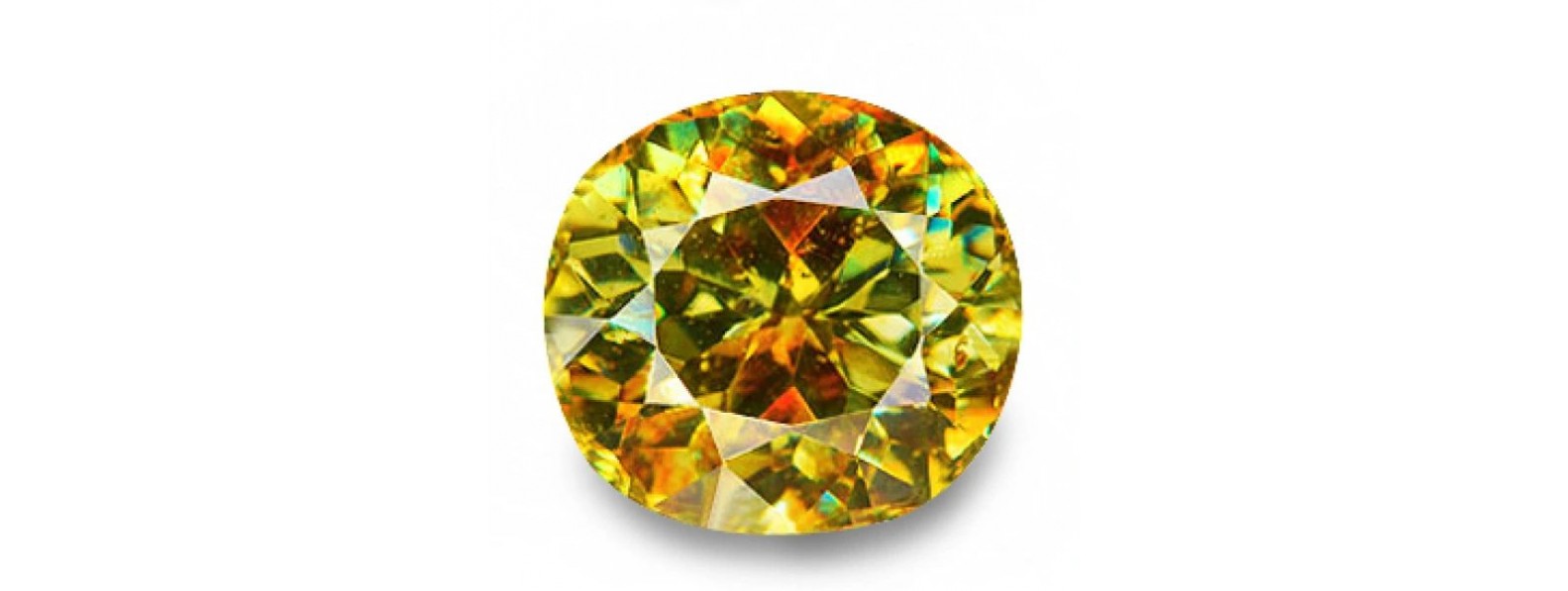
Sphalerite Guide – Brilliance, Fire, Origins and Value
Sphalerite holds the highest dispersion value of any natural gemstone on earth. This single fact, once understood, reframes everything else about the stone. Dispersion is what produces the rainbow fire in diamond that has made it the most celebrated gemstone in human history. In sphalerite, that same property operates at a value of 0.156 versus diamond's 0.044, more than three and a half times the separation intensity. The physical consequence is that properly cut transparent sphalerite in fine quality produces more vivid, more widely separated, more continuously active spectral fire than any other natural gem material. The stone literally cannot show less fire than diamond by its physics; it can only show more.
Why, then, is it not a household name? The answers are straightforward: it is soft (3.5 to 4 Mohs), it has perfect cleavage in six directions making it genuinely difficult to cut, fine transparent facetable material is rare, and the primary source of world-class Spanish rough stopped commercial mining approximately 35 years ago. What it lacks in practicality it more than compensates for in optical spectacle, making it the most coveted fire gemstone among collectors who evaluate stones on physics rather than name recognition.
Explore our sphalerite gemstone collection and related high-brilliance collector gemstones including spinel, tourmaline, garnet, and peridot. For related guides see Spinel Guide, Tourmaline Guide, Garnet Guide, and Peridot Guide.
What Is Sphalerite
Sphalerite is a zinc iron sulfide mineral with the chemical formula (Zn,Fe)S, classified in the isometric (cubic) crystal system. It is trimorphous with wurtzite and matraite, meaning all three minerals share the same chemical composition (ZnS) but crystallize in different structural forms. Sphalerite is the most common and stable polymorph under standard geological conditions.
As a mineral, sphalerite is the world's most abundant zinc mineral and the primary ore of zinc, providing approximately 95% of global zinc production. Zinc is the fourth most widely used metal in the world (after iron, aluminum, and copper), used primarily for galvanizing steel, die-casting alloys, and brass production. The industrial significance of sphalerite as zinc ore is enormous; its significance as a gemstone is known only to a small but dedicated community of collectors.
The gemstone-quality sphalerite that reaches the cutting table represents a tiny fraction of all sphalerite mined globally. Only material with low iron content (producing transparency and warm color rather than opacity and black), high crystal clarity, and sufficient crystal size to yield a meaningful faceted gem is considered gem-quality. This combination is uncommon even within sphalerite-producing deposits, which is why fine faceted sphalerite remains rare despite the mineral's geological abundance.
Name, History, and Etymology
The name sphalerite was formally established in the gemological and mineralogical literature in the 19th century, derived from the Greek "sphaleros" meaning treacherous or deceptive. The reference is to a centuries-old frustration among miners and metallurgists: sphalerite's metallic-looking black or brown crystals closely resemble galena (lead sulfide), which miners historically prized as a lead ore. When what appeared to be galena yielded zinc rather than lead, the mineral earned its reputation as deceptive.
The German trade name "blende" (meaning blind or deceiving) reflects identical exasperation: a material that appeared metallic and valuable but failed to deliver the expected metals. "Zinc blende" and "black jack" are historical trade names preserved in some older texts. The scientific name sphalerite became standard through the 19th century systematic mineralogy movement.
The first systematic gemological description of faceted sphalerite as a collector gem appears in the 20th century literature, with the AJS Gem encyclopedia among the earliest English-language sources to detail the gemstone's dispersion record. The Spanish Aliva mine material, which became available following the cessation of zinc mining operations in the Cantabrian mountains, is primarily responsible for introducing fine facetable sphalerite to the collector gem market in meaningful quantities.
Crystal Chemistry and Structure
Sphalerite's crystal structure belongs to the isometric system, with zinc atoms in tetrahedral coordination with sulfur atoms forming a face-centered cubic framework. Each zinc atom is surrounded by four sulfur atoms, and each sulfur atom is surrounded by four zinc atoms, producing a highly symmetric three-dimensional framework that is isotropic (exhibiting identical optical properties in all directions).
The isotropic optical character of sphalerite has a direct consequence for gemological identification: it does not show birefringence or pleochroism. Under the polariscope, sphalerite remains isotropic, unlike most colored gemstones which are anisotropic. This property, combined with its unusually high refractive index and specific gravity, is part of the standard gemological identification protocol for sphalerite.
Iron substitution for zinc in the crystal structure is the primary variable in both color and physical properties. When Fe²⁺ substitutes for Zn²⁺ in the tetrahedral sites, the iron absorbs in the blue-violet region of the visible spectrum, transmitting yellow, orange, and red wavelengths. Higher iron substitution produces progressively darker colors from yellow through orange to red-brown and finally opaque black when iron substitution is high. Pure ZnS without iron is colorless to very pale yellow, but pure iron-free sphalerite is exceptionally rare in nature.
The specific gravity of sphalerite ranges from 3.9 to 4.1, varying with iron content: higher iron produces higher SG because iron is denser than zinc. This is a useful field identification tool, as sphalerite sinks readily in bromoform (SG 2.89) and in methylene iodide (SG 3.33), giving a clear heavy liquid response that distinguishes it from lighter gems like tourmaline, quartz, or peridot.
The Physics of Dispersion: Why Sphalerite's Fire Is Unmatched
Dispersion in optical physics describes the variation of a material's refractive index with wavelength. All transparent materials have a refractive index that is slightly higher for blue light than for red light, because shorter wavelengths (blue) interact more strongly with the electronic structure of the material than longer wavelengths (red). When white light (a mixture of all visible wavelengths) enters a faceted gemstone, the different wavelengths are refracted at slightly different angles. When the light exits through a crown facet, those different angles produce different exit directions, spreading the colors apart into a visible spectral fan.
The dispersion value (also called the fire value in trade usage) is numerically defined as the difference between the refractive index at 686nm (red, the Fraunhofer B line) and the refractive index at 431nm (violet, the Fraunhofer G line). For sphalerite, this difference is 0.156. For comparison: demantoid garnet 0.057, sphene 0.051, diamond 0.044, zircon 0.039, corundum (sapphire/ruby) 0.018, beryl (emerald/aquamarine) 0.014.
Sphalerite's value of 0.156 is not just the highest in the natural gemstone world; according to the Gem Adventurer trade resource, sphalerite has almost three times more fire than the second most dispersive gemstone (demantoid garnet), and it is specifically excluded from most standard fire comparison lists precisely because, as an exotic gem restricted to specialist collections, its inclusion would make the comparison meaningless. Including sphalerite in a dispersion comparison with diamond is like including a racing aircraft in a comparison of car speeds.
The practical visual consequence is that every facet junction in a well-cut sphalerite produces a wider spectral spread than any other gem can achieve. The total fire display across the face of the stone is not just brighter than diamond fire; it is categorically more vivid, more colorful, and more continuously active across a wider range of viewing conditions.
Refractive Index and Luster
Sphalerite's refractive index of 2.37 to 2.50 (Spanish material typically 2.40) places it among the highest-RI natural gemstones, approaching diamond's RI of 2.42. This high RI has two practical consequences. First, it is responsible for a portion of sphalerite's brilliance: the total internal reflection angle is similar to diamond's, meaning that light entering the pavilion at appropriate angles is totally internally reflected rather than lost through the back of the stone. Second, the high RI combined with the isotropic crystal structure produces the characteristic adamantine (diamond-like) luster on well-polished cleavage surfaces, a brilliant, almost metallic-looking surface gloss that is among the most attractive luster grades available in any gem material.
The specific gravity of 3.9 to 4.1 is comparable to corundum (3.95 to 4.10), sapphire and ruby. This relatively high density for a colored gemstone means that a sphalerite gem will feel heavier than a tourmaline or quartz of the same apparent size, which can be a useful field identification feature.
Formation Geology
Sphalerite forms in several geological environments, each producing material with different typical quality and character.
The most significant geological context for gem-quality transparent sphalerite is hydrothermal ore veins in carbonate (limestone and dolomite) host rocks. Hydrothermal fluids rich in zinc and sulfur circulate through fractures in carbonate sequences at low to moderate temperatures, depositing sphalerite in the fractures and replacing portions of the surrounding carbonate rock in a process called replacement mineralization. The Mississippi Valley-type (MVT) deposit classification, named for the lead-zinc deposits of the central United States, describes this type of carbonate-hosted hydrothermal sphalerite formation and applies to deposits across North America, Europe, and Africa.
The specific conditions of carbonate-hosted hydrothermal deposition tend to produce large, well-crystallized sphalerite with relatively high transparency, because the slow crystallization from low-temperature hydrothermal fluids allows large crystals to form with fewer structural defects than rapid high-temperature crystallization would produce. The Aliva mine deposits in Spain's Cantabrian mountains are carbonate-hosted hydrothermal in character and represent this type of geological context at its finest for gem-quality production.
Sphalerite also occurs in high-temperature metamorphic environments, in polymetallic sulfide ore deposits (where it is associated with galena, pyrite, and other sulfide minerals), and in volcanogenic massive sulfide (VMS) deposits. These environments typically produce smaller crystals with higher iron content and lower transparency, generally not suitable for gem-quality cutting.
Additionally, sphalerite can form as inclusions within other minerals. The IGS gemological reference notes that sphalerite can occur as inclusions in the reddish-orange almandine garnet from certain localities, producing an unusual inclusion type that requires careful examination under magnification to identify correctly.
Global Sources in Detail
Spain (Cantabria region, specifically the Aliva mine in the Picos de Europa national park) is the world's premier source of gem-quality transparent sphalerite. The Picos de Europa (Peaks of Europe) mountain range in northern Spain provided the geological setting for large, transparent, vivid orange-red to toffee-brown sphalerite crystals forming in carbonate rocks. The AJS Gem encyclopedia specifically notes that "some of the finest and largest sphalerite in the world comes from the Aliva mine in the Picos de Europa Mountains in the Cantabria region on the north coast of Spain. Zinc was mined in this region for many years, and when zinc mining was no longer economic the mine produced some exceptional transparent toffee-colored sphalerite in big sizes." Commercial mining at Aliva halted approximately 35 years ago, and existing rough from this source is a finite and diminishing resource.
Mexico produces gem-quality sphalerite from several localities, with material in yellow to orange-amber tones reaching collector-grade transparency. Mexican sphalerite is an important supplementary source as Spanish material becomes more scarce.
Peru contributes sphalerite from the polymetallic ore deposits of the central Andes, with some material reaching gem-quality transparency in orange to red-orange tones. Peruvian material varies widely in quality between individual deposits.
Namibia (Tsumeb mine and Otavi district) is notable for two specific properties: gem-quality transparent sphalerite in various colors, and the extraordinary triboluminescent character of Otavi material. The IGS specifically notes that material from Otavi, Namibia is triboluminescent, meaning it produces light when subjected to friction or mechanical stress. This unusual physical property makes Namibian sphalerite particularly interesting as a mineralogical specimen even when the crystal quality is below gem-cutting grade.
Eastern Europe (Poland's Silesia region, Czech Republic, Bulgaria) produces sphalerite primarily for industrial zinc extraction, with occasional gem-quality transparent material reaching the collector market. The Schalenblende or layered sphalerite formation, particularly from the Silesia region, is a mineralogically distinctive form where concentric layers of different-colored sphalerite and galena produce a banded pattern visible in polished cross-sections. This layered material is cut as cabochons for collector use rather than faceted gems.
United States (various): Several US localities produce sphalerite, primarily as industrial ore. The Franklin, New Jersey locality is historically significant for producing sphalerite alongside the fluorescent mineral assemblages for which Franklin is world-famous. Some transparent gem-quality sphalerite has been documented from various US localities including Tennessee and Missouri.
Physical and Optical Properties: Complete Reference
Chemical Formula: ZnS with variable Fe substitution; general formula (Zn,Fe)S
Crystal System: Isometric (cubic); trimorphous with wurtzite and matraite
Crystal Forms: Tetrahedra, dodecahedra, occasionally pseudo-octahedral with rounded edges
Hardness: 3.5 to 4 Mohs, the primary practical limitation for jewelry use
Refractive Index: 2.37 to 2.50 (isotropic; single RI value); Spanish material typically 2.40
Dispersion: 0.156, the highest of any natural gemstone
Specific Gravity: 3.9 to 4.1, increases with iron content
Cleavage: Perfect in six directions (dodecahedral), making faceting technically demanding
Fracture: Conchoidal to uneven on non-cleavage surfaces
Luster: Adamantine (diamond-like) on cleavage surfaces; resinous to subadamantine elsewhere
Transparency: Transparent (gem quality, low iron) to opaque (industrial, high iron)
Color: Colorless to pale yellow (low iron), yellow, honey-orange, amber, red-brown (increasing iron), black (high iron); rare green from thallium
Streak: White to pale yellow
Fluorescence: Bright orange-red to red under both long-wave and short-wave UV from many localities. Triboluminescent from Otavi, Namibia
Optic Character: Isotropic; remains dark under crossed polarizers (extinction in all orientations)
Treatment: None; entirely natural and untreated
The Cutting Challenge: Six Perfect Cleavages
Sphalerite's six perfect cleavage directions represent the most challenging cleavage situation of any commonly faceted gemstone. Most gem minerals have either no cleavage (tourmaline, corundum) or cleavage in one to four directions. Sphalerite has perfect cleavage in six directions corresponding to the six faces of a dodecahedron (the twelve-sided geometric solid), which means that stress applied in virtually any direction will find a nearby cleavage plane available for propagation.
The geology.com reference on sphalerite notes explicitly that "sphalerite is a difficult stone to cut and polish" and identifies the low hardness combined with perfect cleavage as the factors limiting its jewelry use. AJS Gem confirms "sphalerite is usually completely untreated" and describes it as a "popular stone with collectors" precisely because the cutting challenge limits the supply of well-faceted material and maintains its specialist status.
In practice, cutting sphalerite requires several specific adaptations from standard lapidary technique. Grinding pressure must be lower than for harder gems to avoid propagating cleavage fractures. The lap speed and compound selection must be managed to produce a polished surface without introducing micro-cleavage along the facet surface. Facet junctions must be executed carefully at the correct angles relative to the cleavage geometry to avoid creating stress concentrations at the junction points.
For orientation, sphalerite is typically cut with the table parallel to the cubic cleavage faces or at specific angles to those faces that minimize the probability of cleavage propagation during polishing. The specific orientation used depends on the shape of the available rough and the planned finished stone geometry, and requires knowledge of the specific crystal's cleavage orientation before cutting begins.
Despite all these challenges, skilled lapidaries who work regularly with sphalerite develop reliable protocols that produce beautifully faceted finished stones with minimal cleavage-related loss. At GemPiece, our in-house cutters have significant experience with sphalerite from Spanish rough and understand both the cleavage geometry and the polishing requirements that produce the maximum fire performance in finished stones.
Fluorescence and Triboluminescence
Sphalerite's optical properties do not end with visible light. Under ultraviolet illumination, many sphalerite specimens display vivid orange-red to red fluorescence under both long-wave (365nm) and short-wave (254nm) UV sources. The IGS gemological reference specifically notes "bright orange-red to red in LW, SW, from many localities" as a characteristic fluorescence response for sphalerite. This fluorescence is attributed to manganese (Mn²⁺) trace impurities activated within the ZnS crystal lattice, which absorbs UV energy and emits orange-red visible light.
The Namibian material from Otavi shows an even more unusual optical behavior: triboluminescence, the production of visible light when the material is subjected to mechanical friction or stress. When Otavi sphalerite is rubbed, scratched, or subjected to mechanical pressure, it emits visible orange-red light from the same manganese-activated luminescence mechanism that produces UV fluorescence. Triboluminescence is a relatively rare phenomenon in minerals and adds a significant scientific interest dimension to sphalerite collecting beyond its visual beauty under standard lighting.
Schalenblende: The Layered Sphalerite
A specific and visually distinctive form of sphalerite deserves separate description. Schalenblende, from the German "schalen" (shells) and "blende" (the historical German name for sphalerite), is a layered banded mineral formation in which alternating layers of different-colored sphalerite and galena are deposited concentrically in a botryoidal or stalactitic growth pattern. The cross-section of a polished Schalenblende specimen reveals concentric rings or parallel bands of black (galena), yellow, orange, brown, and tan (different sphalerite compositions), creating a visually striking banded pattern.
Schalenblende is found primarily in the Silesia region of Poland (particularly from the historical Bytom district deposits) and in related Upper Silesian zinc-lead deposits. It is cut as cabochons and polished specimens rather than faceted gems, and it has a dedicated collector following among those who appreciate its distinctive natural patterning. It is classified as sphalerite but displays none of the transparency or fire that characterizes facetable gem-quality sphalerite; it is a separate aesthetic proposition within the broader sphalerite category.
Sphalerite Compared to Other High-Dispersion Gems
Understanding sphalerite's place in the broader high-dispersion gem category helps collectors contextualize its optical performance. The complete dispersion ranking for natural gemstones:
Sphalerite: 0.156. Demantoid garnet (the highest-dispersion garnet species, producing the famous "horsetail" fire): 0.057. Cerussite (lead carbonate, extremely soft and brittle): 0.055. Sphene (titanite, strongly birefringent and trichroic): 0.051. Diamond: 0.044. Zircon (the highest-dispersion colorless gem after diamond in mainstream use): 0.039. Spessartite and other garnet species: 0.028. Corundum (sapphire, ruby): 0.018. Tourmaline: 0.017. Beryl (aquamarine, emerald): 0.014.
Sphalerite's 0.156 value is not just the highest; it is so far above the second value (demantoid at 0.057) that the two stones are in effectively different optical categories. The closest competitor, demantoid garnet, is itself celebrated as one of the most fiery natural gems available. Sphalerite has almost three times demantoid's fire. This context makes clear why the Gem Adventurer trade resource describes Spanish sphalerite as occupying a genuinely exclusive position in the gemstone world.
Value, Rarity, and Market Considerations
The value of fine sphalerite reflects both its genuine optical rarity and the specific scarcity of quality cutting material. Several converging factors contribute to the collector case for fine sphalerite.
The primary Spanish source has been closed for approximately 35 years. Existing Spanish rough is a non-renewable resource that diminishes with each stone cut. This supply constraint alone creates a long-term scarcity trajectory that is more definitive than the supply situations of most colored gemstones, where new mining or new deposit discoveries remain possible.
Fine transparent faceted sphalerite in meaningful sizes is uncommon in the market at any price point. The cutting challenges mean that even where rough is available, many cutters lack the specific experience to produce well-faceted finished stones. The relatively small collector community for this variety means that secondary market liquidity is lower than for mainstream gems, which is a practical consideration for buyers thinking about resale.
Current pricing for gem-quality sphalerite ranges broadly from $20 to $200 per carat for the general range of quality, with fine transparent vivid orange or golden material in excellent cutting quality at $100 to $200 per carat. Premium specimens, particularly fine red and orange stones exceeding three carats in excellent clarity and precision cutting, command impressive prices reflecting both rarity and visual impact. The IGS Buying Guide notes that "smart collectors recognize sphalerite's untapped potential" and that "premium specimens command impressive prices, particularly fine red and orange stones exceeding three carats."
Identification and Gemological Testing
Identifying sphalerite from similar-appearing colored gems requires testing several properties, because its appearance (warm orange-yellow to brown) overlaps with hessonite garnet, topaz, zircon, and various other warm-toned stones.
The refractive index of 2.37 to 2.50 is higher than almost any other orange-yellow gem: hessonite garnet 1.734 to 1.759, topaz 1.609 to 1.643, zircon 1.810 to 1.984, citrine 1.544 to 1.553. The high RI immediately distinguishes sphalerite from most competitors, though zircon (RI 1.810 to 1.984) is also high. Zircon is birefringent; sphalerite is isotropic. The polariscope distinguishes them immediately.
The specific gravity of 3.9 to 4.1 is also diagnostic. Sphalerite sinks readily in methylene iodide (SG 3.33), while most orange-yellow gems of lower density float. The combination of high RI, isotropic optic character, and SG above 3.33 is essentially diagnostic for sphalerite among the warm-toned collector gems.
The strong orange-red UV fluorescence from most localities is a supporting identification feature. The adamantine luster on cleavage surfaces is visually distinctive and recognizable to experienced gemologists.
Care and Preservation
Sphalerite requires specific care practices appropriate to its hardness and cleavage characteristics. Clean with warm water, mild neutral soap, and a soft cloth or brush. Rinse thoroughly and dry gently. Avoid ultrasonic cleaners, which can induce vibration-driven cleavage fractures. Avoid steam cleaning. Avoid harsh chemicals and solvents. Store separately from harder stones to prevent surface scratching from quartz or harder gem contact.
For mounted pieces, protective settings that cover the girdle and minimize the risk of edge impacts are strongly recommended. Loose stones should be stored individually wrapped in soft cloth in separate compartments. Sphalerite's chemical stability is good; it is not sensitive to normal atmospheric conditions or humidity. The primary care concerns are purely mechanical: hardness and cleavage protection.
The surface polish of sphalerite can dull over time with abrasion from handling or exposure to hard surfaces. Re-polishing by an experienced lapidary familiar with sphalerite's cleavage behavior can restore the surface to its original brilliance.
Buying Sphalerite
When evaluating sphalerite for purchase, transparency is the single most critical criterion. The stone's fire performance is completely dependent on light traveling through the full body of the stone, and any cloudiness, milkiness, or dense internal inclusions that scatter light rather than transmitting it reduce the fire display proportionally. True transparent sphalerite, when held up to a light source, should allow clear vision through the stone rather than appearing foggy or murky.
Evaluate fire performance under a single directional point light source in a darkened environment. Move the stone slowly through different viewing angles and observe the spectral flashes that cross the face. Fine sphalerite should show vivid, clearly separated rainbow flashes across the full face, moving continuously and changing character as the stone is rotated. A stone that shows fire only from specific angles or only in brief flashes may have adequate but not exceptional fire performance.
Assess body color under natural daylight. The body color should be warm and attractive without being so dark that it absorbs the light needed for fire display. The sweet spot is a medium-toned warm yellow-orange to orange that provides color presence without sacrificing transparency.
For cutting quality, examine facet sharpness and polish under magnification. Well-executed sphalerite cutting shows clean, sharp facet meets and highly polished facet surfaces with no chipping at the junctions. Given the cleavage challenges of sphalerite cutting, well-executed facets represent significant lapidary skill and add meaningfully to the stone's value.
Browse our sphalerite gemstone collection or explore related collector gemstones: Spinel Guide, Tourmaline Guide, Garnet Guide, and Peridot Guide.